

Stainless Steel Bracelet Overview
A stainless steel bracelet is a practical option for buyers who need a durable, polished wrist accessory that can hold up in everyday retail use. For jewelry brands, wholesalers, and OEM buyers, the main problem it solves is balancing style with wear resistance: the piece needs to look refined, stay visually consistent across production runs, and support different finishes without becoming too fragile for regular handling. The bracelet styles shown here include chain-based and bead-chain designs, with gold, silver, and black tones, so the category can serve both minimalist and statement jewelry collections.
Product Structure and Visible Features
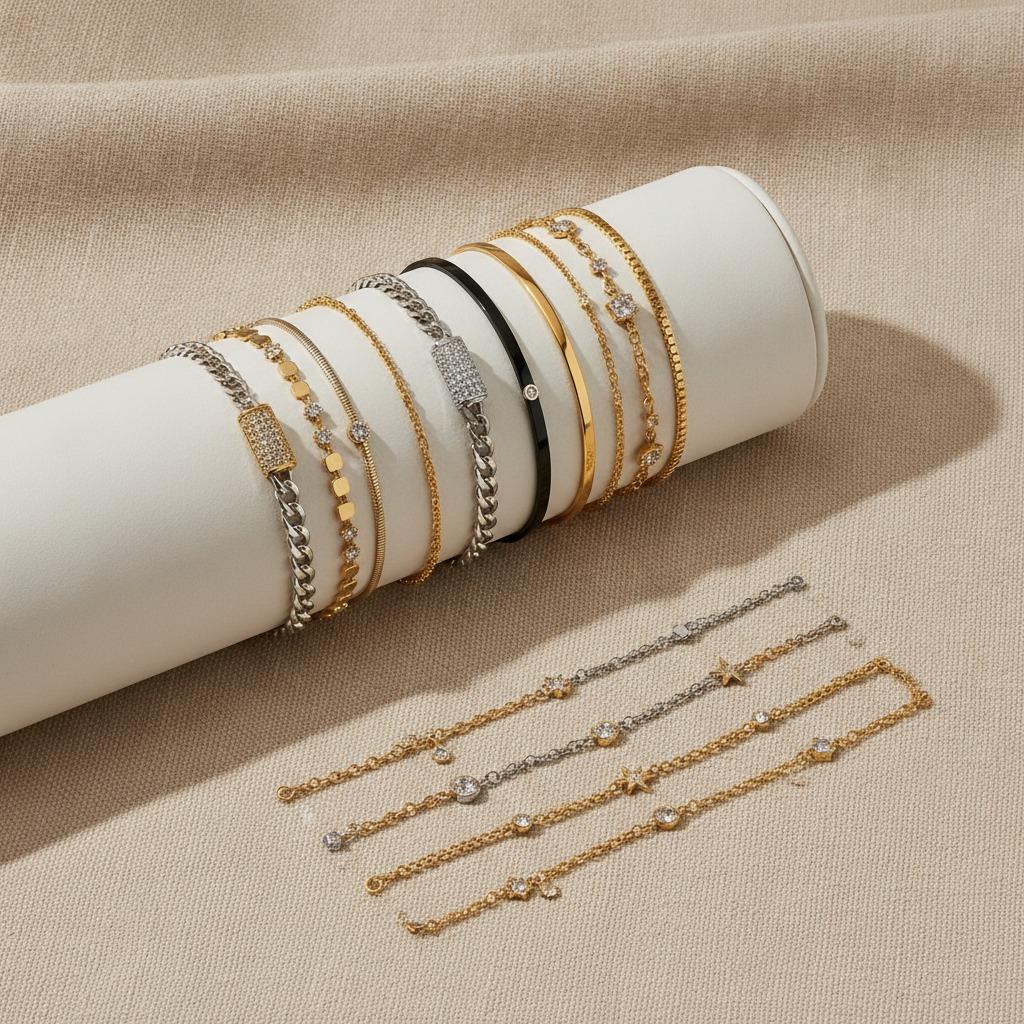
The visible samples show several bracelet formats laid out for display, including chunky curb-style links, fine ball-chain strands, and bracelets with central decorative plates. Some pieces include clear, faceted stone-like accents at the center, while others rely on the rhythm of the link pattern itself. One gold-tone bracelet shows an adjustable extender section and a small tag, which is a common retail-friendly detail for fit flexibility and branding.
Because the product images show multiple sample types, the assortment appears suitable for buyers sourcing either finished bracelets or chain components for custom assembly. The collection also suggests mixed-use styling: some items lean toward everyday wear, while others read as layered fashion pieces.
Visible Dimensions and Style Notes
One bracelet image includes visible measurements of 17 mm by 8 mm for the front decorative section, with a marked weight of WT: 6g and a length note of 6x170mm + 50mm(T). These figures should be treated as image-based reference data for that specific sample, not as universal specifications for the whole collection.
Materials and Finish Options
The images show polished metal surfaces in silver-tone, yellow-gold-tone, and black finishes. The exact base metal is not confirmed, so it would be inaccurate to claim solid stainless steel, brass, or alloy without supplier verification. Still, from a buyer’s perspective, the finish variety is useful because it supports different retail themes and price points.
For collections positioned around an 18K PVD bracelet look, gold-tone finishing can create a warm, premium appearance while keeping the design aligned with contemporary fashion jewelry trends. Black-coated versions can support a more modern or masculine presentation. Silver-tone pieces remain the easiest to merchandise across many customer segments.
Clear stone-like inserts are visible in several center settings. The exact stone material is not identified in the source data, so descriptions should stay general unless samples or test reports confirm whether they are crystal, glass, cubic zirconia, or another insert.
Manufacturing and Assembly Process
The product category appears to involve standard jewelry fabrication steps: link forming or chain production, surface polishing, finishing or plating, and decorative stone setting. In the case of the centered plate styles, a separate module may be assembled onto the chain body before final inspection and packing. Ball-chain designs require more uniform bead forming and continuity control, while wider chain bracelets depend on consistent link geometry and smooth edge finishing.
For OEM buyers, this matters because the visual consistency of each link, clasp, and center plate directly affects perceived quality at retail. When sourcing a handmade bracelet style or handmade-look design, buyers should confirm whether the piece is fully hand assembled, machine produced, or finished with manual setting and polishing steps.
Application Scenarios
These bracelets fit several commercial uses. They can be sold as standalone fashion accessories, used in stacking and layering collections, or bundled as gift items for seasonal retail programs. The cleaner chain designs work well for daily wear, while the decorative plate versions suit dress styling or boutique merchandising. A retailer may also pair these styles with necklaces or anklets in the same finish family for a coordinated line.
From a product planning perspective, a zircon bracelet style with a central stone accent can help create a more giftable, focal-point design without requiring a large amount of metal weight. That makes it useful for both entry-level fashion lines and mid-tier accessory assortments.
Quality Control Considerations
Buyers should ask for checks on link alignment, clasp function, extender reliability, surface smoothness, and stone-setting stability. For plated products, color consistency across batches is also important. Since the image does not confirm material composition, quality review should include base-metal confirmation, plating specification, and visual inspection under normal lighting and close-range viewing.
Where bracelets are sold as retail jewelry, packaging presentation also matters. The displayed samples suggest merchandising on a cylindrical wrist form, which helps communicate shape, drape, and size. A stable presentation fixture can reduce handling damage before shipment and improve shelf appeal.
Customization Guidance for Buyers
Customization can usually focus on chain width, link style, finish color, center-stone design, extender length, and tag placement. Buyers building a private-label line should define whether they want a clean everyday look, a layered fashion profile, or a more decorative centerpiece. If the bracelet is intended for brand resale, request confirmation of logo tags, packaging options, and finish matching across SKUs.
When reviewing samples, compare the bracelet’s visual weight, the proportion of the center plate, and how the chain sits on the wrist. Those details influence comfort and perceived value more than photos alone can show.
Buyer Decision Factors
Before placing an order, consider intended audience, finish preference, target retail price tier, and whether the bracelet should be sold as a single SKU or part of a multi-style collection. If your line needs a refined metal look with repeatable production, stainless-steel-style chain jewelry can be attractive. If your focus is trend-driven retail, mixed finishes and stone accents create more display variety.
For accessory brands, the key questions are simple: does the chain style match your customer, can the finish be reproduced consistently, and does the closure or extender support everyday wear? These points should guide sampling and final approval.
Request Samples and Production Details
If you are sourcing a stainless steel bracelet or a plated chain bracelet collection, ask for sample photos, material confirmation, finish specifications, and assembly details before production. Clear communication at the sampling stage helps avoid mismatched expectations on color, size, and stone appearance. For OEM and wholesale projects, this is the best way to turn a visually strong sample into a reliable retail product line.