
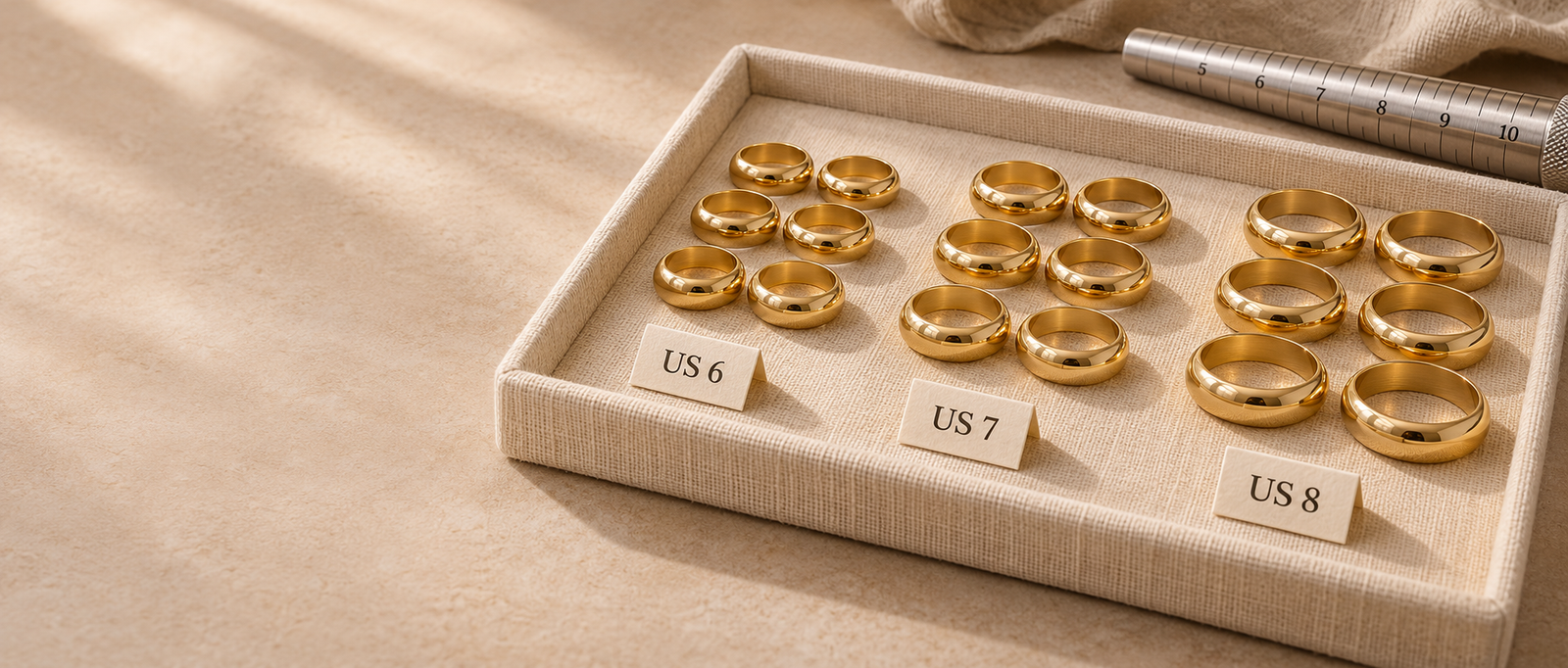
Turn Black Friday ring size sales into order quantities. Follow the 500-ring example.
To set ring size quantities, start with Black Friday sales for one ring style and one market. Count the units customers kept in each size after returns and exchanges. Flag sizes that sold out early. Then divide each size’s count by the total and multiply its share by the number of rings you plan to buy. If US size 7 made up 30% of sales, it gets 150 units in a new 500-ring order. For a restock, check the sellable units and confirmed deliveries you already have in each size before you place the order.
Collect Black Friday Ring Size Sales Data
Export the individual items sold from your online store and point-of-sale system. Count rings sold, so a customer who buys two rings in the same size adds two units to that size. Use the same date range for every size you compare. If you include the full Black Friday to Cyber Monday weekend, record that date range so you can repeat it next year.
What to collect | How it helps |
|---|---|
Order number and product code for each size | Links returns and exchanges to the original sale |
Ring style, band width, finish, and size system | Keeps different products and fit profiles separate |
Units sold, selling price, and discount | Shows which sizes sold at prices you can offer again |
Store or sales channel and customer market | Lets you compare size demand across locations and markets |
Returns, exchange sizes, and reasons | Shows which sizes customers ultimately kept and where fit may be a problem |
Opening stock, restock times, and sellout times | Shows which sizes had less time available for sale |
If you use Google Analytics 4, you can include a product code and variant in your purchase data. Google also documents how to send refund details for individual items. Use your order and inventory records to match exchanges and check when each size was available. Google Analytics ecommerce documentation
Find the Best-Selling Ring Sizes After Returns and Stockouts
Count the size the customer kept
Follow each Black Friday order through its return or exchange. Remove fully returned units from your kept-unit count. When a customer exchanges one size for another, count one sale in the final size.
For example, suppose you initially sold 42 rings in US size 7. Three were returned for a refund, four were exchanged for size 8, and two customers switched from size 6 to size 7. Your final size 7 count is 42 − 3 − 4 + 2 = 37 rings. If your system records replacement rings as new orders, link them to the original order so each purchase counts once.
For an urgent restock, mark the figures as provisional while returns are still open. Track fit complaints separately. If many customers swap a wide band for the next size up, check the ring and its size chart before increasing that size’s order.
Check how long each size was available
A size that sold 10 units and ran out by noon may have more demand than a size that sold 10 units and stayed available all day. Check in-stock time, back-in-stock requests, and customer inquiries before calling a size slow-moving.
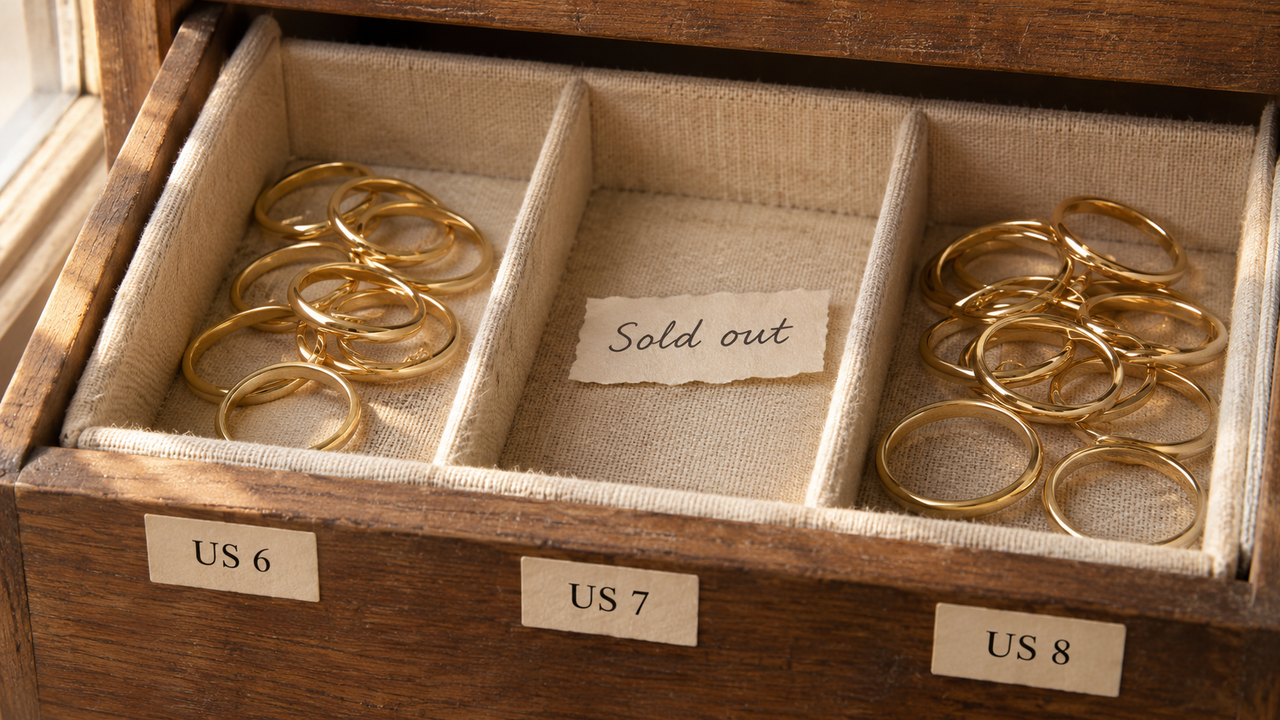
Hypothetical example. A size sold 12 rings during six in-stock hours, or two per hour. If it was unavailable for four more hours with similar traffic, price, and promotion, you could estimate eight missed sales. That gives you 12 recorded sales and 20 estimated units of demand. Keep those figures in separate columns. If the missed hours included a major email send or a different offer, look for a more comparable period before estimating.
Calculate Ring Size Distribution and Convert It Into Order Quantities
Once you have checked returns, exchanges, and stock availability, calculate the mix for each style and market.
- Calculate the share for each size. Divide units kept in that size by total units kept, then multiply by 100.
- Apply the share to your planned order. Multiply the total number of rings you plan to buy by the share for each size.
- Check the total. If you get fractions, round each quantity down first. Assign the remaining units to the sizes with the largest leftover fractions until the order adds up.
Example of a 500-ring purchase order
Hypothetical data. A retailer sold 200 rings of one style in one market. The table uses the units customers kept, and all five sizes were available under comparable conditions. The retailer plans to buy 500 new rings and has no carryover stock to factor in.
Ring size | Black Friday units kept | Sales share | Next order |
|---|---|---|---|
US 5 | 20 | 10% | 50 |
US 6 | 40 | 20% | 100 |
US 7 | 60 | 30% | 150 |
US 8 | 50 | 25% | 125 |
US 9 | 30 | 15% | 75 |
Total | 200 | 100% | 500 |
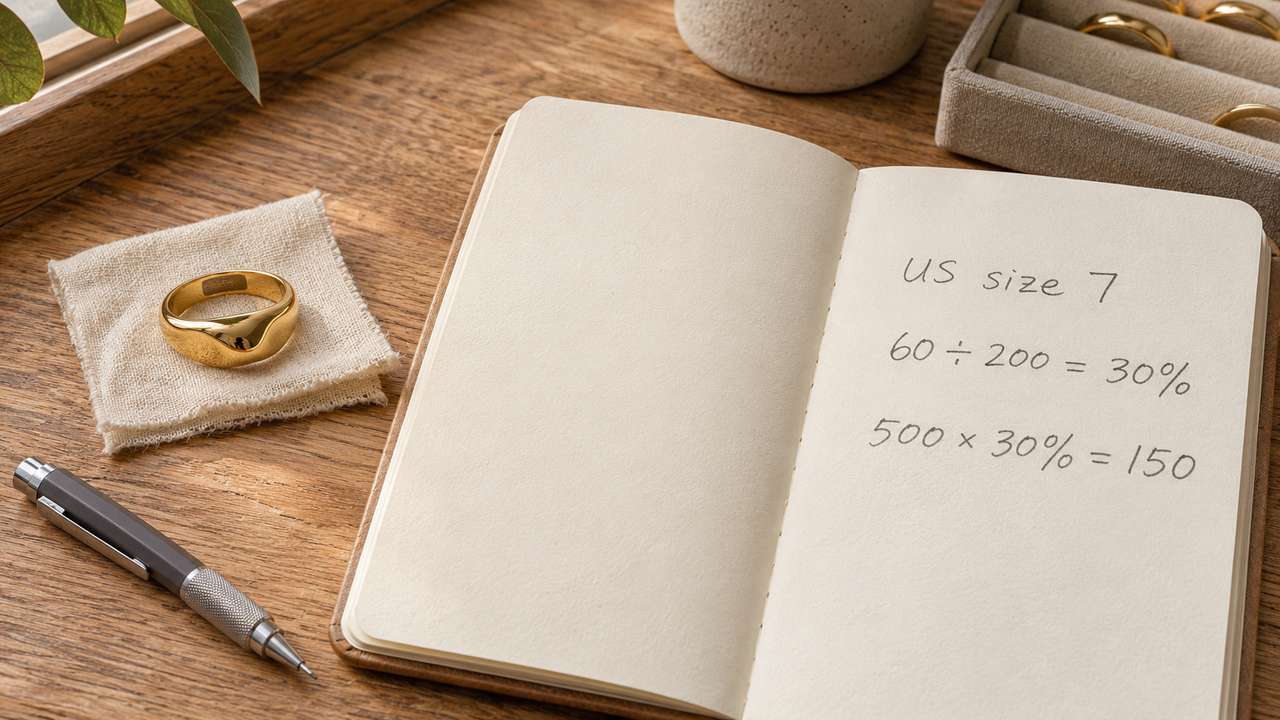
For US size 7, 60 ÷ 200 = 30%, and 500 × 30% = 150 rings. If you use a stockout estimate for any size, update the total before you recalculate the shares. Label the resulting figures as estimated demand shares.
Subtract stock you already have when restocking
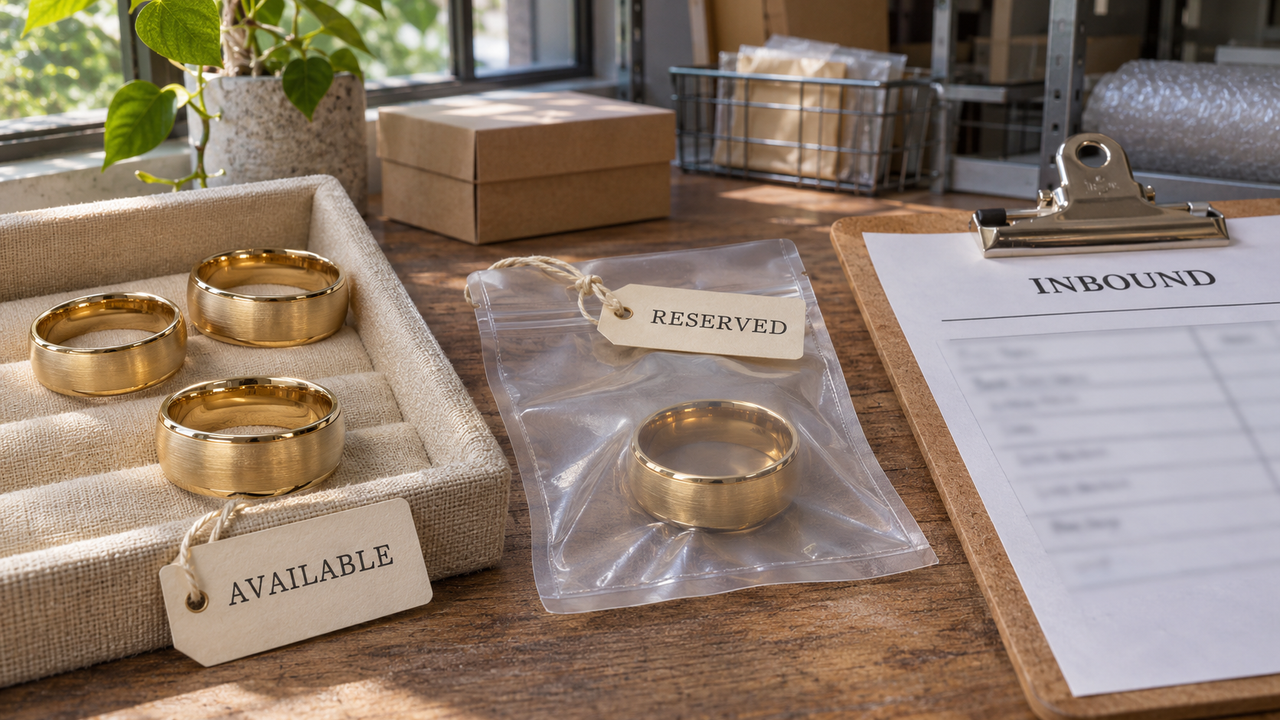
For a restock, use the size mix to set a target for each size. Then subtract the sellable units you expect to have when the order arrives and any other confirmed deliveries due by then. Exclude stock reserved for customers and returns that still need inspection.
If your target is 150 US size 7 rings, you expect to have 35 sellable units left, and another 20 are due in time, order 95 more. If the calculation gives zero or less, skip that size on this order. Ask whether your supplier’s minimum applies to the whole style or to each size before you finalize the quantities.
Adjust Ring Size Inventory Planning by Style and Market
Use a size mix for each fit
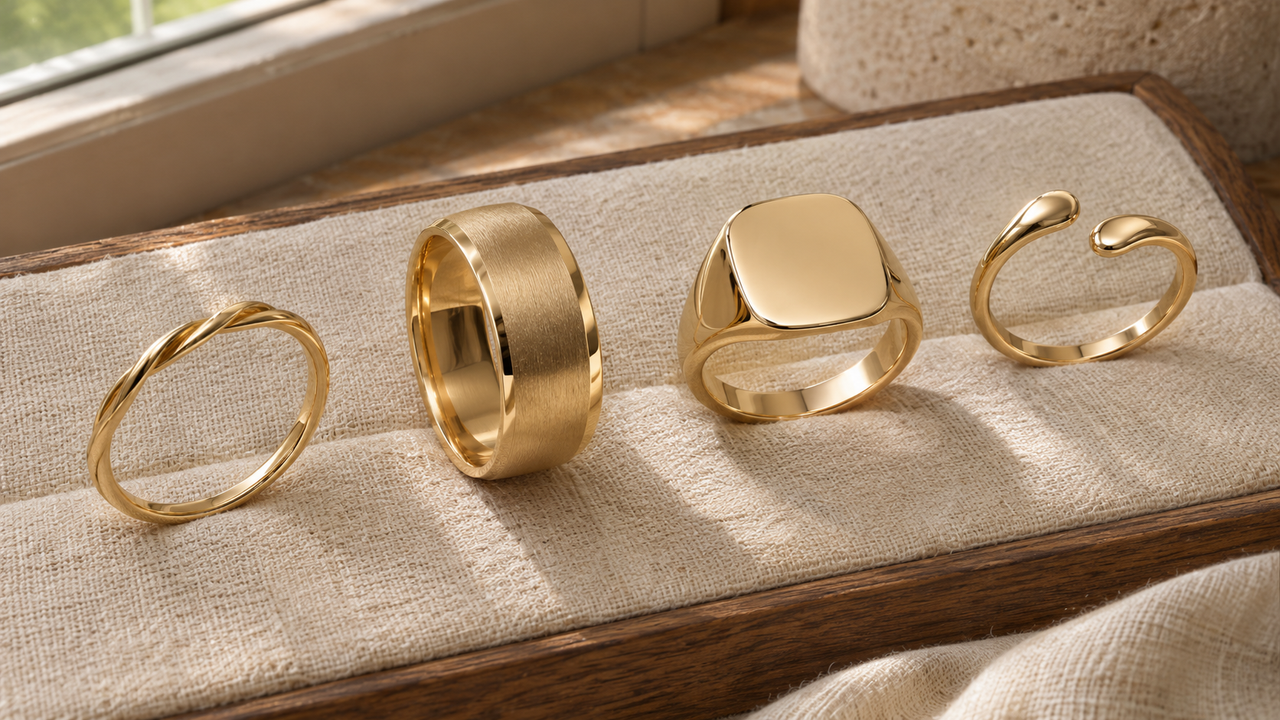
Start with separate counts for slim stacking rings, wide bands, and signet rings. Compare finishes separately if they had different prices, promotions, or stock availability. Track adjustable rings as their own variants. Wide bands can feel tighter than narrow bands, so review exchanges between sizes before copying the mix from one style to another. GIA ring size and fit guide
Match the ring size chart to the market
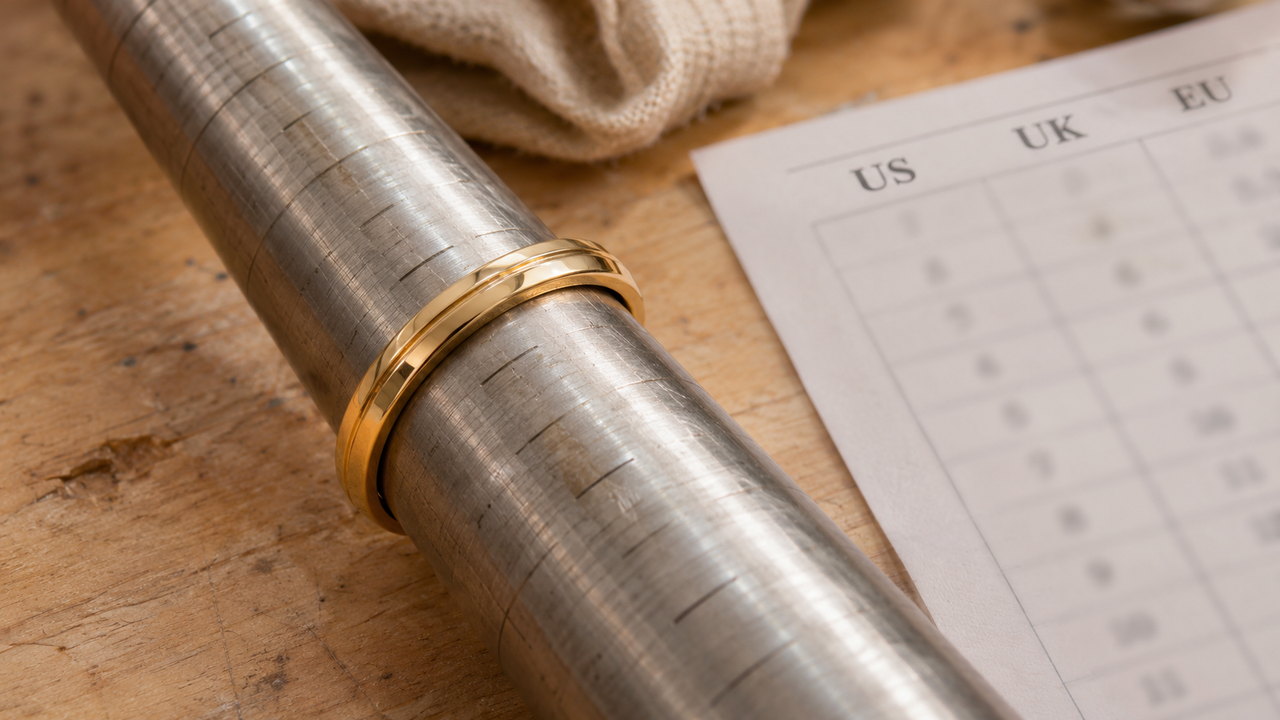
Keep separate sales summaries for markets or audiences that show different buying patterns, including men’s, women’s, and unisex collections where relevant. For orders that use different sizing systems, keep the original size label and map it to your approved supplier chart. Confirm how the supplier measures each size and check the physical samples before ordering. ISO 8653 describes a method for measuring and designating ring sizes. ISO 8653 ring sizing standard
Use Black Friday to improve the next buy
Compare the Black Friday size mix with recent sales of the same style at a similar price. Use sizes that sell well across both periods as the base for the next order. If a size moved only during a deep discount, use a smaller commitment for a regular-price restock. For a new style with little data, start with a small order based on a similar fit, price, and market. Use the first sales and exchanges to revise the next buy.
Conclusion
Build your next order from the sizes customers kept, adjust for sizes that sold out early, and apply those shares to your planned quantity. Before sending the purchase order, check the size chart, stock on hand, and incoming units for each size.
Jewins is a stainless steel jewelry manufacturer that supports jewelry brands and wholesalers with product sourcing and custom jewelry production. Share your ring design, sizing system, finish, and quantity by size to discuss a repeat order or a new collection. Jewins stainless steel ring sourcing and production
Frequently Asked Questions
Is there a standard ring size distribution for retailers?
Use a mix based on your style, market, and customer base. A narrow stacking ring and a wide signet can have different size patterns even in the same store.
How much Black Friday sales data do I need to plan a restock?
There’s no fixed minimum. If one sale or exchange would change the size mix sharply, compare it with more weeks of sales at a similar price or use a small test order.
How do I forecast demand for a size that was out of stock all weekend?
Use earlier in-stock sales for the same size and style under similar conditions. If you have no sales history, record customer requests and test a small quantity before committing to a larger order.
Should I use gross sales or net sales to plan ring size quantities?
Use net units kept after returns and exchanges. Keep gross unit sales, exchange reasons, and stockout times alongside that count so you can see fit issues and missed demand.
What if a supplier only sells rings in fixed size packs?
Compare the pack’s size mix with your target before ordering. Ask about mixed-size orders or single-size top-ups if the pack would leave you short on your best-selling sizes.
Planning Your Next Jewelry Collection?
Share your product references, material, finish, quantity, branding and packaging requirements.