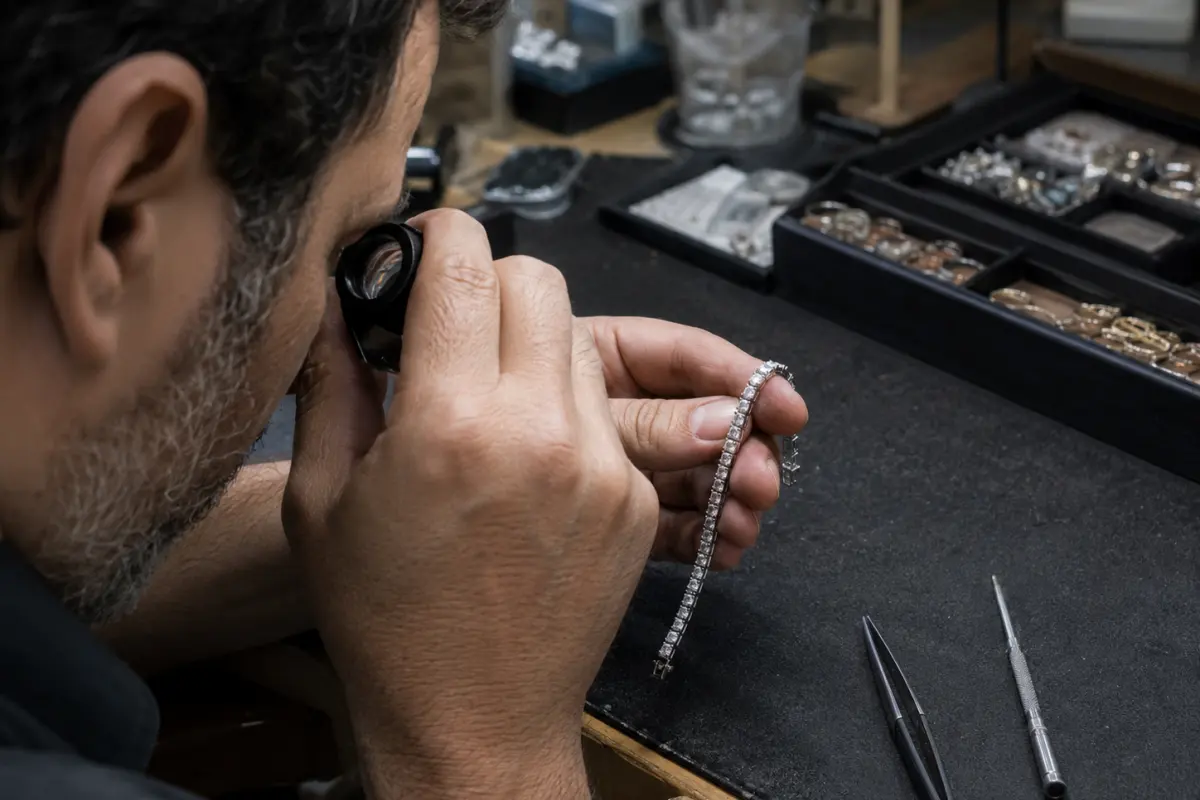

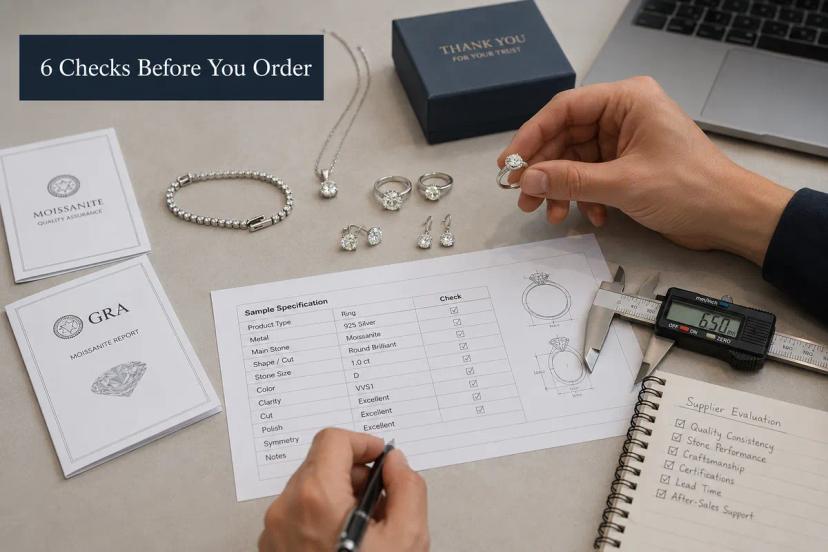
Choosing a wholesale moissanite jewelry supplier is not just about stone sparkle, unit price, or the presence of a certificate — those signals are easy to show and hard to verify. A reliable evaluation checks the stone identity and specification, what any certificate or test document actually covers, the metal and setting specification, sample-to-bulk consistency, MOQ and repeat-order controls, and packaging and defect responsibility.
Buyers who skip these checks tend to discover problems only after a bulk order ships: mixed stone grades, a certificate that does not match the physical batch, loose stones after transit, or unclear reorder terms. When comparing wholesale moissanite jewelry suppliers, buyers should ask each candidate to answer the same specification and evidence questions in writing. This guide walks through six checks you can apply to any supplier before you commit to a sample, let alone a deposit.
Quick Supplier Scorecard: Pass, Verify or Reject
Use this scorecard as a fast first pass, not a substitute for the six checks below — it helps decide whether a supplier is worth moving into sampling, needs more verification, or should be dropped from your shortlist.
A supplier that cannot answer basic stone, metal or documentation questions in writing is a weaker candidate than one that answers slowly but specifically. Vague reassurance ("all our stones are certified," "we never have quality issues") is a signal to verify further, not a reason to relax the check.
| Supplier Check | Pass | Verify Further | Reject |
|---|---|---|---|
| Stone identity & specification | Gives shape, mm size, color/clarity range, tolerance in writing | Gives general grade claims without ranges or tolerances | Cannot describe stone specification beyond "moissanite" |
| Certificate / document scope | Explains issuer, report number, and whether it covers one stone, one item, or a batch | Offers a certificate but cannot confirm what it covers | Claims every stone is certified with no scope explanation |
| Metal & setting specification | Confirms base metal, plating/PVD details, and setting type/prong count | Confirms metal but is vague on setting security | Cannot confirm base metal composition |
| Sample-to-bulk consistency | Has a defined sample approval and bulk QC process | Offers samples but no documented bulk comparison process | No sample approval step before bulk production |
| MOQ, lead time & reorder terms | Separates MOQ by style, customization and packaging | Gives one MOQ figure without breakdown | Cannot explain MOQ logic at all |
| Packaging & defect terms | Has a defined claim period, evidence requirements, and resolution options | Mentions warranty but terms are undefined | No stated process for defects or missing items |
Check 1 — Verify the Moissanite Identity, Grade and Stone Specification
Moissanite is a distinct gemstone material (silicon carbide), not a generic term for any lab-made stone. Before requesting a quote, ask the supplier to confirm the material identity in writing, along with the specification details that affect production and cost.
At minimum, your RFQ or spec sheet should request: stone shape, millimeter dimensions (not only "equivalent carat" wording, since equivalent-carat labeling can vary between suppliers), color range, clarity range, and cut consistency. If your design uses both main stones and small accent stones, specify grade requirements for each separately — accent stones are frequently held to a looser standard, and a supplier that does not distinguish between the two introduces mixed-grade or mixed-color batch risk without telling you.
Ask what stone tolerances the supplier works to, and whether they retain batch samples you can reference if a reorder needs to match an earlier shipment. A supplier who cannot answer these questions in specific terms is not yet ready to quote a defensible bulk price.
This check covers specification, not stone comparison. For a fuller look at how moissanite compares with cubic zirconia on hardness, brilliance and sourcing, see Moissanite vs cubic zirconia for jewelry brands.
Check 2 — Confirm What Each Certificate or Test Document Actually Covers
A certificate is only useful if you know exactly what it covers. Moissanite documentation comes in several forms that are not interchangeable: a lab report for a single loose stone, a report tied to one finished item, a supplier-issued card with no independent issuer, or a batch-level statement covering a production run. Some documents explicitly exclude small accent stones, which matters if your design uses melee-size stones around a main stone.
Before you rely on any document, verify: who issued it, whether it has a report number, whether that number can be looked up independently where a lookup service exists, whether the document matches the physical stone or item in front of you, and whether it applies only to the main stone or to the full order. Do not assume a batch-level statement means every individual stone was independently tested — ask the supplier to clarify this directly.
Treat vague claims such as "all our stones are certified" as a prompt for verification, not as proof. Not every moissanite stone in an order requires or receives its own individual certificate, and a supplier's general certification page is not, by itself, evidence of stone identity for a specific order.
Check 3 — Lock the Metal Base, Plating or PVD and Setting Specification
"Moissanite jewelry" describes the stone, not the metal, plating or setting quality around it, and those elements carry their own risk if left unspecified. Confirm the exact base metal (for example, 316L stainless steel, sterling silver, or another material the supplier states explicitly), and note that supporting parts such as posts, clasps, solder points and findings can use a different metal than the main body.
If the piece is plated or PVD-coated, ask for the plating or PVD color, and where relevant, the coating thickness and whether there is a base layer or protective coating underneath. These details affect durability and consistency across a production run, not just appearance.
For the setting itself, confirm the setting type, prong count and shape, pavé spacing where applicable, minimum supporting metal around the stone, and setting alignment. Poor finishing around the setting can leave sharp edges, while weak supporting metal, misaligned prongs or excessive polishing may reduce setting security.
Check 4 — Approve a Physical Sample and Define Bulk QC for Loose-Stone Risk
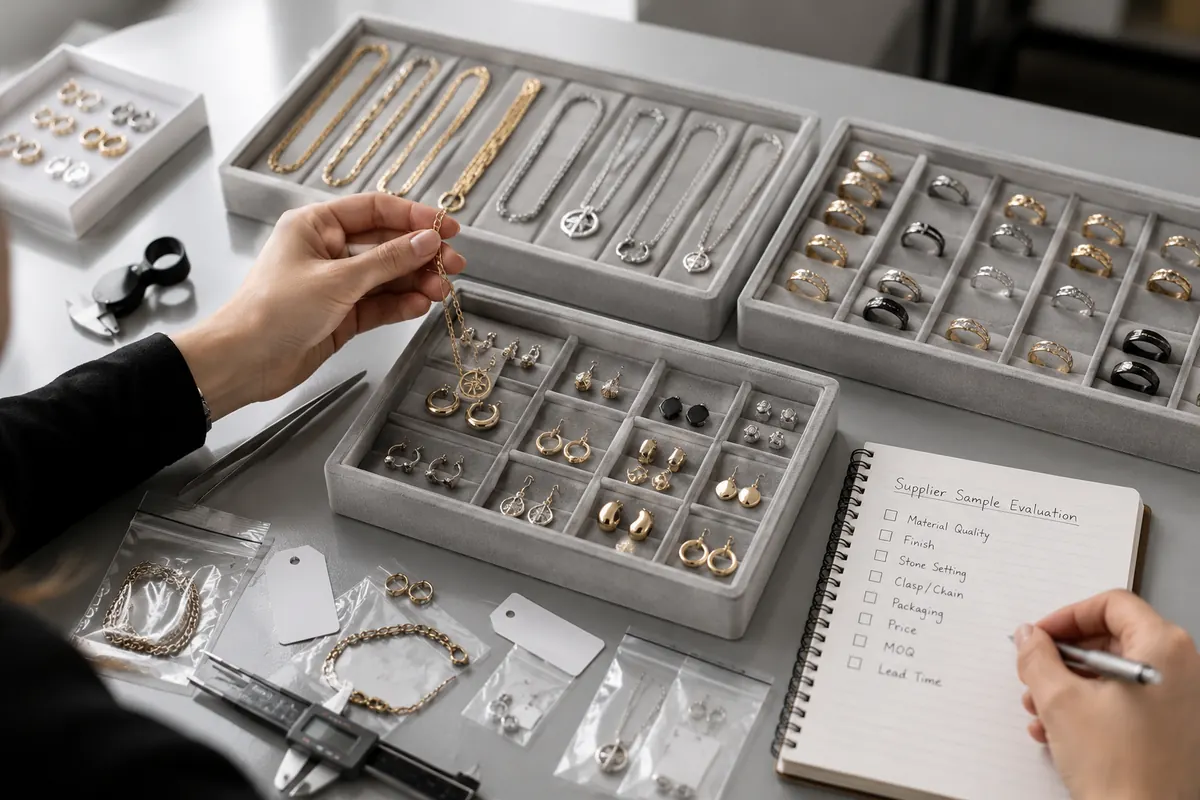
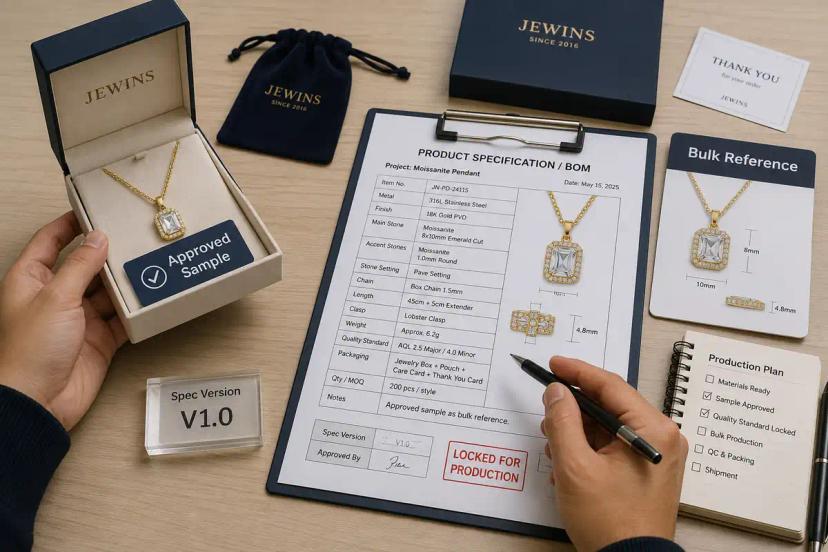
Photos and renders are not sufficient for sign-off on a moissanite piece, because stone placement, setting security and finish color are difficult to judge from an image. Depending on project complexity, approval may include CAD, a resin or unfinished prototype, and a finished physical sample. At minimum, buyers should approve a finished sample before bulk production. Once approved, that piece should function as your golden sample — a physical reference the supplier and buyer both use to judge later production.
Before bulk production starts, lock the bill of materials and specification against the golden sample: stone position and orientation, product weight and dimensions, finish color, logo placement (if applicable), and setting security. Ask what loose-stone inspection the supplier performs, and whether pieces are cleaned and reinspected after that check. Sampling ratio or AQL level is a question to raise with the supplier, not something to assume — treat any figure given as the supplier's stated practice, not a guarantee.
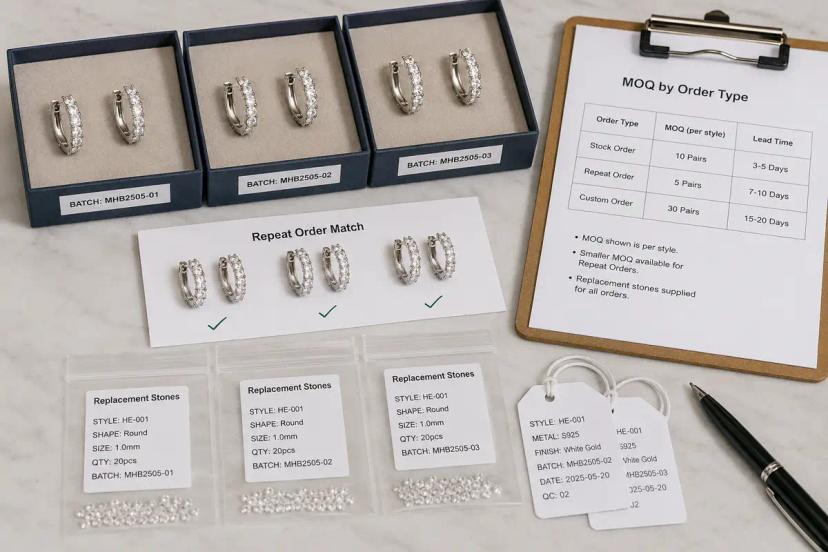
Compare the first sample, first bulk order and any repeat order against each other, not only against the original brief, and confirm the supplier keeps batch identification and retained samples for future reorders.
For the full manufacturing sequence from CAD to shipment, see the custom jewelry manufacturing process.
Check 5 — Compare MOQ, Lead Time, Capacity and Repeat-Order Controls
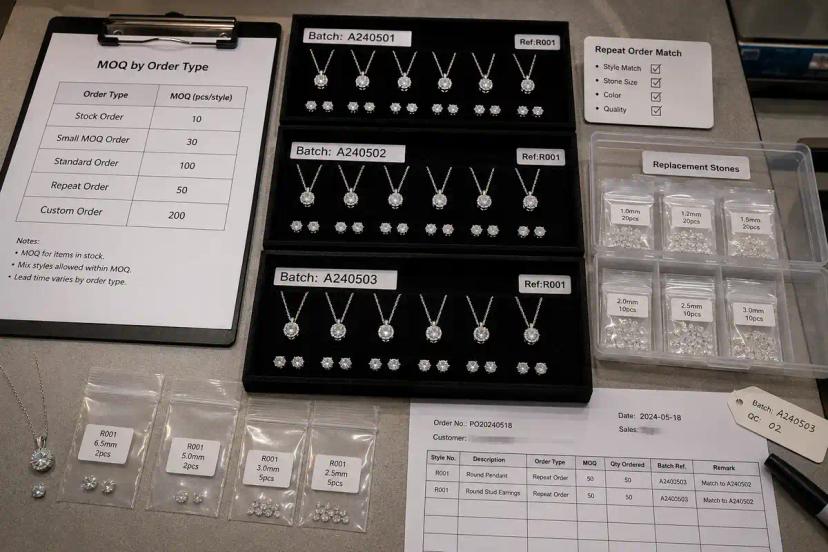
A single MOQ number rarely applies across an entire order. Ask the supplier to break MOQ down by existing styles versus new styles, color or finish changes, custom stone shapes or sizes, OEM design work, packaging, logo printing, and mixed-SKU orders. If a supplier gives one MOQ figure, ask what it includes and which changes — finish, stone size, packaging, custom tooling — would trigger a different minimum.
On timing, ask separately about CAD turnaround, sample production time, first bulk order lead time, and repeat-order lead time, since these are rarely equal. Also ask about peak-season capacity, material and stone preparation, mold/CAD file version control, and how finish and color consistency is maintained across production runs. If you plan to reorder regularly, ask how the supplier supports replenishment planning and what Incoterms and shipping responsibility apply. Confirm MOQ and lead-time figures in writing for your specific design, quantity, finish and packaging requirements.
Repeat orders also carry moissanite-specific stone-matching risk. Ask whether the supplier records the approved stone size, shape, color range and accent-stone specification; whether that specification carries over to repeat orders; whether replacement stones are available for after-sales use, matched separately for main and accent stones; and whether retained samples or batch references exist to check a reorder against.
For a deeper comparison of production models and how they affect MOQ, IP and control, see OEM vs ODM jewelry manufacturing.
Check 6 — Confirm Private-Label Packaging, Defect Handling and After-Sales Terms
Packaging and after-sales terms are easy to overlook during sampling and expensive to renegotiate later. Confirm what the supplier can produce for jewelry box, pouch, brand card, care card, barcode, label and outer carton, and ask for a packaging sample approval step before bulk packaging is produced — packaging MOQ and logo proofing often follow a separate timeline from the jewelry itself. If you plan to reorder, ask how packaging consistency is maintained between runs.
Ask specifically how the supplier protects against scratches and stone loss during shipping. Transit can expose weak settings or inadequate protective packaging, so confirm how finished pieces are separated, secured and inspected before shipment. Then confirm the after-sales terms directly: what counts as a valid claim for missing items, wrong products, loose stones or finish defects; the claim window and evidence required; and whether resolution options include repair, replacement, credit or refund. Also confirm replacement-stone availability (free, charged, or an agreed spare quantity), who covers shipping for valid manufacturing-defect claims, and how manufacturing defects, transit damage and normal wear are distinguished.
Do not assume consumer-style warranty language (a fixed return window, a blanket guarantee) applies automatically to a custom B2B order — ask the supplier to state their terms for bulk and private-label orders specifically, and get the distinction between normal wear and a manufacturing defect in writing.
For packaging specification and sample approval workflow, see jewelry packaging specification and sample approval.
Before You Pay a Deposit: Red Flags and RFQ Checklist
A few warning signs are worth treating as reasons to slow down, not proceed:
- The supplier cannot define stone grade or tolerance beyond general terms.
- A single certificate is presented as proof covering an entire batch.
- Metal composition is described vaguely or inconsistently across communications.
- Sample specifications are never written down or confirmed in an approval document.
- MOQ categories (style, customization, packaging) are bundled into one number with no breakdown.
- Bulk and repeat-order QC steps are not defined before you ask.
- Defect and after-sales responsibility is left undefined until a problem occurs.
- Packaging specifications are never formally approved before bulk production.
- The supplier relies mainly on marketing language ("premium quality," "100% guaranteed") instead of specific, checkable details.
One unresolved critical issue — such as unknown base metal, no physical sample approval or no defect-resolution process — may be enough to reject a supplier. Several smaller documentation gaps should at least pause the order until they are resolved. Use the RFQ checklist below to put requirements in writing from the start — this reduces ambiguity before bulk production.
| RFQ Item | What the Buyer Should Specify | Evidence or Confirmation to Request |
|---|---|---|
| Product design | Reference image or CAD, dimensions | Supplier's CAD proof or resin sample |
| Stone specifications | Shape, mm size, color/clarity range, main vs. accent grade | Written spec sheet, retained reference sample or batch identification, where available |
| Base metal | Exact alloy/material | Material declaration in writing |
| Finish | Plating/PVD color, thickness where relevant | Finish sample matched to golden sample |
| Setting | Type, prong count, pavé spacing, minimum metal support | Physical sample inspection |
| Quantity | Order quantity by style/customization/packaging tier | MOQ breakdown by category |
| Sample requirements | CAD, resin, finished-sample stages required | Sample approval sign-off process |
| Packaging | Box/pouch/card/label/carton specification | Packaging sample approval |
| Timeline | CAD, sample, first bulk and reorder lead times | Written timeline per stage |
| QC | Loose-stone inspection, reinspection, sampling approach | Supplier's stated QC process |
| Defect handling | Claim period, evidence needed, resolution options, replacement stone arrangement | Written after-sales terms |
| Reorder requirements | Batch matching, version control expectations | Retained sample/batch ID confirmation |
How Jewins Supports Moissanite Jewelry Projects
Jewins works with jewelry brands and wholesalers to turn a moissanite jewelry concept into a production-ready order, following a consistent sequence: requirement review, stone/material/finish confirmation, sample approval, relevant production and inspection discussion, packaging planning, and repeat-order specification control.
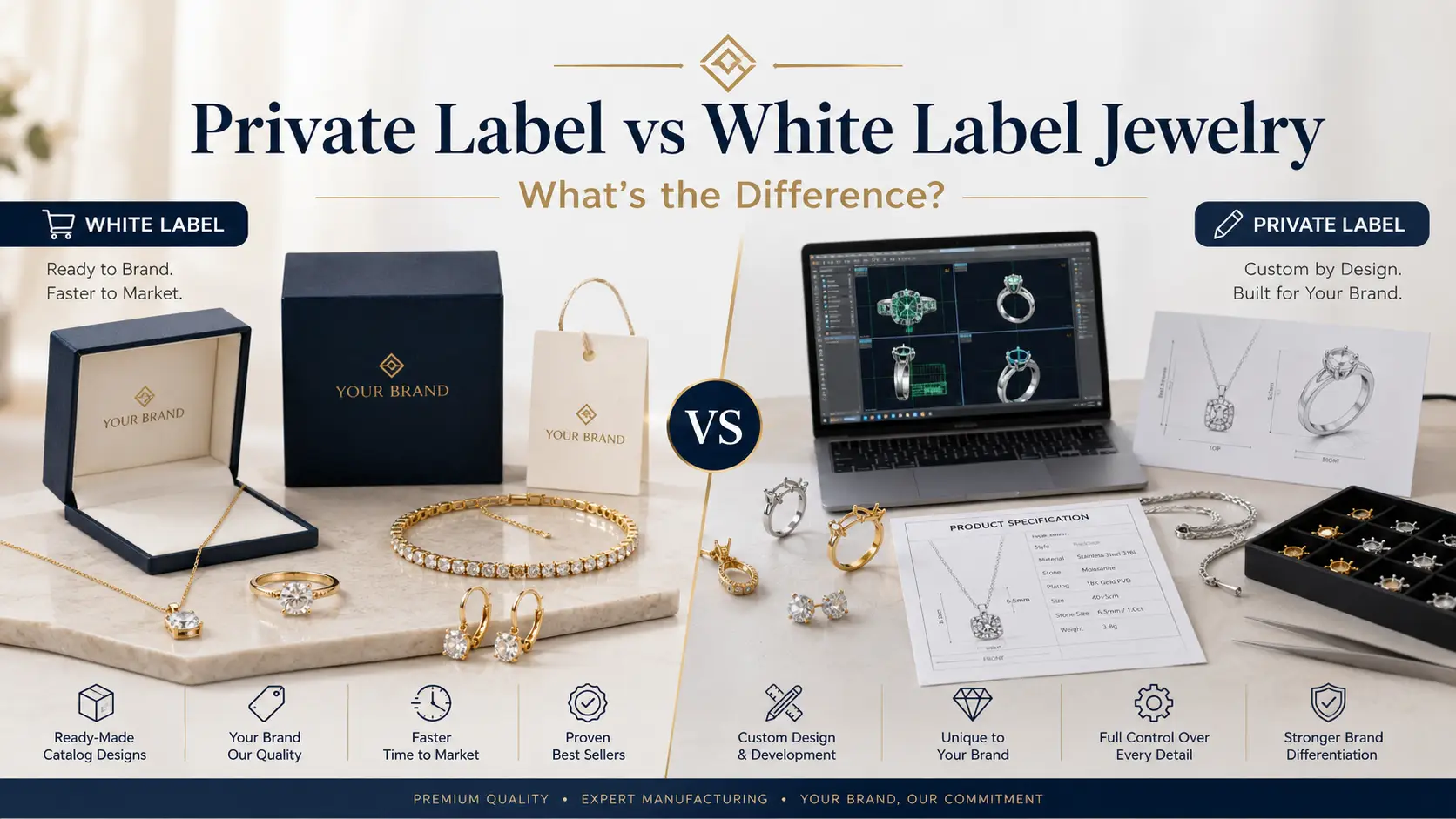
Where a project needs a fully custom design or a modified existing style, Jewins supports OEM/ODM discussion to clarify what changes and what stays standard. Before bulk production, samples are confirmed against your requirements, and Jewins can review relevant production and inspection checkpoints based on the confirmed product specifications. For brands building their own packaging identity, Jewins supports private-label packaging planning, and for buyers placing repeat orders, coordinates the requirements needed to keep a reorder consistent with the original batch.
To get a useful quote quickly, send: your product or reference design, stone shape and size, base metal, finish color, quantity, sample requirements, packaging needs, and target launch date. Sharing these details upfront helps Jewins prepare a more accurate and comparable quotation. You can review Jewins' broader manufacturing capabilities on the solutions page.
FAQ
What is the minimum order quantity for wholesale moissanite jewelry?
MOQ typically varies by category rather than being a single number: existing stock styles, styles with color or finish changes, fully custom OEM designs, and custom packaging can each carry a different MOQ. Ask your supplier to break this down by category before you plan your first order, rather than relying on one quoted figure.
Can I order a sample before placing a bulk order?
For custom or modified products, buyers should request and approve a physical sample before bulk production. The exact sequence may vary by project complexity — see the golden sample and approved-sample process described above for what to check at each stage.
What documents should a supplier provide to verify moissanite identity and specifications?
Ask for a written stone specification (shape, size, color/clarity range) and clarify what any certificate covers — a single stone, a finished item, or a batch. Confirm the issuer, report number, and whether it can be checked independently, and don't assume a general certification claim covers every stone in your order.
Can a supplier customize the jewelry box or add a brand logo?
Many suppliers support custom packaging and logo printing, but packaging MOQ and logo proofing often run on a separate timeline from the jewelry itself. Confirm packaging specification and get a packaging sample approved before it's produced at bulk quantity.
What happens if stones loosen or quality problems appear after delivery?
This depends entirely on the supplier's stated after-sales terms, which should be confirmed in writing before you order — not assumed from general reassurance. Ask about the claim period, what evidence is required, and whether resolution options include repair, replacement, credit or refund, and confirm in advance whether replacement stones are available as one of those options, along with who covers shipping cost for a valid claim.
Ready to Move Forward?
If you're evaluating a wholesale moissanite jewelry supplier for an upcoming order, send Jewins your design or product reference, stone specifications, material and finish, order quantity, sample requirements, packaging needs, and target timeline to get a specification-based response.
Request a moissanite sample or quote →