
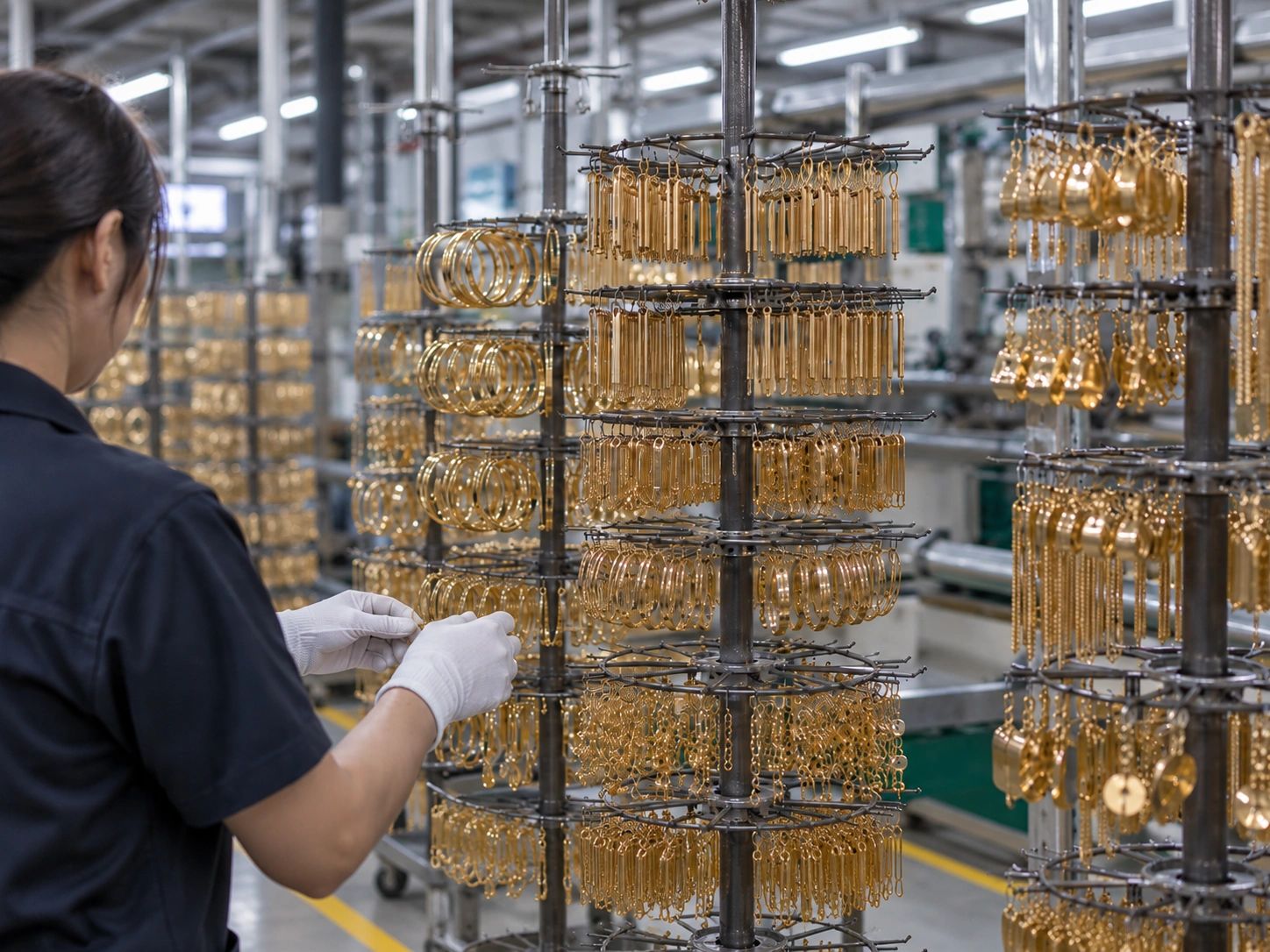
Why gold-tone stainless steel can change with wear, how PVD differs from electroplating and which specification and care factors matter.
Gold-tone stainless steel does not have one universal wear result. The base material may resist corrosion, while the visible gold color comes from a separate finish that can change through abrasion, chemicals, exposure and care.
What people mean by tarnish
Tarnish usually describes a chemical change at the surface. On gold-tone stainless steel, buyers may also be seeing coating wear, scratching, residue, discoloration from products used on the jewelry, or exposure of the base color. Those mechanisms should not be treated as the same problem.
The role of 316L stainless steel
JEWINS uses 316L as the default stainless steel specification, with product-specific exceptions documented. The steel provides the substrate; it does not by itself determine how a gold-tone coating will look after use.
PVD and electroplating are different systems
PVD uses a vacuum-deposition process, while electroplating deposits material through an electrochemical process. Either can be appropriate when the specification, preparation and process controls match the product. Their performance should be judged from the actual coating system and sample, not a universal multiplier or fixed lifespan.
Read the current JEWINS PVD process and quality overview for the manufacturing context.
What affects gold-tone appearance
- Base-material and surface preparation
- Coating system, color target and process control
- Product geometry, edges and high-contact areas
- Friction, sweat, cosmetics, cleaning products and chemicals
- Storage, cleaning and frequency of wear
Water exposure needs a qualified claim
Stainless steel can perform well in many everyday conditions, but a gold-tone finished product should not be promised for unrestricted water, chlorine, saltwater or chemical exposure without product-specific evidence. Clasps, stones, adhesives and mixed components may have different limits.
How to care for gold-tone stainless steel jewelry
- Remove visible residue with a soft, non-abrasive cloth.
- Use mild cleaning only when suitable for the complete product.
- Rinse carefully and dry completely.
- Avoid abrasive cleaners, bleach and uncontrolled chemical exposure.
- Store pieces separately to reduce scratching and friction.
What brands should specify
A sourcing specification should identify the substrate, finish system, color reference, surface preparation, sample approval criteria, appearance tolerances and any required test scope. Claims must match the actual finished product.
How to distinguish wear from a quality defect
Normal wear tends to appear first at repeated-contact areas and changes with use. A quality problem may include inconsistent color between pieces, incomplete coverage, poor adhesion at delivery or failure against an agreed test. The distinction should be made against the approved sample, specification and inspection record.
Frequently asked questions
Will solid stainless steel beneath a gold finish rust?
Stainless steel is selected for corrosion resistance, but performance depends on grade, construction, contamination, environment and care. Mixed components can behave differently.
Does PVD always last longer than electroplating?
The processes differ, but a universal ranking is not reliable without the full coating specification, sample and use conditions. Compare actual systems rather than process names alone.
Can a brand advertise a piece for shower wear?
Only when the finished product, all components and evidence support that defined use. A broad statement based only on stainless steel or PVD is insufficient.
Conclusion
Gold-tone stainless steel can retain its appearance well when the substrate, finish, product design, use and care align. It is more accurate to explain those conditions than to promise that every item will never change.
Contact JEWINS to discuss a product-specific finish and quality brief.
Governed Facts and Evidence
These references state the approved scope used for this article. Evidence applies only within the scope and limitations shown.
Controlled facts
- Default stainless steel material
316L stainless steel is the standard material used across JEWINS stainless steel jewelry, with product-specific exceptions documented where applicable.
Supporting evidence
- 316L Stainless Steel Material Test Report
Report CTT2509013416EN records a PASS result against ASTM A276/A276M-25 grade 316L element-content requirements for the tested 1022CB-12mm box buckle body only.
Relationship scope: The report supports only the submitted 1022CB-12mm box buckle body and must not be generalized to every product or component.
Evidence scope: Element-content verification for the submitted 1022CB-12mm box buckle body.
Limitations: The PASS result applies only to the tested box buckle body; it is not per-SKU certification for every product or component.
View document
Planning Your Next Jewelry Collection?
Share your product references, material, finish, quantity, branding and packaging requirements.