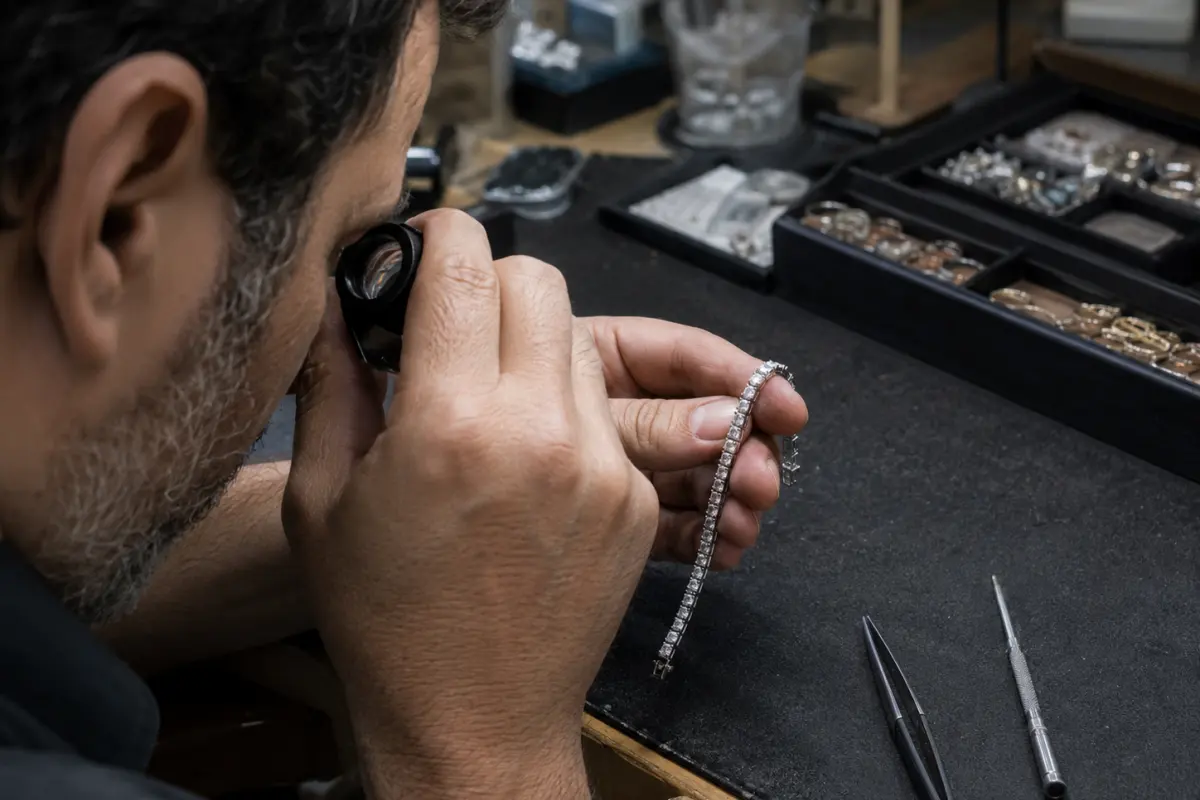

Stones can fall out because of wear, significant impact, design vulnerability, poor stone-to-seat fit, insufficient or uneven retaining metal, setting inconsistency, finishing-related metal loss or deformation, or a missed reinspection step. A missing stone or one photograph does not, by itself, prove what caused the failure.
For a brand preparing bulk production, the real issue is not only why one stone came loose. It is whether the problem is isolated, design-related, or repeated across a batch. The goal is to build enough control and evidence to diagnose a complaint instead of guessing.
Is Stone Loss Always a Manufacturing Defect?
Not automatically. The same symptom—a loose or missing stone—can result from normal wear, accidental impact, a vulnerable design, inconsistent setting work, excessive finishing, or a batch-level process problem.
- Normal wear: Retaining metal can bend, wear, or lose effective contact over time.
- Accidental impact: A knock can move a prong or deform another retaining feature.
- Design-related vulnerability: Thin walls, exposed prongs, and dense small-stone layouts can be more sensitive to stress.
- Setting execution problems: A mismatched seat, uneven stone position, or insufficient remaining metal can reduce security.
- Polishing or finishing damage: Excessive metal removal near a setting can weaken it before shipment.
- Batch-level inconsistency: Similar failures across several pieces suggest a repeatable production issue rather than one isolated event.
| Observation | Possible Explanation | More Consistent With | Evidence Needed |
|---|---|---|---|
| Bent or visibly worn prong | Repeated wear or impact | Wear / impact | Wear pattern and use history |
| Stone repeatedly loosens in the same position | Seat or retaining-metal problem | Design / setting risk | Seat, prongs and adjacent stones |
| Several units from one batch show similar failure | Process inconsistency | Manufacturing / QC risk | Batch and production records |
| Stone loss after a documented collision | Impact damage | Impact | Deformation and impact marks |
| Uneven stones or visible gaps before use | Setting inconsistency | Manufacturing risk | Approved-sample comparison |
These observations can indicate possible causes, but they do not prove responsibility on their own.
Why Do Stones Fall Out of Jewelry?
Wear, Impact, and Metal Deformation
Retaining metal is not static once jewelry enters use. Prongs, beads, channel walls, and bezel edges can bend, wear, or deform. A significant impact can move a prong enough to loosen a stone, while repeated use can expose a weak area that was not obvious when the piece was new.
This still does not settle the cause by itself. An isolated impact mark points in a different direction from several units in one batch showing the same loose position. Diagnosis depends on the condition of the setting, use history, and whether a pattern exists.
The Stone Does Not Match the Seat
The stone seat, sometimes called the bearing, is the ledge or shaped contact area that supports the stone inside the setting. Nominal diameter alone is not enough. Two stones listed at the same size may differ in depth, angles, girdle profile, or actual shape.
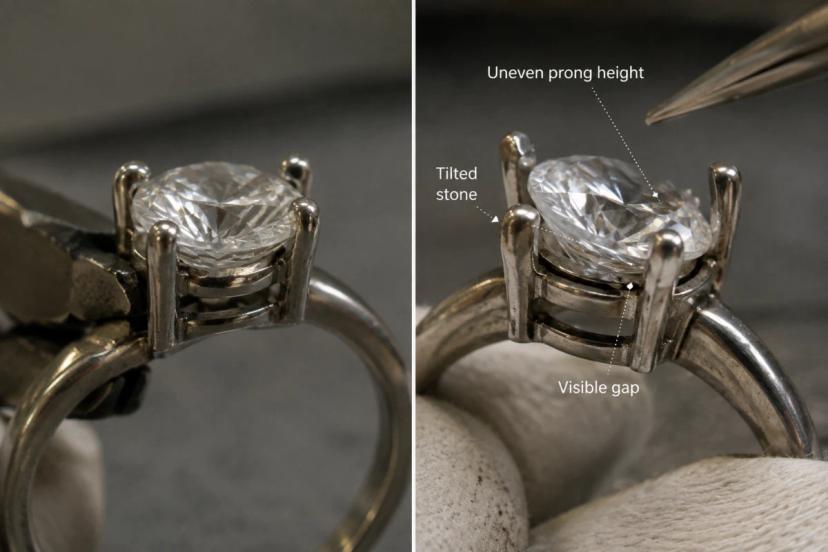
A seat that is oversized, uneven, or poorly matched may leave a visible gap or unstable contact even when the stone looks acceptable from the front. GIA’s quality-assurance benchmark for a round stone in a platinum prong setting illustrates the qualitative principle that the stone should sit level and be supported by a bearing fitted to its geometry. The numerical details on that page are specific to its example and should not be treated as universal standards.
For multi-stone production, mixed size groups can create inconsistent fit across one piece or one batch. This is why actual sorting and matching matter. Stone choice also affects the specifications a brand needs to control; our guide to moissanite vs cubic zirconia for bulk jewelry explains how size and cut differences can affect production decisions.
Too Little or Uneven Retaining Metal
A secure setting needs enough usable metal at the correct contact points. Overcut prongs, thin beads, uneven channel walls, or insufficient bezel contact can reduce security. A stone may also sit tilted if the contact is uneven, creating different stress at different points.
There is no single prong-coverage percentage that applies to every alloy, stone shape, and setting style. What is acceptable depends on the design and must be checked at the SKU level. The practical question is whether the retaining metal remains sufficient, even, and correctly positioned after setting and finishing.
Casting or Structural Weakness
Casting porosity or a thin structural area can matter when it interrupts a load-bearing path, such as a prong root, bead, or narrow channel wall. But not every surface pinhole causes stone loss. Location, severity, and the relationship between the defect and the failure all matter.
A useful inspection therefore separates cosmetic surface marks from defects that may reduce structural continuity around the setting.
Polishing, Finishing, or Missed Reinspection
Polishing removes small amounts of metal to create a smooth surface. That is normal, but excessive finishing near a setting can reduce or deform the metal holding the stone. GIA’s prefinishing benchmark notes that excessive post-setting finishing can reduce prong dimensions or deform components, which supports reinspection after polishing.
Electroplating and PVD are different coating processes, and neither replaces correct mechanical setting security. A coating cannot compensate for a poor seat or insufficient retaining metal. For more on the coating side of production, see our guide to PVD coating quality for bulk orders.
Settings should also be checked after cleaning or rework where those steps may reveal an existing weakness. Ultrasonic cleaning may expose a setting that was already loose, but that does not make the cleaning process the automatic root cause.
| Failure Mode | Why It Matters | What Brands Should Inspect |
|---|---|---|
| Stone-size mismatch | Inconsistent contact with the seat | Stone sorting and actual fit |
| Poor seat preparation | The stone lacks stable support | Gaps, levelness and bearing fit |
| Insufficient retaining metal | Reduced setting security | Prong, bead, channel or bezel condition |
| Uneven setting | Stress and movement differ across stones | Alignment and height consistency |
| Excessive polishing | Retaining metal may be reduced | Post-polishing reinspection |
| Missed final inspection | Weak settings may reach shipment | Finished-product and pre-shipment records |
Why Pavé and Small Stones Need Tighter Control
Pavé, micro-pavé, side-stone, tennis, and iced-out designs place many stones and small retaining features close together. Small differences in stone dimensions, seat preparation, alignment, or metal removal can repeat across many positions rather than appearing only once.
GIA’s bead-setting benchmark emphasizes precise seat fit, usable bead metal, consistent contact, and enough supporting metal beneath the setting. Its numerical details apply to the specific platinum example, but the broader lesson is useful: dense small-stone designs leave less room for inconsistency.
Pavé and high-stone-count designs are not automatically defective, but they require tighter control over stone matching, retaining metal, finishing, and inspection.
Why Can a Sample Pass but Bulk Production Still Fail?
Different Stone Batches
Stones that look identical on a specification sheet can still vary between batches or suppliers. A new batch should be checked against the approved requirements rather than assumed to match the sample.
Operator and Process Variation
A sample is often made carefully as a single piece. Bulk production may involve different setters or workstations, so seat preparation, alignment, and tightening must be reproduced consistently across the order. A good sample proves the design can work; it does not prove the process is already repeatable.
Polishing and Finishing Variation
Polishing pressure, direction, and material removal can vary. Because finishing can change the condition of the retaining metal, inspection before polishing is not enough.
The Sample Is Not Linked to Specifications
An approved sample is most useful when tied to a controlled SKU, CAD or drawing, stone specification, setting method, surface finish, and approved revision. The sample is a visual and physical baseline, not a substitute for measurable production requirements.
7 QC Checks Before Approving Bulk Production
These checks build on the broader controls in our guide to bulk jewelry inspection and defect handling, but focus specifically on stone security.
Check 1: Confirm Stone Specifications and Sorting
Verify stone size, shape, and depth or height where relevant, together with appearance consistency. For multi-stone designs, confirm that sorting and size matching happen before setting.
Check 2: Verify Stone-to-Seat Fit
Check that the stone sits level, the seat matches the actual stone, no visible support gap remains, and no movement is detected before final finishing.
Check 3: Define Setting-Specific Acceptance Criteria
Prong, pavé, bead, channel, bezel, and adhesive-supported positions require different inspection criteria. Where a mechanical setting is specified, adhesive should not be used to compensate for poor seat preparation or insufficient retaining metal. Adhesive-only or adhesive-supported designs require their own material, application, and curing criteria.
Check 4: Approve and Retain a Physical Sample
Keep the approved sample tied to versioned specifications and retain it for bulk comparison. If the stone specification, setting method, or finish changes materially, reconfirm the reference.
Check 5: Add First-Piece and In-Process Checks
Use first-piece or in-process checks for new designs, high-stone-count products, micro-pavé, higher-value items, or runs using a changed stone or production batch.
Check 6: Reinspect After Polishing and Surface Finishing
Recheck after stone setting, polishing, electroplating or PVD where applicable, rework, and before shipment. Each checkpoint should confirm the actual condition of the finished setting rather than rely on an earlier stage.
Check 7: Define Final Inspection and Problem Records
Define missing, loose, tilted, and damaged stone conditions before production starts. Also define how rework, reinspection, defect photos, batch identification, repeat-order comparison, and complaint review will be handled.
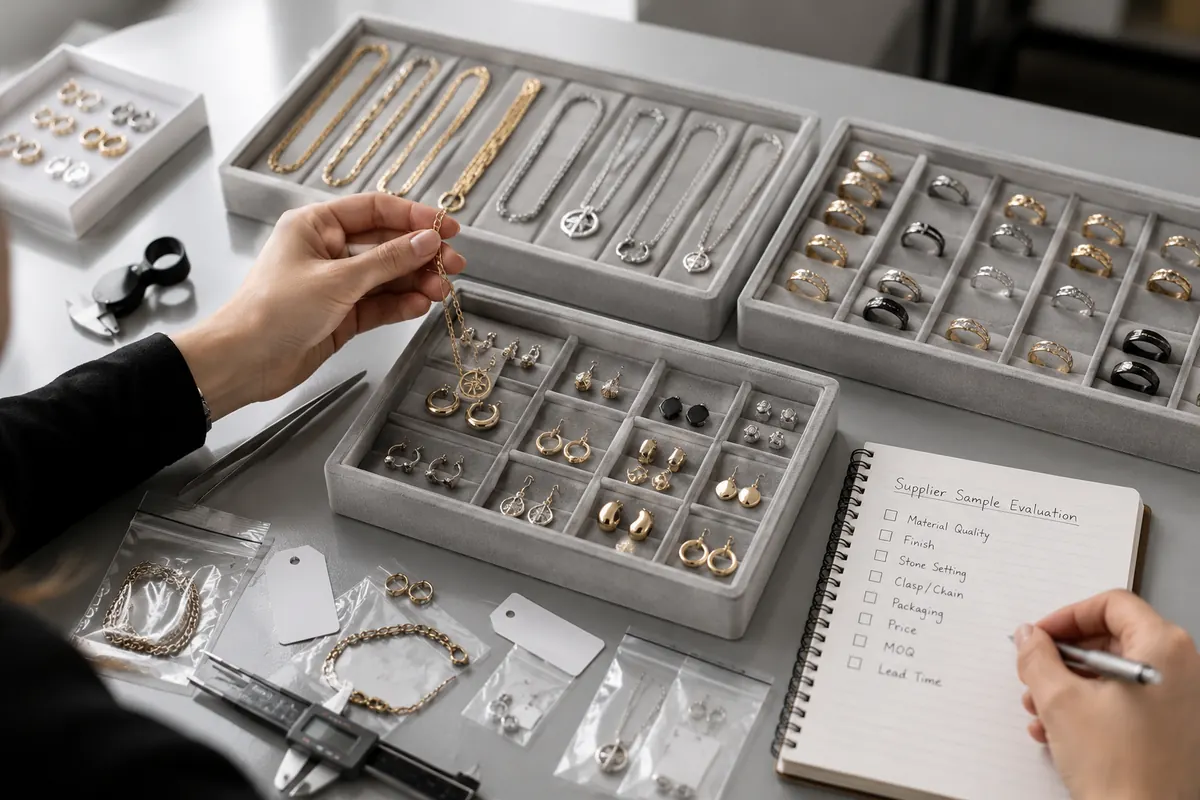
| Check | What to Confirm | Evidence to Request |
|---|---|---|
| Stone matching | Actual stone and seat compatibility | Sorting or matching photos |
| Approved sample | Controlled bulk reference | Sample approval record |
| Setting condition | Alignment and retaining metal | Macro inspection photos |
| In-process QC | Checks before finishing | Inspection or rework record |
| Post-process QC | Condition after polishing or finishing | Post-process check record |
| Final release | Loose, missing, tilted and damaged stone status | QC report or inspection photos |
| Repeat orders | Comparison with the earlier approved batch | Version or batch reference |
How Jewins Controls Stone-Setting Risk
The principles above are industry-facing. The following points describe practices Jewins has confirmed in its own production workflow.
Stone Sorting and Matching
Jewins checks stone size, shape, height, damage, mixed stones, and appearance. Small stones and moissanite are sorted and matched before setting. When a mismatch is found, the response may include replacing the stone, adjusting the seat, or reworking the piece.

Approved Sample as a Bulk Reference
A client-approved sample can be retained as the production reference, and bulk pieces are compared against it. New or higher-risk designs may include first-piece confirmation, a pre-production sample, or a short-run check. This follows the same sample-to-bulk logic used in Jewins’ sample-led custom necklace production.
In-Process Stone-Setting Inspection
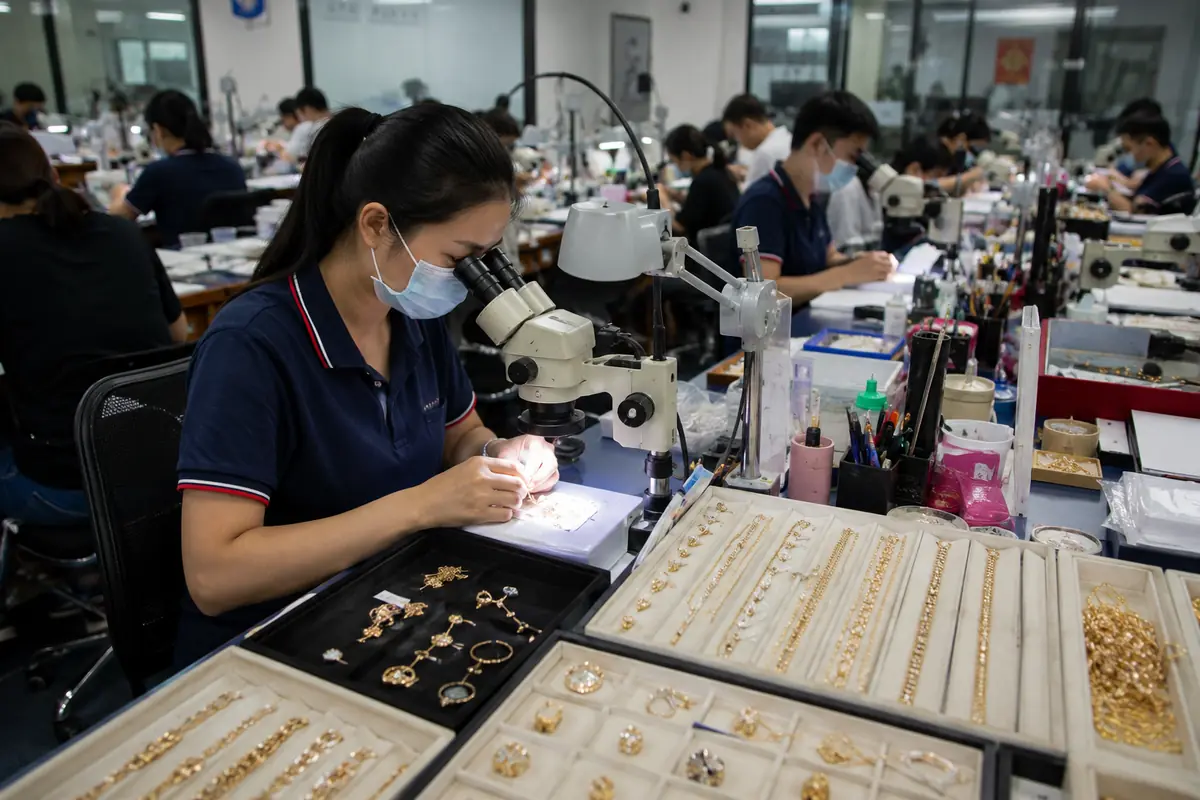
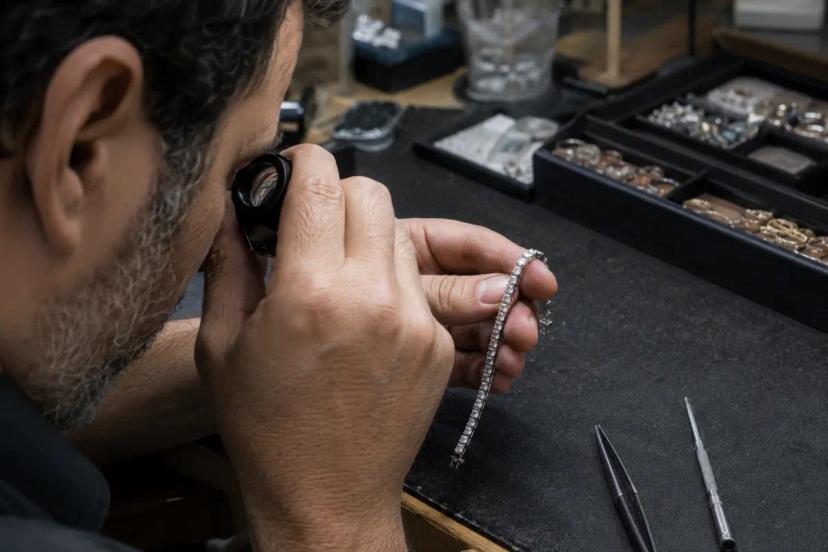
During setting, Jewins uses visual checks, magnified inspection where needed, and gentle probe or tweezer checks. Setter self-checks are supported by team-lead and QC review. Loose, missing, tilted, or uneven stones are reworked.
Post-Polishing and Post-Finishing Reinspection
Jewins rechecks stone-setting condition after polishing and surface finishing, and again during finished-product and pre-shipment inspection. The exact inspection scope depends on the design, stone-setting risk, and order requirements.
Jewelers of America also includes confirming that stones are tight and secure in prong, channel, and other settings as part of a finished jewelry quality check. Its jewelry repair and care guidance is not a bulk sampling standard, but it supports the principle that final security must be checked in the finished piece.
Repeat-Order and Complaint Review
For repeat orders, Jewins may compare retained samples, CAD or drawings, stone specifications, historical products, production records, and customer feedback. Complaint review may include photos, loss location, time in use, known impact, order or batch, and whether similar issues appear elsewhere in the batch before a likely cause is assigned.
Anonymous Production Case
In one fully set pendant order, several stone positions showed inconsistent fit. The internal review found that stones from different size groups had been mixed during production. The affected pieces were reworked, and later production used stricter stone sorting and size matching before setting.
The case did not establish an industry-wide defect rate. It showed why sorting and fit checks are more useful before setting than after the piece has already moved through polishing and finishing.
Frequently Asked Questions
Is it normal for stones to fall out of jewelry?
Stone loss is not an expected outcome, but it does not by itself prove a manufacturing defect. Wear, impact, design sensitivity, setting execution, and finishing can all contribute. A useful review looks at the setting condition, use history, approved sample, and whether the same issue appears elsewhere in the batch.
Why do small pavé stones fall out more easily?
The stone material is not necessarily the problem. Small stones and small retaining features require tighter consistency in sorting, seat preparation, alignment, usable metal, and inspection. With many stones set close together, small process differences have more chances to repeat across one piece.
Does moissanite fall out more easily than diamond?
Retention depends mainly on the design, actual stone dimensions, seat fit, setting structure, workmanship, finishing, and use—not only whether the stone is moissanite or diamond. A well-matched moissanite setting can be more secure than a poorly matched diamond setting.
Can polishing make stones loose?
It can increase risk if too much metal is removed or a retaining feature is deformed. That does not mean every polishing process loosens stones. The practical control is to inspect the setting after polishing rather than assume the pre-polishing condition remains unchanged.
Can ultrasonic cleaning cause a stone to fall out?
Ultrasonic cleaning may reveal an already weak or incompatible setting, but it should not automatically be treated as the original cause. The stone may have been loose beforehand, or the design, stone treatment, or adhesive system may not have been compatible with the cleaning method.
What should a brand check before approving bulk production?
Confirm stone specifications and sorting, actual stone-to-seat fit, setting-specific acceptance criteria, an approved and retained reference sample, first-piece or in-process checks where needed, post-finishing reinspection, and clear final-inspection records tied to the production batch.
Preparing a Stone-Set Collection?
Share your design, stone specifications, target quantity, and approved-sample requirements with Jewins before bulk production. The team can review stone sorting, setting-specific QC, and post-finishing reinspection for your SKUs.
Contact Us