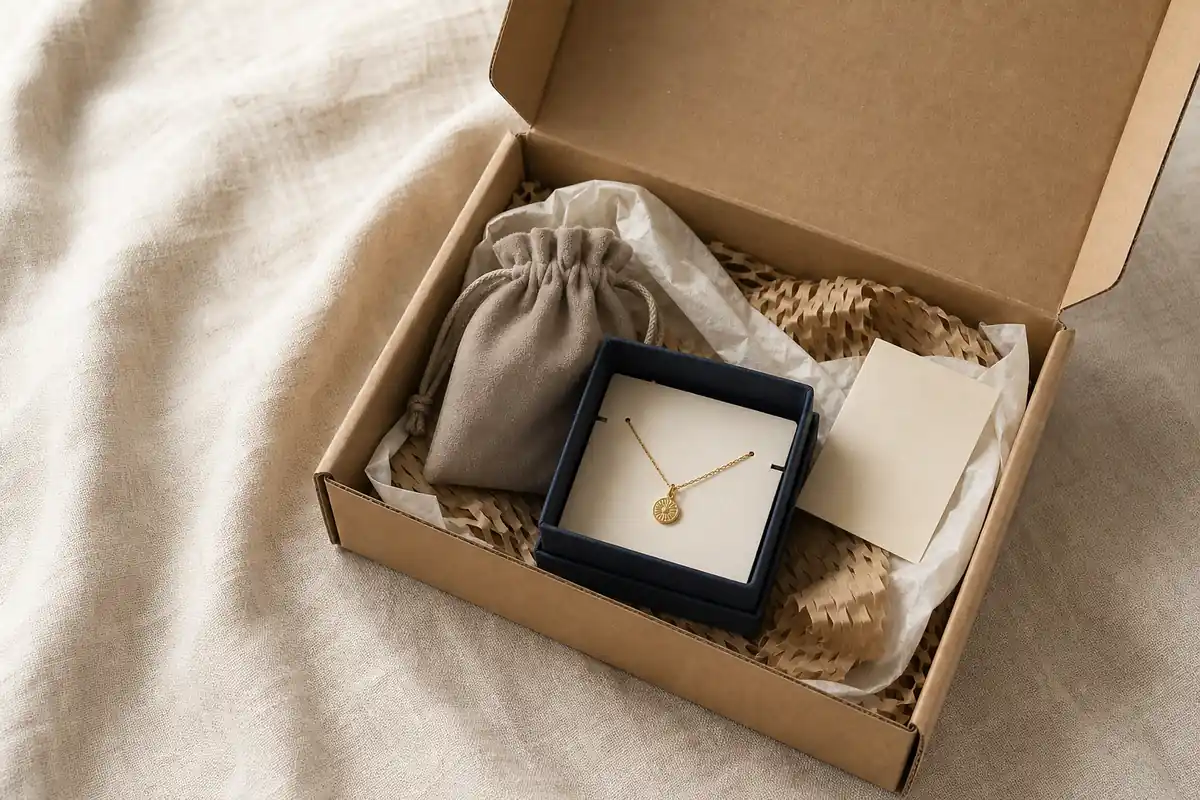

Good jewelry packaging for small business needs to do three jobs at once: protect the product, survive fulfillment, and present the brand consistently across every order. A gift box alone is not a complete DTC shipping system — it holds and presents the piece, but it rarely accounts for movement in transit, carrier handling, or repeat packing at scale. Before choosing logo finishes or decorative details, a small or growing jewelry brand should first decide how each product will be held in place and how it will move through shipping. Getting fixation and protection right first makes the branding decisions that follow much easier to lock in.
Key Takeaways: Jewelry Packaging for Small Businesses
Choose how the jewelry will be held before deciding the outer box style, finish, or decorative details.
Use a limited set of core box sizes and interchangeable inserts where product dimensions and protection needs allow.
Define dimensions, materials, inserts, branding, shipping protection, and acceptance standards before requesting a quote.
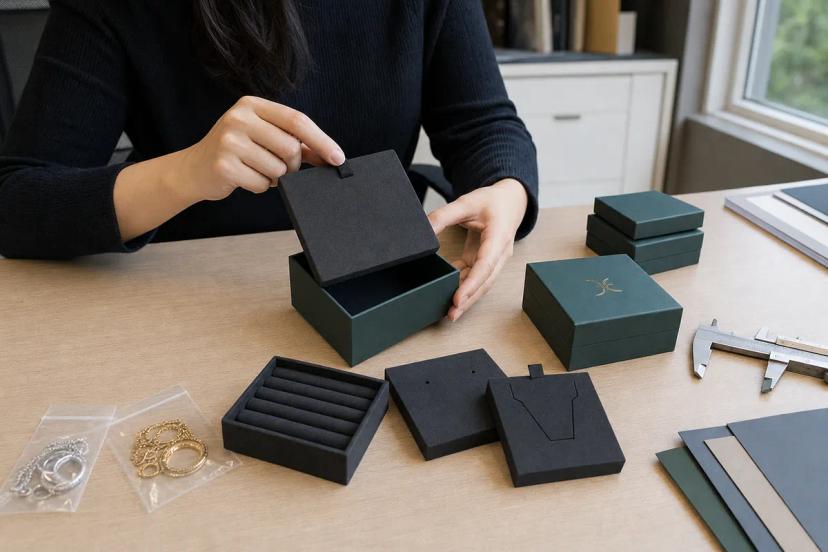
What Should Jewelry Packaging Do for a Small Business?
Packaging for a small jewelry brand is easiest to plan as three connected layers rather than one box choice. Each layer answers a different question, and skipping one can lead to a support ticket, a damaged return, or a packaging redesign down the line.
| Packaging layer | Main job | Typical failure when ignored |
|---|---|---|
| Product presentation | Communicates the brand and the unboxing experience | Packaging looks generic or inconsistent across SKUs |
| Product fixation | Helps hold the jewelry in place and limit movement, tangling and surface contact inside the package | Chains tangle, stones rub against surfaces, earrings separate from their pair |
| Shipping protection | Keeps the presentation packaging and product intact through carrier handling | Boxes crush, lids pop open, product shifts inside an oversized mailer |
None of these layers replaces the other two. A beautifully finished box can still allow a necklace to tangle if there's no fixation point inside it, and a well-fixed piece can still arrive damaged if the outer shipping layer wasn't matched to the box.
Choose the Product-Fixation Layer First
Before selecting a box style or finish, decide how each jewelry type will be held in place. The inner structure — not the outer box — is what helps limit movement, tangling and surface contact during handling. Well-chosen jewelry box inserts are one of the key factors in limiting movement inside the presentation package.
| Jewelry type | Main movement or damage risk | Fixation or insert requirement | What the buyer should confirm |
|---|---|---|---|
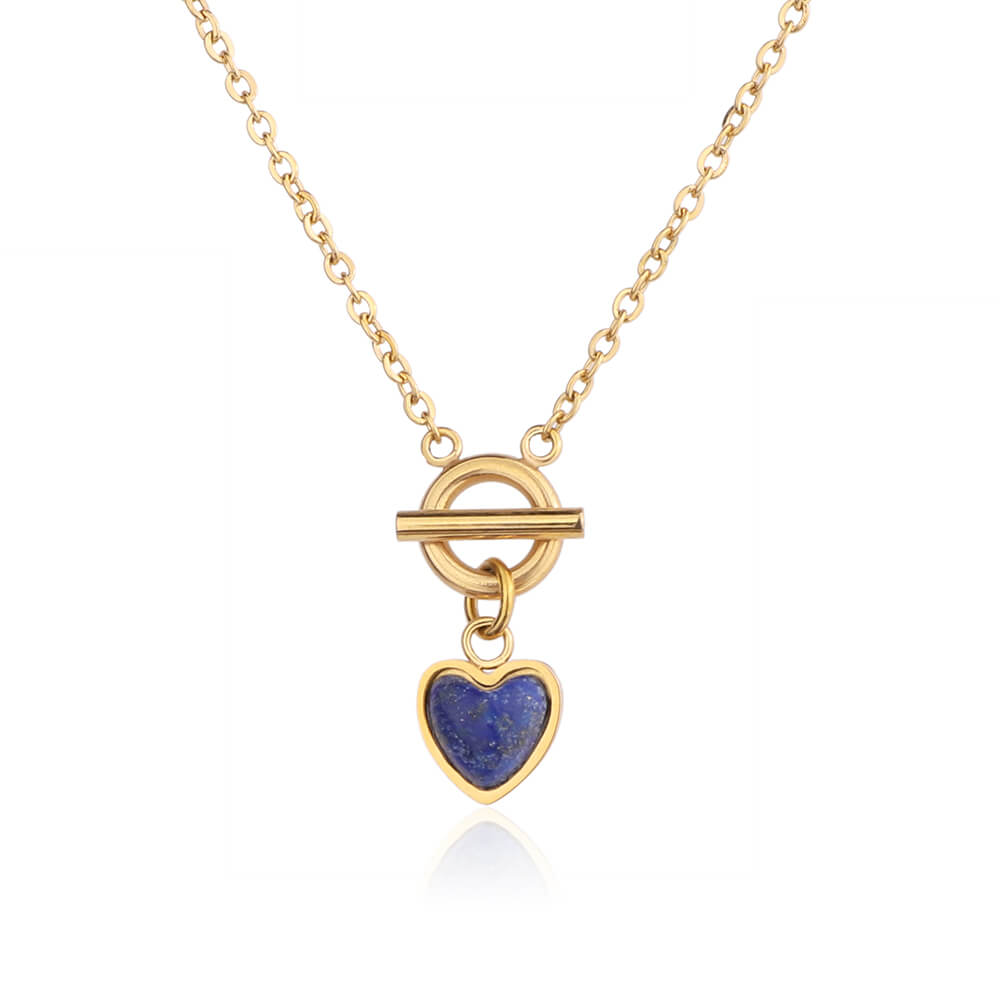
| Necklaces and pendants | Chain tangling, clasp movement | Chain tabs, slots or a card the chain wraps around | Chain length range the insert needs to accommodate |
| Earrings | Pairs separating, post or hook damage | Earring holes, pads or slotted cards that hold both pieces together | Post length and back type used across the earring range |
| Rings | Shifting inside the box, band scratching | Ring slots sized to the band | Ring size range and band width across the collection |
| Bracelets and bangles | Movement inside a box sized for smaller items | Longer inserts or a dedicated bracelet cavity | Whether one insert can serve multiple bracelet lengths |
| Stone-set jewelry | Raised stones or settings contacting the insert or box during movement | Adequate clearance and a padded structure that limits contact with protruding settings | Whether stones sit proud enough to need extra clearance |
| PVD-finished jewelry | Surface marking from friction | Soft, non-abrasive inner lining | Which lining materials the supplier confirms are suitable for the specific finish |
No insert structure can promise to completely eliminate tangling, scratching or damage — the goal is to reduce the risk that movement causes it, not to guarantee an outcome. Once fixation requirements are clear for each product type, the box or pouch style can be chosen to fit around them.
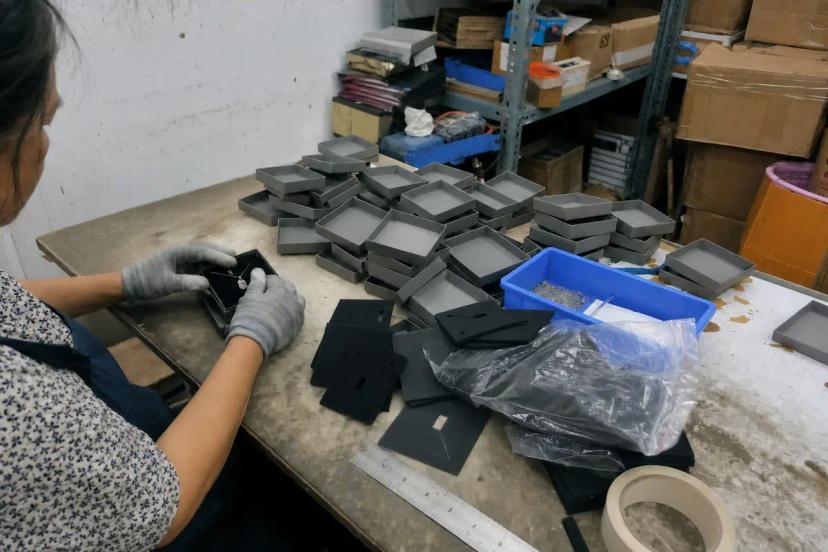
Build a Small Core Packaging System
A common early-stage mistake is designing a different box for every SKU. That approach is hard to reorder, hard to forecast, and often leaves a brand holding packaging stock for a product that's been discontinued. In practice, good jewelry packaging ideas for small business owners usually start from fixation and shipping needs, not from color and decoration — a small brand may be able to cover much of its range with a limited set of core box sizes and interchangeable inserts.
The approach generally involves:
- starting with one or two core box sizes that cover the majority of the product range;
- using different inserts inside the same box shell for different product types;
- grouping products by similar dimensions and protection needs rather than by collection name;
- separating permanent packaging elements (box, structure) from seasonal or campaign elements (sleeves, tags, ribbon) that can change without a full box redesign;
- avoiding packaging dead stock by checking projected product volume against packaging order quantities before committing;
- planning ahead for packaging needs when the product assortment is expected to expand.
The same outer box can often serve several product groups just by changing the insert, card or fixation point inside it, rather than commissioning a new box for each one. When a new product is being developed, it's worth checking whether it can fit into the existing packaging system before deciding a new box size is needed.
| Product group | Core box size | Insert variation | Branding variation | Reorder advantage |
|---|---|---|---|---|
| Small items (studs, thin rings, pendants) | Compact core box | Ring slot or small chain tab insert | Interchangeable card or sleeve | One box SKU covers several product types |
| Mid-size items (standard necklaces, hoop earrings) | Mid-size core box | Chain tab or earring pad insert | Interchangeable card or sleeve | Shared box reduces packaging SKU count |
| Larger or bulkier items (bangles, statement pieces) | Larger core box | Extended or padded insert | Interchangeable card or sleeve | Fewer box sizes to forecast and reorder |
Exact dimensions should come from the buyer's own product measurements and a packaging supplier's guidance — they are not something to standardize in the abstract.
Separate Product Presentation From Shipping Protection
The jewelry box or pouch a customer opens is not always the same package that survives the shipping journey. Jewelry shipping packaging is best planned as its own layer, separate from the presentation box, rather than assumed to be the same thing. It helps to think of the full path in layers:
- Jewelry and insert — the fixation structure discussed above.
- Inner presentation box or pouch — what the customer actually sees and unboxes.
- Protective wrapping or movement control, where the shipping method or box size requires extra cushioning.
- Shipping mailer or carton — the outer package that goes through the carrier network.
- External shipping label and fulfillment requirements — including how the package needs to be sealed and labeled for the chosen carrier.
An ecommerce order shipped through a courier network generally needs more protection than a piece handed directly to a customer at a retail counter or given as an in-person gift, simply because it passes through more handling steps. This applies whether an order ships through a Shopify store, TikTok Shop, Instagram checkout or Amazon fulfillment — the exact packing requirements can differ by platform and carrier, so it's worth checking current platform and carrier guidance directly rather than assuming one set of rules applies everywhere. For general carrier-side packing principles, review the UPS Packaging Guidelines.
Before shipping, check:
- Product movement inside the presentation box or pouch
- Chain or clasp position relative to the insert
- Insert fit — snug enough to prevent shifting, not so tight it damages the piece
- Box or pouch closure — securely shut before it goes into the outer package
- Outer-package space — enough cushioning around the inner box so it isn't loose inside the mailer or carton
Add Branding After Product Fit Is Confirmed
Once fixation and shipping protection are settled, branding decisions are easier to make without compromising either one. Elements to plan for typically include:
- Logo position — chosen so it doesn't interfere with the insert or closure;
- Finish — print, foil, deboss or similar methods are common examples, and the right one depends on the box material and budget;
- Care card — instructions for keeping the finish or stones in good condition;
- Thank-you card — a personal touch that doesn't need to affect the fixation layer;
- Social or reorder information — how a customer can find the brand again or reorder;
- Barcode or SKU identification — useful for fulfillment accuracy as the catalog grows;
- Seasonal branding — kept separate from the core box design so campaigns don't require a full packaging redesign.
Branded jewelry packaging should reinforce the brand without interfering with product fit, shipping protection, or the ability to reorder the same packaging consistently. If a branding element changes how the insert fits or how the box closes, it needs to be tested again before it goes into production. This is also where a list of jewelry packaging ideas becomes a system: the same visual direction can carry across the brand only once it's been checked against fixation and shipping first, rather than treated as a standalone inspiration exercise.
Create a Packaging Specification Before Requesting a Quote
This is the most useful reference in this guide. A clear specification makes it possible to get accurate quotes, compare suppliers on the same basis, and avoid back-and-forth revisions during sampling.
| Specification field | What to define | Why it matters |
|---|---|---|
| Packaging type | Box, pouch, or combination | Sets the baseline structure and cost category |
| Dimensions | Internal and external measurements | Determines fit for the product and the insert |
| Material | Paperboard, fabric, or other substrate | Affects durability, finish options and cost |
| Color or Pantone reference | Target color and approval reference | Supports clearer color approval and repeat-order comparison |
| Logo position | Placement on box, pouch or card | Affects finishing method and layout |
| Printing or finishing method | Print, foil, deboss or other examples | Determines cost, lead time and durability of the branding |
| Insert structure | Fixation method for the specific jewelry type | Has a direct role in product protection |
| Product fixation points | Where and how the product is held | Clarifies how the insert is intended to limit movement |
| Care card | Included or not, and content | Sets customer expectations for product care |
| Thank-you card | Included or not, and content | Part of the unboxing experience |
| Barcode or SKU | Format and placement | Supports fulfillment accuracy |
| Inner packaging | What sits directly around the product | Bridges fixation and presentation |
| Outer shipping protection | Mailer, carton or additional cushioning | Confirms the shipping layer is planned, not assumed |
| Packing quantity | Units per shipment or carton | Affects logistics and storage planning |
| Acceptance standard | What counts as a passable sample or batch | Gives both sides a shared reference point |
Working through this table before requesting quotes creates a more complete brief and gives suppliers a clearer basis for quoting and sampling. For a small or growing jewelry brand, this specification can also serve as a starting point when discussing custom jewelry packaging options with a manufacturing partner. Not every supplier will be able to provide every item on this list, so it's worth confirming which fields a given partner can support before finalizing a brief.
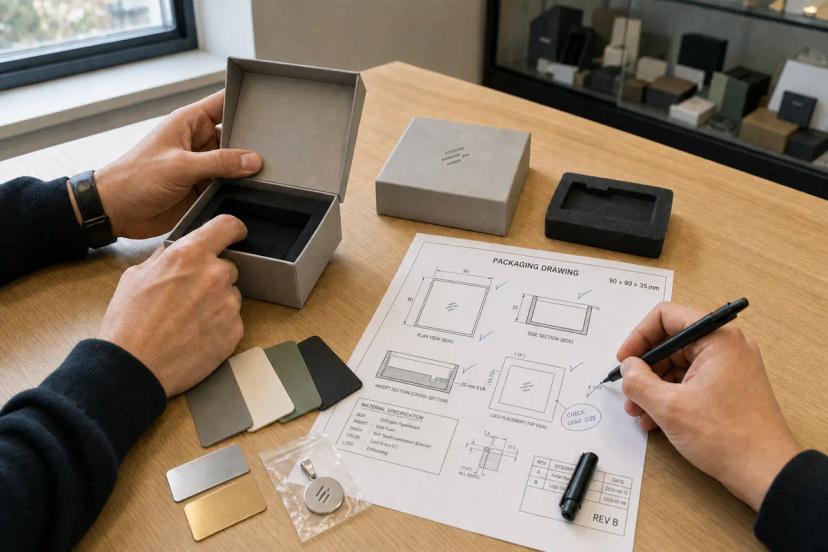
Approve Packaging Samples Before Repeat Orders
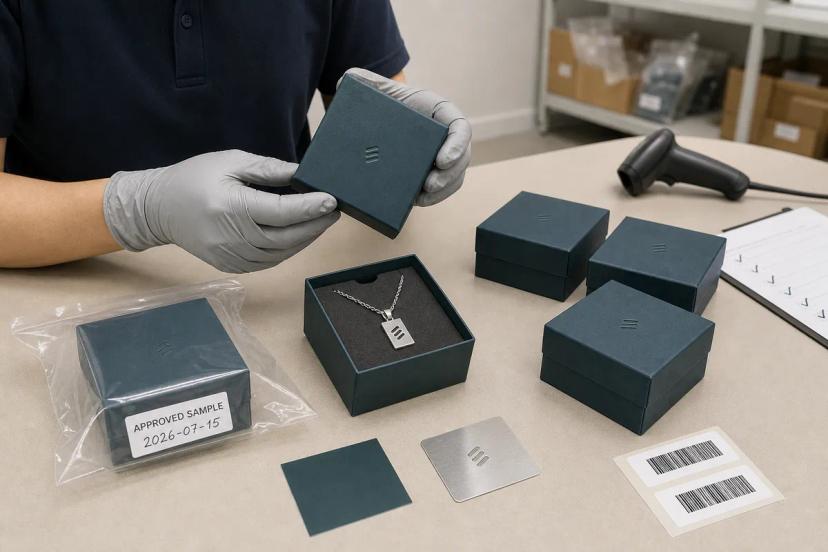
Before approving packaging for ongoing use, it helps to check it against a consistent list rather than relying on a visual impression alone.
Sample approval checklist:
- Internal dimensions match the product and insert
- Insert fit holds the product without excess movement
- Jewelry doesn't shift when the box is tilted or gently shaken
- Necklace or chain sits correctly on its tab or slot
- Color is consistent with the approved reference
- Logo size and placement match the spec
- Print or foil is clear and free of smudging or misregistration
- Box or pouch opens and closes as intended
- Packaging holds up after a basic internal packing-and-handling check
- Barcode or SKU is scannable and legible
- Packing method matches what was agreed for fulfillment
- Master carton or outer packaging arrangement is confirmed, where relevant
This kind of check is a basic internal packing-and-handling check, not a carrier certification, standardized transit test, or guarantee against shipping damage.
Once a sample is approved, it's worth keeping a physical reference sample on hand, documenting any changes made between rounds, and coordinating packaging inventory with product replenishment so the two don't fall out of sync. When a branding refresh or a new box version is planned, mapping out the transition — including how to handle existing packaging stock — avoids a gap between old and new packaging mid-cycle. As order frequency increases, brands may need a broader jewelry solution for growing brands that coordinates production, packaging and replenishment.
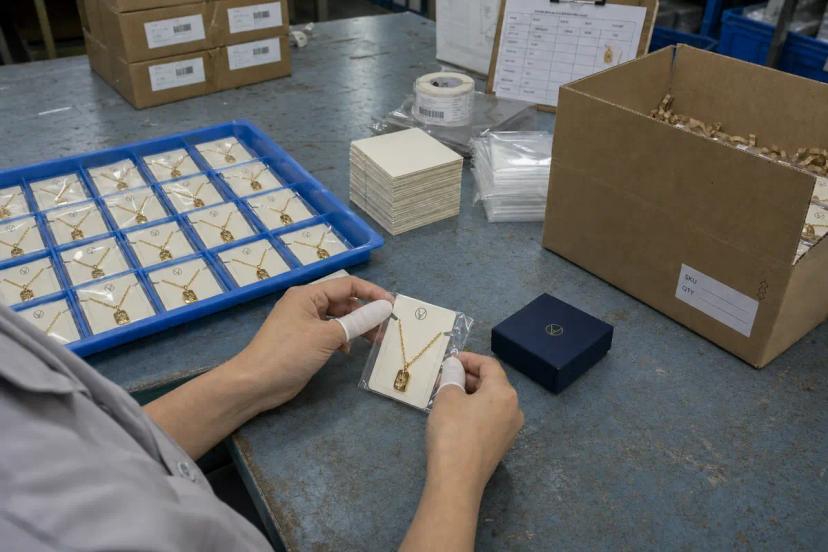
Use Sustainable Packaging Claims Carefully
Terms such as recyclable, recycled, compostable, biodegradable, FSC-certified, plastic-free and eco friendly jewelry packaging may have specific technical, certification or market requirements. Before repeating any of these claims to customers, it's worth verifying:
- The actual material composition of each packaging component;
- The scope of any certification (which parts of the packaging it covers, and which it doesn't);
- Inks, coatings and adhesives, which can affect whether a claim still applies to the finished piece;
- Whether the claim applies to the complete packaging unit or only to one component of it;
- Requirements in the specific markets the product ships to, since environmental-claim rules can vary by region.
A sustainable jewelry packaging claim that's accurate for the outer box may not be accurate for the insert, the printing, or the adhesive holding it together. Checking with the packaging supplier before making the claim publicly is the safer approach. For U.S. environmental marketing claims, review the FTC Green Guides.
How Jewins Can Support Jewelry and Packaging Coordination
Jewins' packaging page presents available packaging options. For a specific product line, brands should confirm the applicable packaging scope, product dimensions, branding requirements, sample arrangements and repeat-order needs directly with Jewins, since these depend on the product and packaging format involved.
Frequently Asked Questions
What packaging is best for a small jewelry business?
There isn't one packaging format that works best for every product. The right choice depends on the jewelry type, how it needs to be fixed in place, and how it will be shipped. A useful starting point is to confirm the fixation requirement for each product type first, then choose a box or pouch style that can hold that insert. From there, match the outer shipping layer to the order volume and carrier being used.
Are jewelry pouches or boxes better?
Neither format is universally better — it depends on the product, the pouch material, how the product is fixed inside it, and whether a rigid outer shipping layer is used around it. A well-fixed pouch inside a protective outer mailer can work for many products, but pouches generally offer less built-in structure than a box, which is why they need more attention to fixation and outer protection. Boxes tend to offer more consistent fixation options, like slots and tabs, without relying as heavily on the outer layer. Some brands use both, depending on the product line.
How should jewelry be packaged for shipping?
Start by confirming the product is properly fixed inside its insert so it can't shift, then check that the presentation box or pouch closes securely. From there, add cushioning or a shipping mailer sized so the inner box doesn't move around loosely. Requirements can vary by carrier and by platform, so it's worth checking current shipping guidance for the specific channel being used.
How can a brand reduce the number of packaging SKUs?
Group products by similar dimensions and fixation needs rather than by collection, then design one or two core box sizes that can hold different inserts for different product types. Keep seasonal or campaign elements — like sleeves or tags — separate from the core box structure so they can change without triggering a full packaging redesign.
Should packaging be sampled before bulk or repeat orders?
Yes. Sampling gives a chance to check dimensions, insert fit, color consistency, logo placement and closure before committing to a production run. It's also useful to run a basic internal packing-and-handling check on the sample, since some issues only appear once the packaging has been through handling. This is not a carrier certification, standardized transit test, or guarantee against shipping damage.
What should be included in a jewelry packaging specification?
A useful specification covers packaging type, dimensions, material, color reference, logo position, printing or finishing method, insert structure, product fixation points, care card, thank-you card, barcode or SKU, inner packaging, outer shipping protection, packing quantity, and an agreed acceptance standard. Having these defined up front makes it easier to get accurate quotes and compare packaging suppliers on the same basis.
Related Reading
Custom Jewelry Manufacturing Guide for Growing Brands OEM vs ODM Jewelry Manufacturing: Which Model Fits Your Brand? How Growing Jewelry Brands Can Build a More Reliable Supply ChainDiscuss Your Jewelry Packaging Requirements
Tell Jewins about your jewelry type, packaging format, branding requirements and expected order plan. The applicable packaging scope and sample arrangements can then be confirmed for your project.
Contact Us →