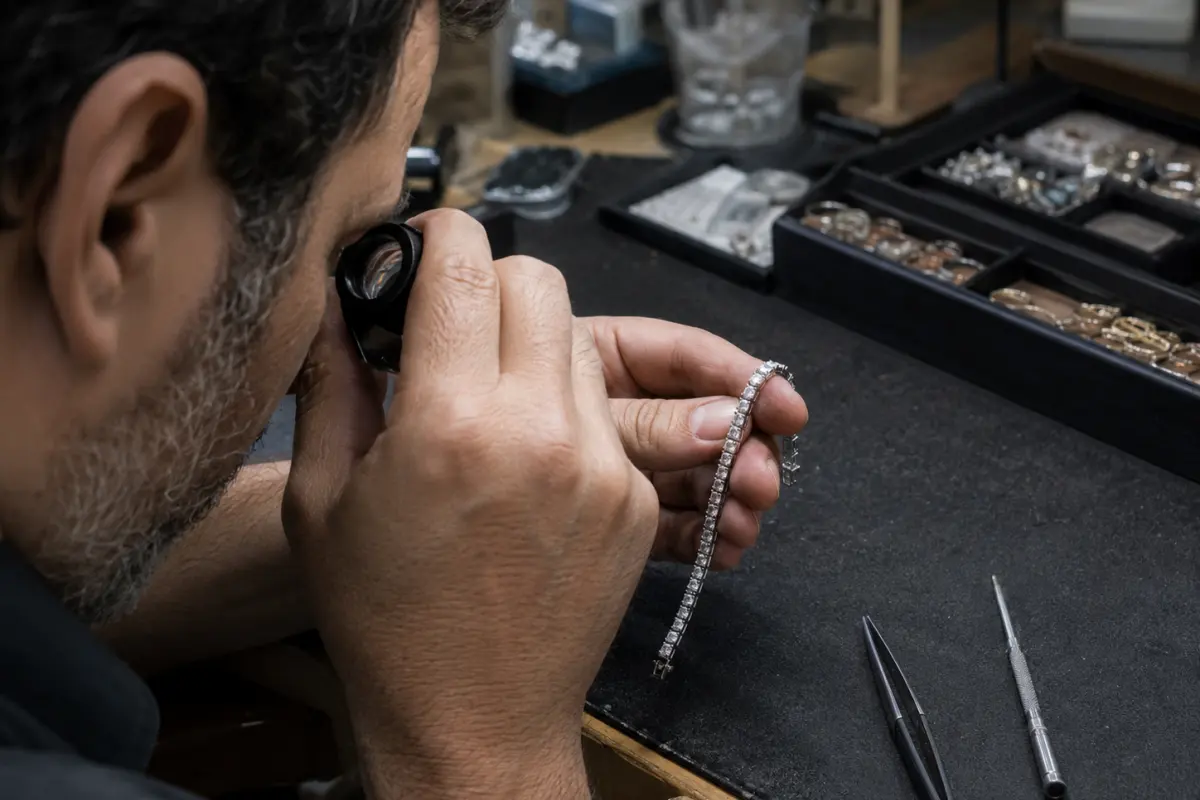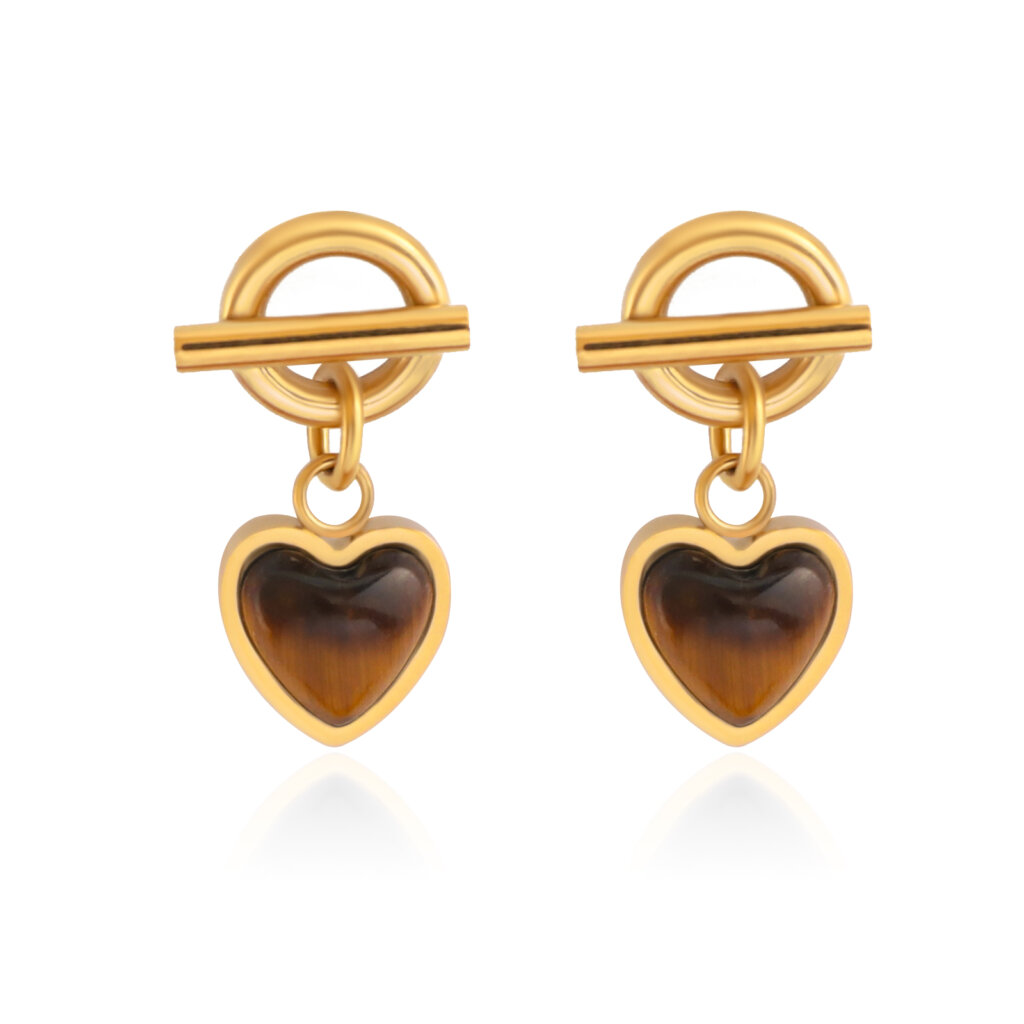

Moissanite is generally the stronger starting option for frequent-wear and premium-positioned jewelry because it offers higher scratch resistance and stronger spectral fire. Cubic zirconia is generally lower-cost and can fit entry-price, trend-led, or cost-sensitive lines. Neither stone is diamond or laboratory-grown diamond, and the right choice depends on product positioning, expected wear, stone specification, and bulk-production consistency.
Key Takeaways
Moissanite is generally more scratch-resistant and is a stronger starting option when long-term or frequent wear is a priority.
CZ is generally lower-cost and can support entry-price, trend-led, and high-stone-count designs when the product description sets the right expectations.
Confirm stone identity, cut, size, setting security, and repeat-order specifications with a physical sample before bulk production.
Moissanite and cubic zirconia (CZ) are both popular diamond simulants, but they are not the same material and they do not perform the same way in daily wear. Moissanite is a silicon carbide gemstone with higher hardness and stronger fire, while CZ is a stabilized zirconium oxide that is generally more affordable and heavier for its size. Neither stone is diamond or laboratory-grown diamond, and neither is automatically “better” — the right choice depends on how a piece will be worn, priced, and positioned. This guide compares the two materials on sparkle, durability, and value, then breaks down how jewelry brands can match each stone to the right product line.
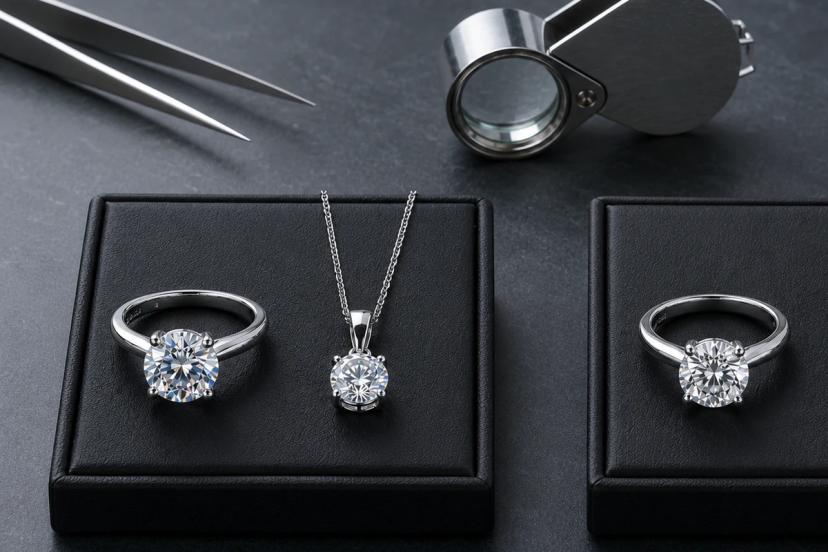
Moissanite vs Cubic Zirconia: Quick Comparison
| Factor | Moissanite | Cubic Zirconia (CZ) |
|---|---|---|
| Composition | Silicon carbide (SiC) | Stabilized zirconium oxide (ZrO₂) |
| Mohs hardness | Approximately 9–9.25 | Approximately 8–8.5 |
| Refractive index | Approximately 2.648 and 2.691 (double refraction) | Approximately 2.15–2.18 (single refraction) |
| Fire / dispersion | Generally stronger spectral fire | Generally lower fire than moissanite |
| Relative weight | Lighter at comparable size and cut | Generally heavier at comparable size and cut |
| Typical price position | Generally higher-priced than CZ | Generally lower-cost |
| Best suited for | Frequent-wear and premium-positioned SKUs | Entry-price and trend-led fashion lines |
| Main buyer risk | Higher stone cost may not suit price-sensitive lines | Surface wear, quality variation, and mismatched durability expectations |
| Diamond status | Not diamond or lab-grown diamond | Not diamond or lab-grown diamond |
What Are Moissanite and Cubic Zirconia?
Moissanite is a crystalline form of silicon carbide. It was first identified in nature and is now produced synthetically for use in jewelry as a diamond simulant. Cubic zirconia is a synthetic material made from zirconium oxide that has been stabilized with compounds such as yttria or lime, since pure zirconium oxide is not naturally stable in the cubic crystal form used for gems.
Both materials are classified as diamond simulants — stones that visually resemble diamond without sharing its composition or crystal structure, a distinction described in GIA's overview of simulant and imitation gem materials. This matters for brand messaging: moissanite is sometimes confused with lab-grown diamond because both are lab-produced, but the two are chemically different materials, and neither moissanite nor CZ should be described or marketed as diamond or laboratory-grown diamond.
Which Has Better Sparkle and Appearance?
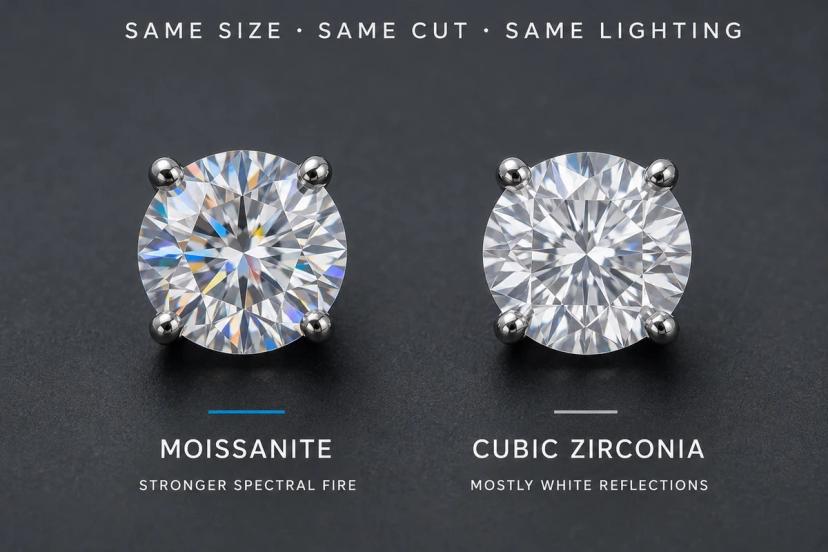
Sparkle in a gemstone comes from a mix of brilliance (the return of white light) and fire (the flashes of spectral color). Moissanite has a higher refractive index than CZ and is double-refractive, meaning light splits into two rays as it passes through the stone. This structure, combined with its dispersion value, generally gives moissanite stronger, more colorful fire than CZ.
CZ is single-refractive and has a lower refractive index and dispersion range than moissanite. A well-cut CZ can still appear bright, but it generally displays less spectral fire. Its final appearance varies with cut, polish, stone quality, size, and lighting.
Appearance in either stone can also vary by quality, cut, wear, and maintenance, so two stones of the same material will not always look identical. This is worth noting in product descriptions rather than promising a single fixed look across every SKU.
Which Is More Durable for Everyday Wear?
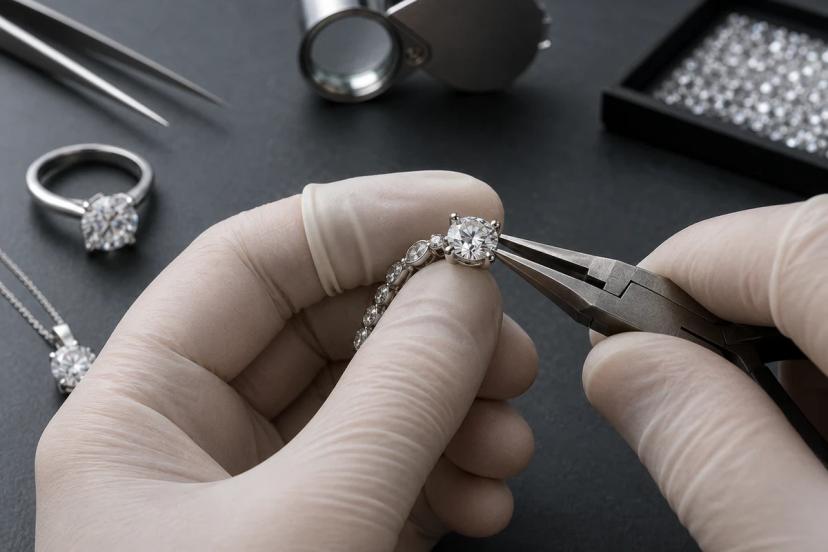
Hardness is one of the clearer differences between the two materials. Moissanite sits at approximately 9–9.25 on the Mohs scale, based on GIA's technical paper on synthetic moissanite, while CZ sits at approximately 8–8.5, per GIA's cubic zirconia update. This makes moissanite generally more scratch-resistant than CZ, though it does not mean moissanite is scratch-proof or that it will never show wear over time — durability also depends on the setting, how the piece is worn, and how it is cared for.
CZ, at 8–8.5, is still a reasonably hard stone and can hold up to normal wear when properly set. CZ does not automatically become cloudy with age. A hazy appearance can result from surface buildup, scratches, coating wear where a coating is used, or other wear-related changes. Yellowing is a separate color change rather than the same phenomenon as clouding. Appearance in either material varies by quality, cut, wear, and maintenance, and brands should avoid absolute claims in either direction.
Moissanite is suitable for long-term wear when properly set and cared for, which is why daily-wear pieces — rings, bracelets, and other items exposed to frequent contact — are generally a stronger fit for it. For occasional-wear pieces, fashion collections, or lower price points, CZ can be suitable when the stone is set securely and the piece is marketed for its intended use case.
How Do Price and Value Compare?
CZ is generally the more affordable of the two materials, which makes it a common choice for entry-level and fashion jewelry where price sensitivity is high. Moissanite typically sits at a higher price position, reflecting its greater hardness and stronger fire.
Weight is a related factor. CZ has a higher specific gravity than moissanite and will generally weigh more than moissanite at comparable dimensions and cutting proportions, which affects how a finished piece feels in hand.
For jewelry brands, price and positioning are really about matching the stone to the product’s role in a collection — a decision explored in more detail in the next section, and one that often comes down to whether a piece is meant to move volume at a lower price or anchor a premium position within the line.
Which Should Jewelry Brands Choose?
There is no single correct answer — the better fit depends on the product’s role in a brand’s lineup. The table below outlines common scenarios.
| Brand Scenario | Better-Suited Stone | Why |
|---|---|---|
| Everyday-wear rings, bracelets, and stackables | Moissanite | Higher hardness supports frequent contact and daily wear |
| Affordable, trend-driven fashion collections | Cubic Zirconia | Lower cost supports high-volume, price-sensitive lines |
| Hero or flagship SKUs meant to anchor a collection | Moissanite | Stronger fire and a higher price position suit premium positioning |
| Pavé or high-stone-count designs | Depends on cost target and positioning | Per-stone cost and desired price point should drive the choice, not stone type alone |
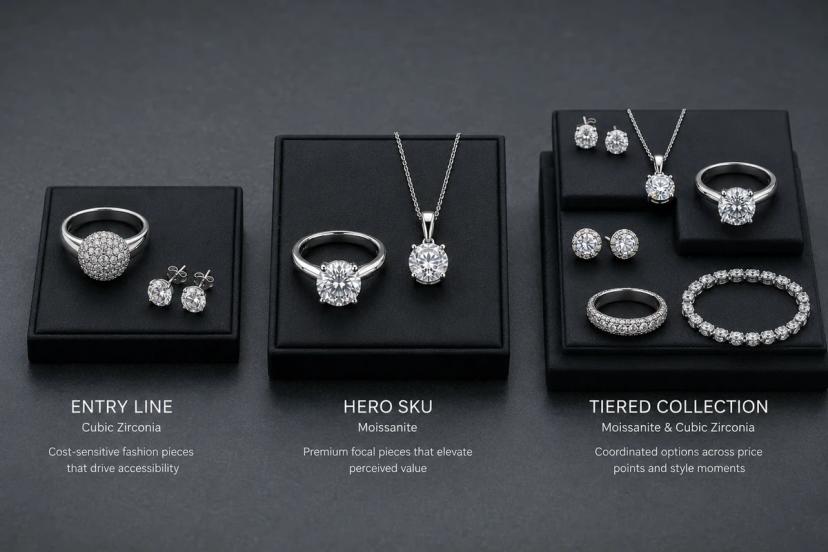
| Mixed-price product lines across tiers | Both, used deliberately by tier | Lets a brand offer an entry price point and a premium upgrade path |
A brand can use CZ for volume-driven, lower-price items and reserve moissanite for pieces positioned as a step up in quality and price. When stone choice is matched clearly to price point and product description, it can help reduce expectation mismatch, since customers are less likely to assume every stone in the catalog performs identically.
Bulk-Order Sample and QC Checklist
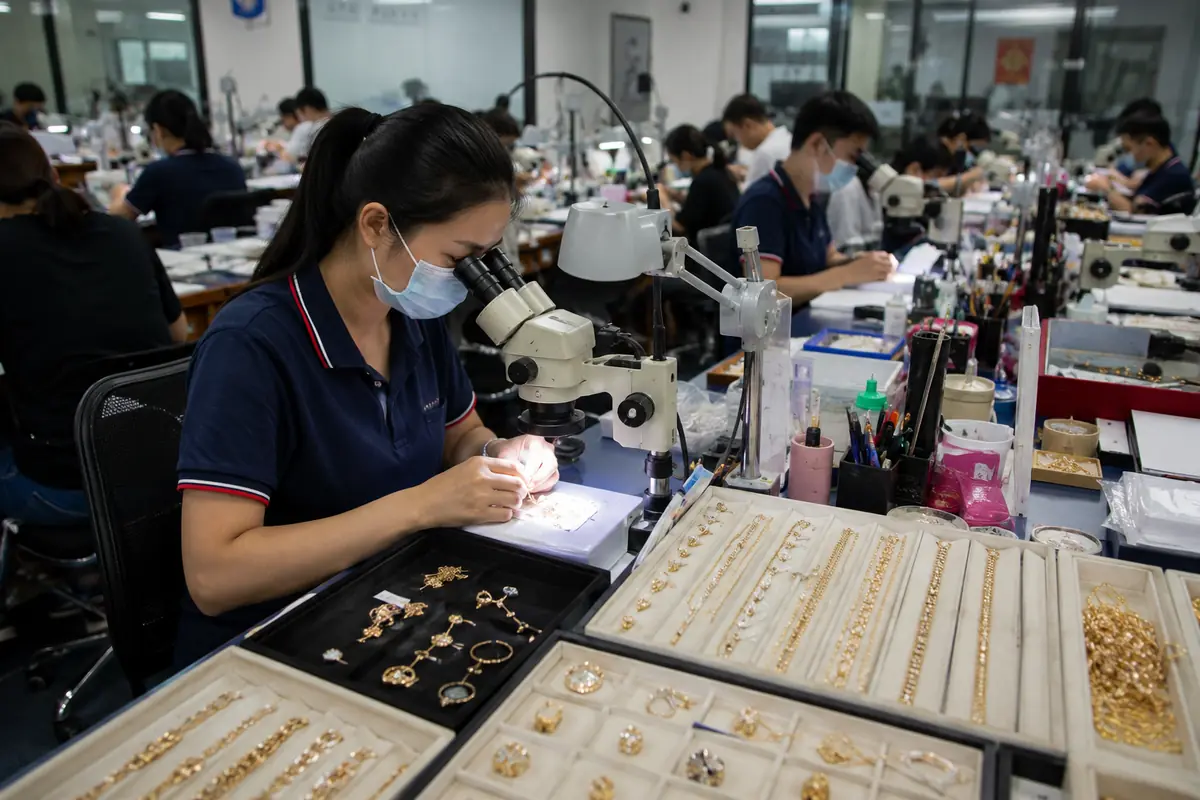
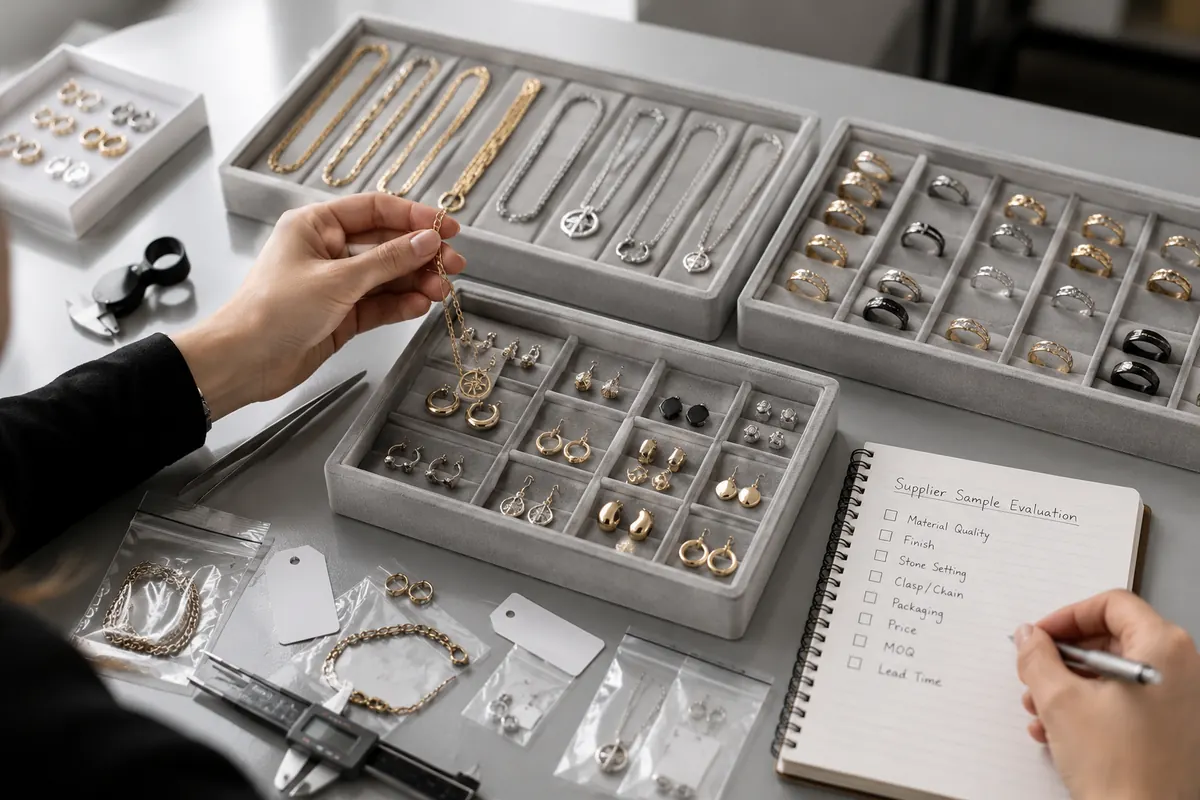
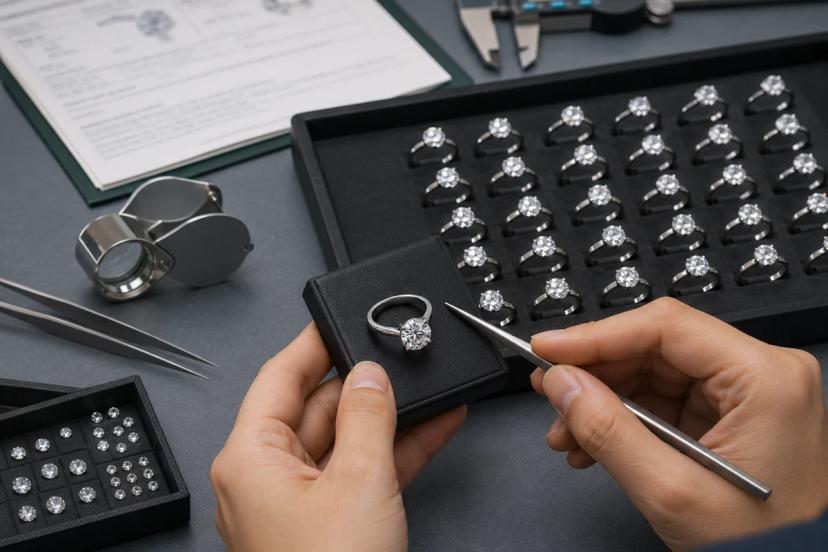
Material choice on paper is only half the decision — consistency in production is what actually protects a brand’s margins and customer experience. Before placing a bulk order for moissanite or CZ jewelry, buyers should check:
- Stone identity confirmation. Confirm in writing whether the stone is moissanite, CZ, or another material — visual similarity alone is not a reliable way to identify a gemstone from images or listings.
- Physical sample approval. Request a pre-production sample to confirm stone color, cut quality, and how the piece looks and feels in hand before committing to a full run.
- Stone size and cut consistency. Ask how the manufacturer controls size and cut variance across a production batch, especially for multi-stone or pavé designs.
- Setting security. Check prong or bezel tightness and setting method, since a well-cut stone in a loose setting still creates wear and loss risk.
- Batch-to-batch consistency. For reorders, confirm that stone sourcing and cut standards are documented so repeat orders match the original sample.
- QC inspection standards. Ask what inspection process is applied before shipment, including how many pieces per batch are checked and what defects are flagged.
Working through a custom jewelry manufacturing guide before finalizing specs can help brands catch gaps in stone sourcing, cost structure, and sampling timelines early in the process, before they become issues in a live production run.
From Stone Selection to Repeatable Production
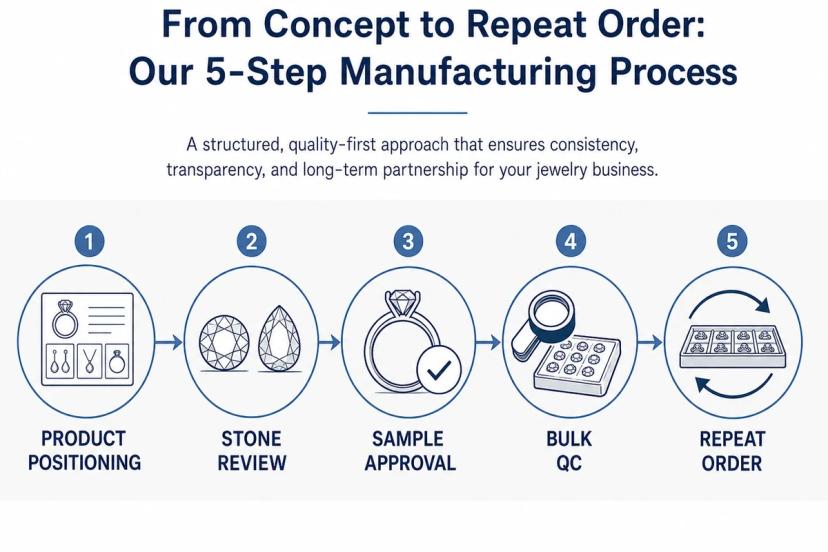
Jewins works with jewelry brands through a structured process for moving from stone choice to a finished, quality-checked order:
- Product positioning. Jewins starts by discussing where a piece sits in a brand’s lineup — entry-price, mid-tier, or hero SKU — since this shapes whether moissanite or CZ is the more suitable stone.
- Stone option review. For rings specifically, the custom stainless steel rings configuration lets brands choose between CZ, moissanite, or no stone at the specification stage, so the tradeoffs in hardness, fire, and cost are considered before production begins.
- Physical sample approval. Before bulk production, brands can request a physical sample to confirm stone appearance, cut, and setting quality firsthand rather than relying on renderings alone.
- Bulk QC. Once a sample is approved, production moves to bulk order with inspection checks applied before shipment.
- Repeat-order consistency. For reorders, stone sourcing and cut standards are referenced against the original approved sample to keep repeat batches aligned with what was first signed off.
Brands building out a moissanite-focused line can review the existing wholesale moissanite jewelry collection as a reference point for finish, setting style, and stone presentation. For brands weighing broader questions — low-MOQ sampling, OEM/ODM options, or how to structure a multi-tier collection — Jewins' jewelry manufacturing solutions page outlines how sourcing and production support scales with brand growth.
Frequently Asked Questions
How can you tell cubic zirconia from moissanite?
The most reliable way is testing or professional gemological verification rather than visual inspection alone, since both stones can look similar in photos or under casual lighting. Moissanite’s double refraction can sometimes be observed under magnification as slight doubling of facet edges, which CZ does not show, but this is not always easy to see without training. For bulk orders, the more practical step is requesting written confirmation of stone identity and a physical sample from the manufacturer.
Does cubic zirconia become cloudy over time?
Not necessarily. CZ does not automatically become cloudy with age. A hazy appearance can result from surface buildup, scratches, coating wear where a coating is used, or other wear-related changes. Yellowing is a separate color change rather than the same phenomenon as clouding. Quality, cut, wear, and maintenance all affect how a stone looks after extended wear.
Is moissanite suitable for everyday jewelry?
Moissanite’s higher hardness (approximately 9–9.25 on the Mohs scale) generally makes it suitable for long-term wear when the stone is properly set and cared for. This does not mean moissanite is scratch-proof or immune to wear — proper setting and reasonable care still matter for how the stone performs over time.
What should buyers check before ordering moissanite or CZ jewelry in bulk?
At minimum, buyers should confirm stone identity in writing, approve a physical pre-production sample, verify size and cut consistency, check setting security, and ask how the manufacturer maintains consistency across repeat batches. Skipping sample approval can create mismatched expectations in bulk orders.
Can jewelry brands use both moissanite and CZ in one collection?
Yes. One option is to use CZ for lower-priced pieces and moissanite for premium or hero items within the same collection, giving customers an entry point and an upgrade path without redesigning the line from scratch.
Ready to Choose the Right Stone for Your Collection?
Choosing between moissanite and cubic zirconia comes down to how a piece fits into your product lineup — price tier, expected wear, and the impression you want a stone to make. Tell Jewins about your product specs, stone options, sample requirements, and bulk-order QC needs.
Contact Us →