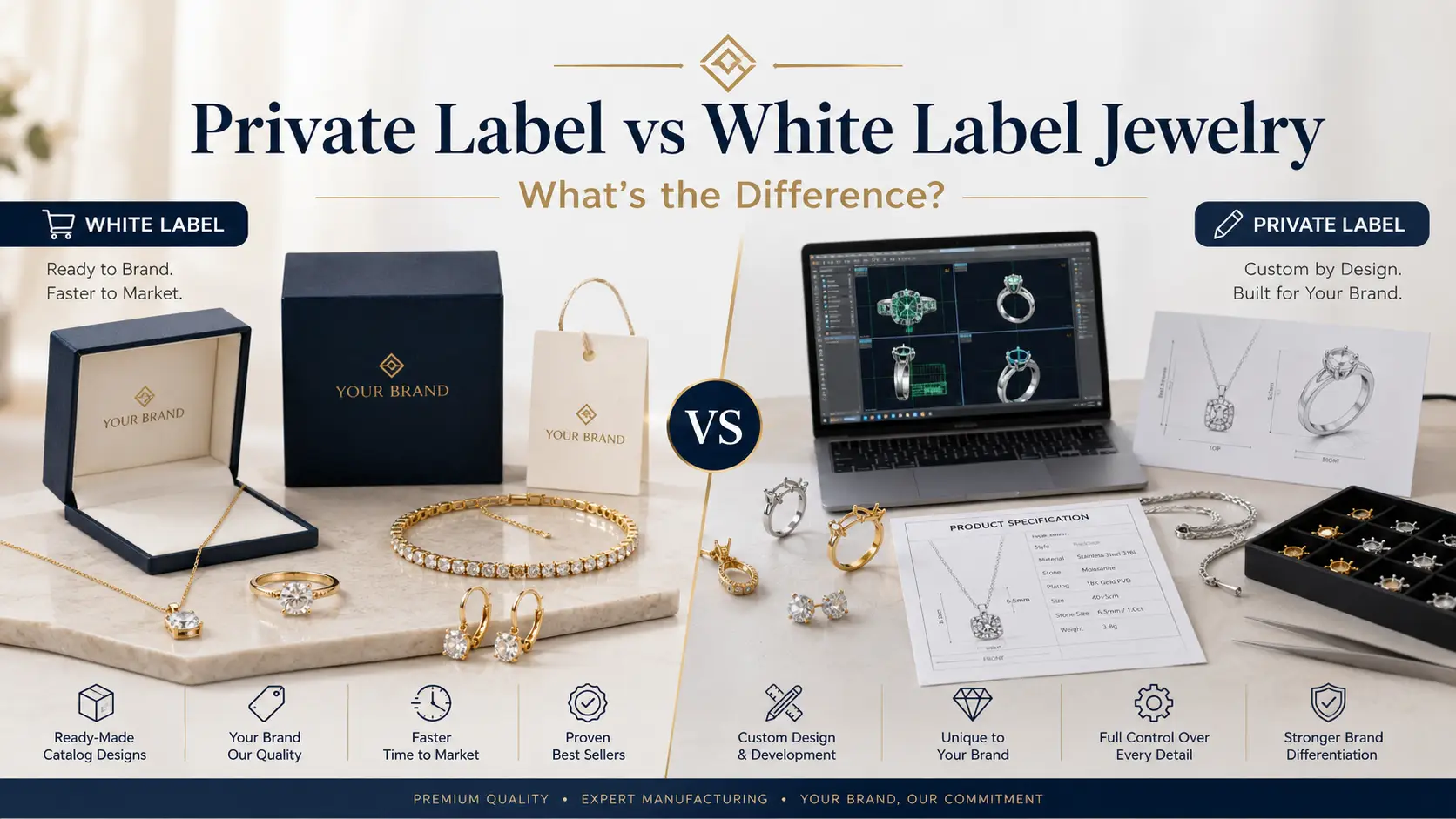

Private label and white label jewelry differ mainly in how much of the design is built or modified for your brand versus taken from a supplier’s existing catalog, and in how exclusivity, tooling, IP, and repeat-production terms are handled. The terms are not standardized across the jewelry industry, so buyers should confirm the actual working arrangement rather than rely on the label alone.
Before comparing the two models, it is worth being direct: “private label” and “white label” are not standardized across the jewelry industry. Two suppliers can use the same term to describe different arrangements. Instead of choosing a partner based on which word they use, confirm the specifics that actually determine cost, flexibility, and risk.
- Design source: Is the piece existing or developed for your brand?
- Customization scope: What can actually be changed?
- MOQ: What applies to the first order and to reorders?
- Sampling process: How are samples developed and approved?
- Exclusivity: Is the design locked to your brand, or sold to others too?
- IP / mold ownership: Who owns the CAD files and tooling?
- Repeat production terms: How will reorders be kept consistent with the approved specification?
These seven points are the real basis for comparison in this article, not the labels themselves.
What Is Private Label Jewelry?
Private label jewelry generally means a supplier’s existing design with brand-specific changes, or a design developed collaboratively, is sold under your brand name. The degree of customization, exclusivity, design input, and ownership can vary significantly from one supplier agreement to another.
In practice, “private label” covers a range of arrangements. On one end, it can mean taking an existing catalog design and applying your logo, hallmark, or packaging with no changes to the piece. On the other end, it can mean working with the supplier’s design team to develop a piece specifically for your brand, sometimes with an agreement that it will not be sold to other buyers. In between, there is partial customization — stone setting, plating, chain style, or finish layered onto a base design.
Because the term spans this whole range, “private label” alone does not tell you whether you are getting a proprietary product or a lightly modified catalog item. The exclusivity terms, customization scope, and design-file ownership are what actually define the arrangement, and those need to be confirmed in writing. For a broader look at custom development, see What Is Custom Jewelry Manufacturing?.
What Is White Label Jewelry?
White label jewelry typically refers to a supplier’s existing, ready-made design that is rebranded under your name with little to no modification to the product itself. It can be faster to bring to market and may require less upfront development than a fully custom or brand-exclusive arrangement, but this is not a fixed rule across all suppliers.
The core idea is that the product exists independently of any one buyer — the same design may already be sold, or available to be sold, to other brands too. What changes is the branding layer: logo, hallmark, hangtag, packaging, and listing content. The underlying manufacturing specification generally stays close to the supplier’s standard build.
This does not mean white label products are always unmodifiable. Some suppliers allow surface-level adjustments — plating color, chain length, or stone size within a catalog range — while keeping the base design and tooling unchanged. Others treat it strictly as “as-is, rebrand only.” Ask specifically what can be adjusted rather than assuming either extreme. Brands testing a new category may also want to review How to Start a Jewelry Brand with Low MOQ.
Private Label vs White Label Jewelry: Key Differences
The clearest way to compare the two models is side by side across the factors that actually affect cost, timeline, and long-term control — not the label a supplier attaches to them.
| Factor | Private Label | White Label |
|---|---|---|
| Design source | Existing supplier design with brand-specific changes, or a collaboratively developed design | Supplier’s existing catalog design |
| Customization | Typically broader — stone setting, materials, finish, and sometimes structure | Usually limited to branding, with some suppliers allowing minor cosmetic options |
| Exclusivity | May include exclusivity terms, depending on contract | Often shared with other buyers unless separately negotiated |
| MOQ | Varies by supplier, design complexity, and production setup; not automatically higher | Varies by supplier and product; not automatically lower |
| Sampling | May involve development, modification, and approval rounds | Usually starts from an existing product, with branding or limited modification confirmation |
| Development time | Often longer when design or tooling work is required | Often shorter when the base product already exists |
| Upfront development cost | Can include design, mold, or tooling costs depending on the agreement | Can be lower when existing tooling and specifications are reused |
| Inventory risk | Depends on whether production is made-to-order or stocked, demand certainty, and MOQ | Depends on the same factors; not inherently lower or higher |
| Branding / packaging | Can be integrated into the brand-specific product and launch plan | Usually applied as a branding layer on an existing product |
| Repeat production | Reorder consistency should be tied to approved specifications and production terms | Reorder availability and consistency should be confirmed for the catalog SKU |
| IP / mold ownership | May belong to the brand, the supplier, or be shared — this must be specified | Typically remains with the supplier unless otherwise agreed |
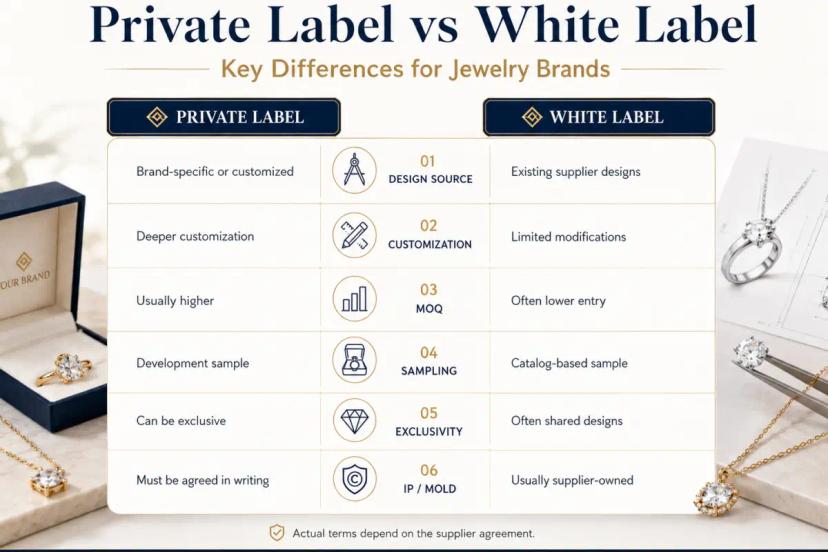
The direction of each difference is common across suppliers, but the magnitude and exceptions depend on the specific agreement. Treat this table as a framework for questions to ask, not a set of guarantees.
When Should a Brand Choose Private Label?
Private label tends to fit brands that need product differentiation, plan to build around specific design lines, or want more control over exclusivity and future development — even if it usually requires more time and coordination upfront.
This model is worth considering when a brand’s positioning depends on having something competitors do not carry — a signature setting style, a proprietary silhouette, or a design tied to a specific collection story. It can also fit brands planning multiple design generations over time with the same supplier, not just a single order. Because it usually involves more design input and sometimes exclusivity negotiation, the brand should decide whether the added development effort is justified by the expected role of that SKU.
It is less suited to a launch that must test the market with minimal upfront development, since design and sampling rounds can add time before the first sellable batch is ready.
When Is White Label the Better Option?
White label tends to fit brands that need to launch or test quickly, want to validate demand before committing to deeper product development, or want to limit upfront design and tooling work.
A brand testing a category can use existing supplier designs instead of waiting on a full development cycle. It can also use white label for faster catalog rotation — testing multiple SKUs before deciding where to invest in deeper customization. Because the design and tooling already exist, white label can reduce development time and upfront cost, though exact MOQ and packaging options still depend on the supplier.
The trade-off is differentiation: if the same or similar design is available to other buyers, a brand relying heavily on white label products may find it harder to build a distinct product identity over time.
Can You Start With White Label and Move to Private Label?
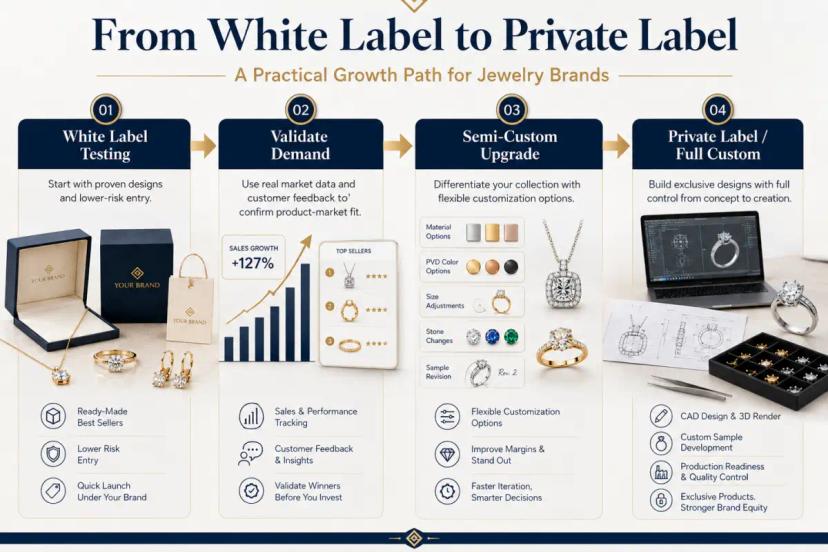
Yes. A brand can use white label products to validate demand with lower development commitment, then move selected SKUs into private label development once sales data supports the investment. The transition is possible, but it is not automatic and depends on what the supplier agreement allows.
Moving from white label to private label on a given design usually requires a separate conversation about exclusivity, tooling ownership, and whether the existing design can be modified or must be redeveloped. Some suppliers can adapt an existing catalog item; others may require a fresh development process for a brand-specific version. Confirming this path before committing to a white label product intended as a long-term hero SKU avoids surprises later.
How Private Label and White Label Relate to OEM and ODM
OEM and ODM describe the manufacturing relationship — who provides the design and who manufactures it — while private label and white label describe the branding and commercialization arrangement. The two sets of terms overlap, but they are not interchangeable.
In simple terms, OEM (Original Equipment Manufacturer) typically means a supplier manufactures to the buyer’s own design or specification, while ODM (Original Design Manufacturer) means the supplier provides its own design as the basis for the product. A private label product might be produced through either an OEM- or ODM-style process depending on how much of the design originated with the brand, while a white label product is usually closer to an ODM-style arrangement because it starts from the supplier’s existing design. The exact fit depends on the supplier’s process, so confirm directly rather than assuming a fixed mapping. For a deeper breakdown, see OEM vs ODM Jewelry Manufacturing.
What to Confirm Before Sampling or Ordering
Regardless of which label a supplier uses, the details that actually protect a buyer are the same: design ownership, customization limits, MOQ at each stage, sampling process, and terms for repeat production.
A few B2B-specific points are easy to overlook early on but matter once a program is running:
- First-order MOQ and reorder MOQ may differ. Confirm both before committing to a product.
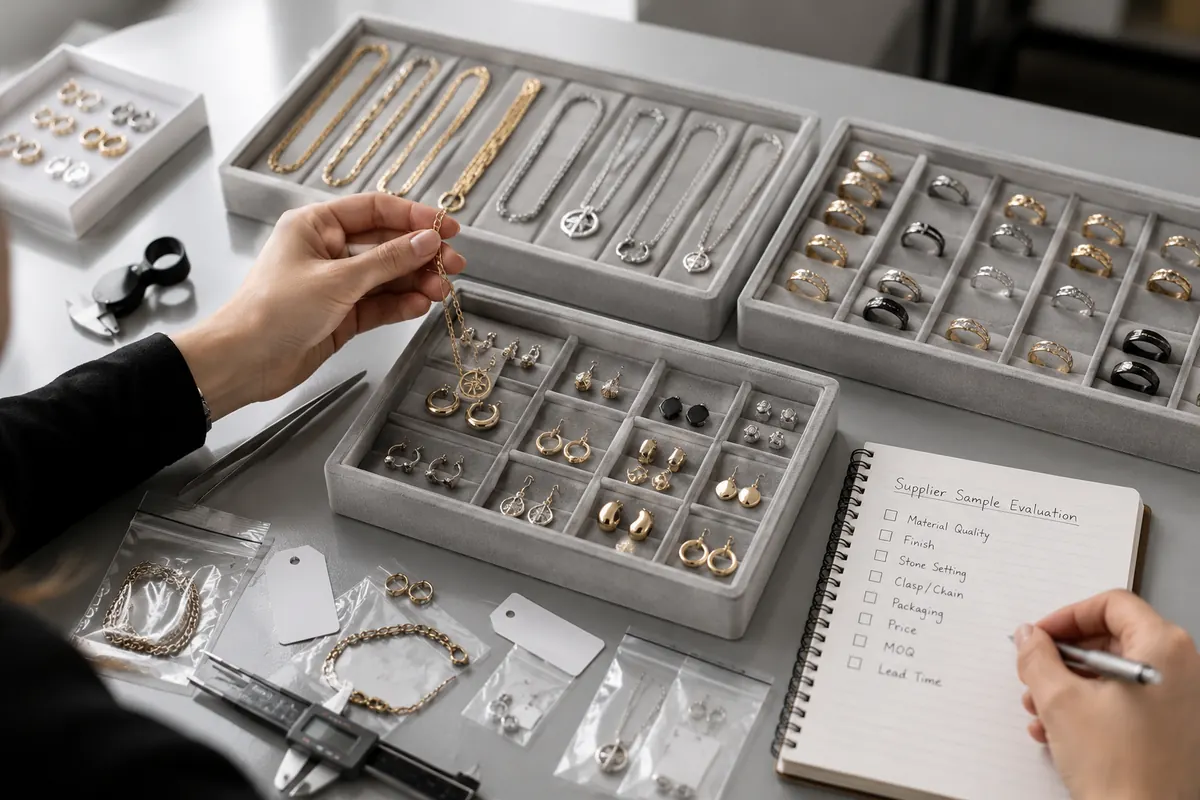
- Sample approval is distinct from bulk-production control. Ask how the approved sample is translated into repeatable specifications for the bulk order.
- Packaging MOQ can be separate from product MOQ. Custom boxes, pouches, cards, or inserts may have their own minimums.
- Catalog SKUs can be discontinued. For white label especially, confirm how reorder availability will be handled.
- Materials and finishes can change between production runs. Ask how changes in material source, plating, PVD, stone, or other specifications are communicated and approved.
- Mold and CAD ownership should be written down. Include what happens to files or tooling if the relationship ends.
- Exclusivity needs a defined scope. Specify whether it applies by product, market, territory, channel, or time period.
- Specification version control matters for reorders. Confirm how approved design changes are recorded and carried into future production.
Before requesting a quote, confirm:
- Is the design existing or developed for my brand?
- What can be modified?
- Is the design exclusive?
- Who owns CAD files and molds?
- What is the sample process?
- What are the first-order and reorder MOQs?
- What branding and packaging options are available?
- How will specifications be repeated consistently?
Working through this list — regardless of what a supplier calls its offering — gives a clearer picture of what you are agreeing to than the label alone.
Branding details can also create separate production constraints. If packaging is part of your launch plan, review Private Label Jewelry Packaging before you finalize the product MOQ and sample plan.
Jewins supports white label as a distinct service mode, and the exact product, branding, and modification scope is confirmed by SKU before sampling or ordering. For private label projects, Jewins uses a broader three-level structure so brands can choose how far they want to move from an existing product toward an exclusive custom design.
| Jewins Project Route | Typical Scope | What Brands Should Confirm |
|---|---|---|
| White Label | A separate Jewins service mode for brands that want to work from existing products rather than start with full custom development. | Available SKUs, branding options, allowed modifications, MOQ, packaging, and reorder availability. |
| Basic Private Label | Catalog or in-stock designs with brand additions such as laser engraving, a metal logo tag, or custom packaging. Current Jewins projects typically start around 30–50 pieces per style, while some in-stock items may support single-piece logo marking. | Exact MOQ, logo location, packaging MOQ, available stock, and reorder terms. |
| Semi-Custom Private Label | Existing designs can be adjusted in areas such as PVD color, stainless-steel grade, stone color or type, chain length, ring size, and selected structural details. Changes that affect stone size, setting structure, or overall proportions may require new CAD work, re-sampling, or tooling. | Which changes can reuse existing tooling, which require a new sample, and how the revised specification will be controlled for bulk and reorders. |
| Full Custom Development | Development from a sketch, reference image, or 3D file through CAD, prototyping, tooling, pre-production sample approval, and bulk manufacturing. Current Jewins projects typically require higher quantities, often around 100–300 pieces per style/color depending on design and process; mold fees are commonly quoted around US$80–300 per style. | CAD and mold terms, sample approval, exclusivity scope, NDA, production MOQ, and repeat-order specification control. |
Exclusivity and tooling: For exclusive developments, molds are typically physically retained at the Jewins factory after the mold fee is paid, while ownership rights or an exclusivity period are defined through the project agreement, NDA, and exclusivity terms. During the agreed protection, exclusive customer designs are not displayed in Jewins’ online showroom or sold to third parties. The exact legal and commercial terms should be confirmed in writing for each project.
Frequently Asked Questions
Is private label the same as white label jewelry?
No. Private label can range from an existing supplier design with brand-specific changes to a collaboratively developed product, sometimes with exclusivity. White label generally starts from an existing catalog design and focuses more on rebranding or limited modification. In practice, the line can blur depending on how a supplier structures the agreement.
Which has lower MOQ?
There is no universal rule. White label can have a lower entry MOQ when an existing design and tooling are reused, but MOQ still depends on the supplier, product, material, finish, packaging, and production setup. Confirm both first-order and reorder MOQs directly.
Can white label jewelry be customized?
Sometimes, to a limited degree. A supplier may allow plating color, chain length, stone options, logo, hallmark, or packaging changes while keeping the base design and tooling unchanged. Other suppliers offer white label strictly as rebrand-only, so the allowable changes should be confirmed before sampling.
Can I switch from white label to private label later?
Often it is possible, but the path depends on the supplier’s design, tooling, and exclusivity terms. Moving a catalog SKU into private label development may require new CAD work, tooling, a fresh sample, or a separate exclusivity agreement.
Is private label the same as OEM?
Not exactly. OEM describes a manufacturing relationship based on the buyer’s own design or specification. Private label describes the branding and product arrangement, and it can be produced through either an OEM- or ODM-style process depending on how the design is created.
Which model is better for a new jewelry brand?
It depends on the brand’s goal. White label can suit faster market testing with less upfront development, while private label can suit brands ready to invest in deeper differentiation, customization, and longer-term product development. A brand can also use the two models for different SKUs.
Choosing a Jewelry Production Model for Your Next Collection?
Share whether you want to start from an existing SKU, modify a current design, or develop a new piece from scratch. Jewins can help you define a suitable white label, private label, or full-custom path for stainless steel and moissanite jewelry, including sampling, branding, packaging, QC, and repeat-production requirements.
Contact Us