
Custom Stainless Steel Rings: 9 Technical Specifications Brands Should Lock Before Sampling
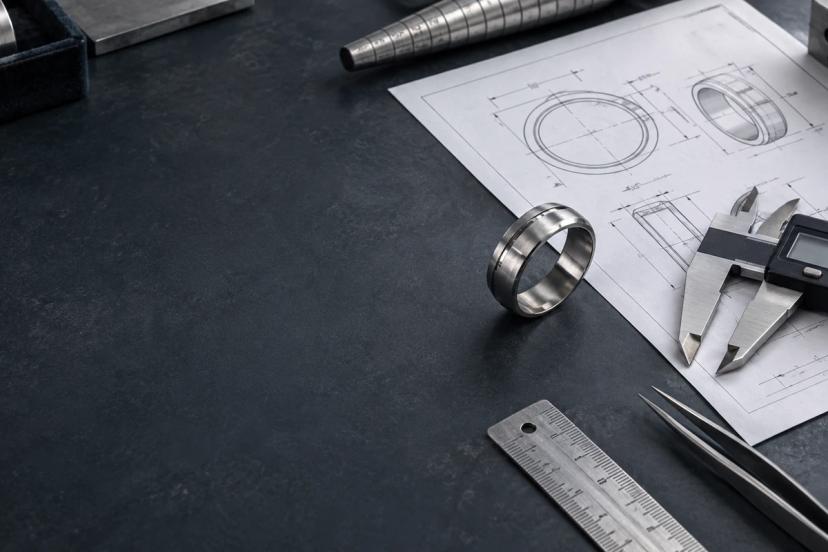
Before a custom stainless steel ring goes into sampling, a brand should define the ring size system, a measurable inner diameter or circumference, band width, band thickness, ring profile, dimensional tolerance, engraving details, stone-setting requirements, and a surface-finish or PVD color reference. The base material grade, such as 304 or 316L stainless steel, should also be confirmed; the nine points below focus on ring-specific dimensions and construction details. A reference photo communicates a concept, not a specification. Factories need measurable, repeatable data to turn that concept into a sample — and later, into consistent bulk production.
Custom Ring Pre-Sampling Specification Checklist
Use this table as a quick reference before sending a design or reference image to a manufacturer. The examples below illustrate format only — they are not universal standards, and actual values depend on the design.
A custom ring spec sheet is the written production reference that records the ring's agreed sizing system, measurable dimensions, construction details, branding, stones, finish, and acceptance criteria before sampling begins.
| Specification | Example | Why It Matters |
|---|---|---|
| Ring size system | US Size 7 | Prevents sizing-system confusion between brand, factory, and end market |
| Inner diameter / circumference | 17.35 mm inner diameter | Gives the factory a measurable reference beyond a size label |
| Band width | 6.0 mm | Defines visual proportion, stone layout, and how the ring is likely to feel on the hand |
| Band thickness | 1.6 mm wall thickness | Affects structural strength, weight, and manufacturing feasibility |
| Ring profile | Comfort-fit interior, flat exterior | Two rings with the same outer size can wear differently depending on profile |
| Tolerance | Agreed per dimension with the manufacturer | Defines acceptable variation across a sample and across a bulk order |
| Logo / engraving | Laser-engraved, inside band, centered | Removes ambiguity around placement, method, and legibility |
| Stone specification | 1.5 mm round CZ, 12-stone pavé row | Reference photos alone can't define stone size, count, or spacing |
| Surface finish / PVD reference | Matte gold-tone PVD, sample-matched | "Gold" alone is open to interpretation; a physical reference is not |
1. Lock the Ring Size Standard and Target Market
Ring sizing is not universal. US, UK, and EU sizing systems use different measurement conventions, and a size that fits correctly in one system will not automatically match the same numeric size in another. "Size 7" only means something specific once the sizing system behind it is confirmed.
Brands selling into multiple regions should identify which market the sample is built for, and confirm that the same sizing system is used consistently from the first sample through bulk production. ISO 8653:2016 defines ring-size measurement and designation for manufacturing use and can serve as a shared technical reference. The immediate priority, however, is agreement: both sides should be working from the same system, expressed the same way, on every document connected to the project.
Buyer takeaway: The factory should know exactly which sizing system is being used — not just a number, but the standard behind it.
2. Record the Inner Diameter or Circumference
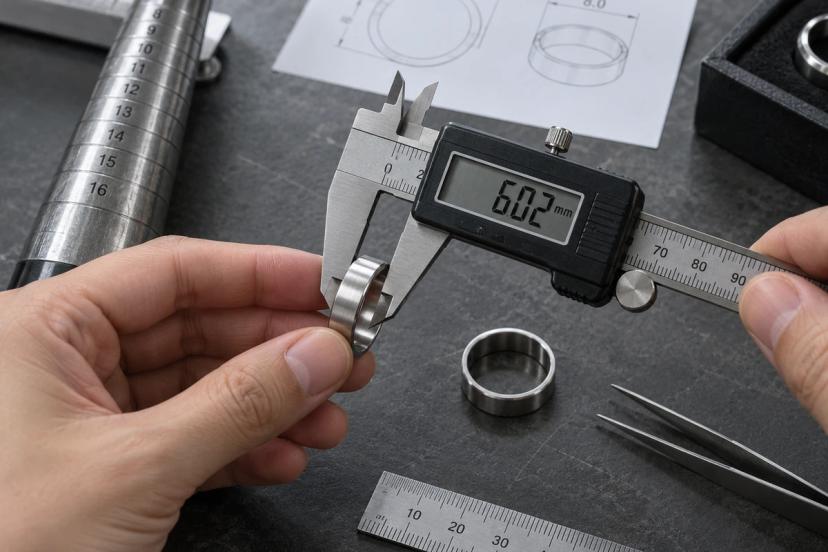
A size designation like "Size 7" is a label, not a physical measurement. Recording a measurable inner diameter or internal circumference alongside the size label gives the factory a dimension that can be checked directly with tools during sampling and inspection, rather than interpreted from a size chart.
This distinction matters most during two moments: when a sample is first measured against the design intent, and later, when bulk production is checked against the approved sample. A measurable reference reduces the chance that two people — a designer and a production technician, for example — interpret "Size 7" differently based on different regional charts.
Key idea: Do not rely on the size label alone. Record a measurable inner dimension as part of the written specification, not just the size name.
3. Define the Band Width
Band width is one of the most visible proportions on a ring, and it does more than affect appearance. Width influences how much surface area is available for stone layout, how heavy the ring feels on the hand, and how the fit is perceived — a wider band can sit differently on the finger than a narrow one, even at the same internal size.
Common examples across custom ring projects include widths such as 4 mm, 6 mm, or 8 mm — though these are illustrations of how a specification should be written, not recommended values for a given design. "Medium width" is a description, not a manufacturing specification. A factory cannot cut tooling or set a mold to "medium"; a specific millimeter value is what allows a sample to be produced and repeated accurately.
4. Define Band Thickness or Wall Thickness
Band thickness — sometimes called wall thickness — is a separate dimension from band width, and the two are often confused. Width is the visible surface dimension; thickness refers to how much metal makes up the structure of the band. It affects structural strength, finished weight, material use, engraving depth, manufacturing cost, and, in some designs, whether the intended stone setting is practical.
A CAD render or a reference photo can suggest an intended thickness visually, but images do not convey the physical millimeter value a factory needs to machine or cast the piece correctly. Two rings that look identical in a photo can end up with noticeably different weight and structure if their wall thickness was never specified in writing.
5. Specify the Ring Profile and Cross-Section
Ring profile describes the shape of the band's cross-section — for example, a flat profile, a domed profile, or a comfort-fit interior designed to round the inside edge of the band. Profile is a manufacturing specification, not just a styling detail.
Two rings can share the same outer diameter and band width and still feel different on the hand because their interior profile is different. A comfort-fit interior, for instance, changes how the band contacts the finger compared to a flat interior, independent of size. Stuller's industry ring-size reference guide also notes that shank profile, width, and fit affect how a ring should be measured. Profile is therefore a wearability consideration expressed as a specification — brands should describe it in the same document as the other dimensions, rather than assuming a factory will infer it from a photo.
6. Agree on Dimensional Tolerances Before Sampling
This is one of the most overlooked steps in custom ring development — and one of the most consequential.
Manufactured jewelry cannot be controlled by an instruction like "make every piece exactly the same." All production processes carry some degree of natural variation. A useful technical specification identifies which dimensions are critical to the design and clarifies that acceptable variation should be agreed upon for those dimensions, rather than left undefined.
The specification should record both the target and the acceptance method for each critical feature:
| Critical feature | What to record |
|---|---|
| Ring size / inner diameter | Target value + acceptable tolerance |
| Band width | Target width + acceptable tolerance |
| Band thickness | Target thickness + acceptable tolerance |
| Stone layout | Position, spacing, and alignment standard |
| Logo / engraving | Position, orientation, size, and visual requirement |
| Surface finish | Approved sample or agreed color/finish reference |
A tolerance is not a sign that a factory accepts poor quality. It defines the acceptable production window for a measurable feature. The appropriate tolerance depends on the design, the manufacturing method, and which dimensions are considered critical — it should be agreed between the brand and the manufacturer rather than assumed. This conversation is most useful before the sample is approved, not after bulk production has already shipped. Once a sample is approved without a tolerance discussion, there is no documented standard to measure a bulk shipment against if variation appears later.
7. Define the Engraving and Logo Specification
"Add our logo" is an instruction, not a specification. It leaves too much open to interpretation — where the logo goes, how large it is, and how it's applied can all vary widely between what a brand pictures and what a factory produces.
A usable engraving or logo specification should identify:
- The artwork file itself (vector format where possible)
- Logo dimensions
- Position on the ring (inside band, outside band, near the stone setting, etc.)
- Orientation
- Application method, where relevant (laser engraving, stamping, or another process)
- An approximate depth, contrast, or visual reference, where relevant to the selected method
- How the logo relates to other elements, such as ring size markings or stone placement
Because engraving legibility and placement can be difficult to judge from a rendering, logo position and clarity should be checked on the physical sample rather than approved from a digital mockup alone.
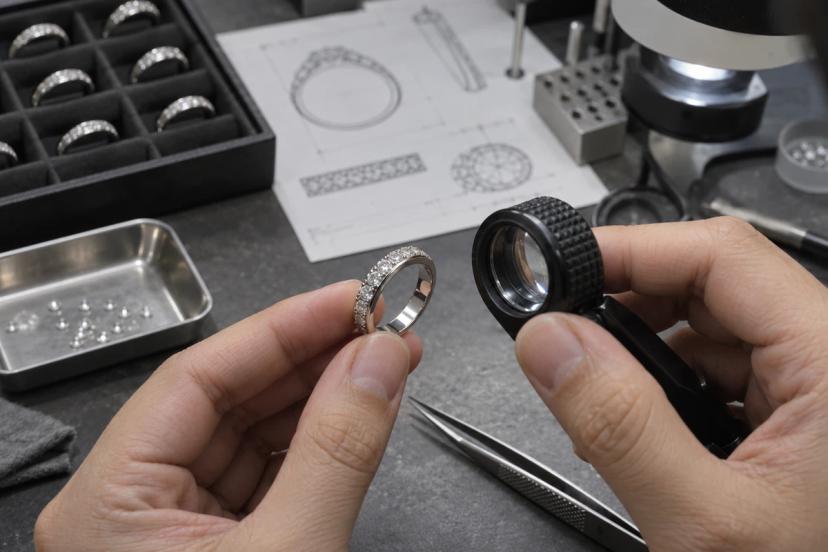
8. Lock the Stone and Setting Specification
For stone-set rings, a reference photo cannot define the details that actually control cost, appearance, and structural reliability. A workable stone specification typically covers:
- Stone type (for example, CZ or moissanite)
- Stone shape
- Stone size
- Stone quantity
- Spacing between stones
- Layout (single row, pavé, cluster, center stone with accents, etc.)
- Setting type
- Alignment and symmetry
- Location on the ring
A photo can suggest a general look, but it cannot reliably communicate exact stone dimensions, precise quantity, setting geometry, or spacing — these need to be written down. The physical sample is the point where a brand should confirm both how the stones look and how the setting has actually been executed, since setting quality is difficult to judge from images alone. For a deeper inspection framework covering seat fit, retaining metal, alignment, finishing, and batch patterns, see Jewins' guide to why stones fall out of jewelry.
9. Define the Surface Finish and PVD Color Reference
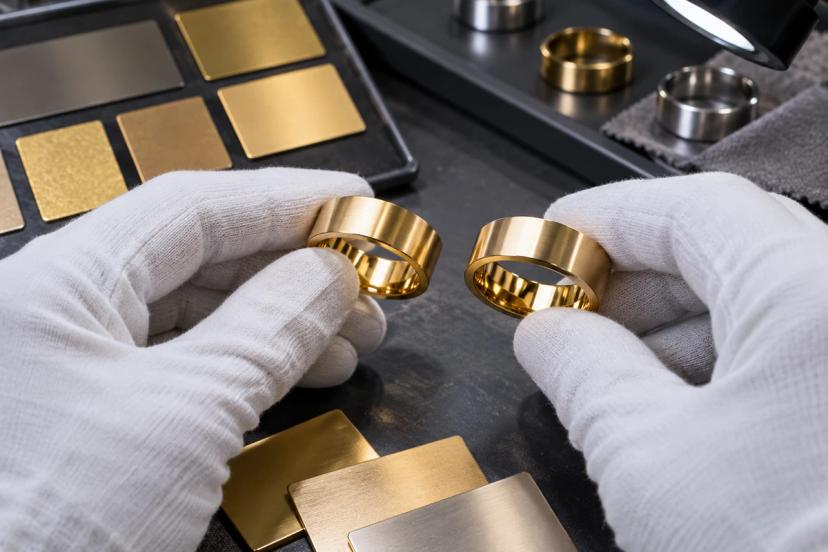
"Gold ring" describes an idea. It does not describe a finish a factory can reproduce consistently. Terms like "gold," "champagne gold," or "18K gold color" can each be interpreted differently depending on who is reading them and what reference they have in mind.
Surface finish specifications for custom stainless steel rings typically define:
- Finish type — polished, brushed, matte, or mirror
- PVD color tone — for example, gold-tone, rose-gold-tone, or another agreed shade
- Any other agreed finish detail specific to the design
An approved physical sample, or an agreed visual and color reference, becomes the practical production standard once terminology alone proves ambiguous. PVD color can show some batch-to-batch variation because the final appearance depends on coating parameters, surface preparation, substrate condition, part geometry, and the approved color target. For this reason, brands should not rely on a phrase such as "18K gold color" alone.
The project record should identify the approved sample or color reference, the relevant finish description, and the production batch being compared. That controlled reference gives both sides a practical standard for later production; it helps manage variation rather than promising that every PVD run will be visually absolute. Jewins' guide to PVD coating for stainless steel jewelry explains the coating process and the sourcing checks brands can use alongside the approved finish reference.
What Should Be Locked After the Ring Sample Is Approved?
Sample approval is often treated as a single checkbox — "the sample looks good" — but that is not enough to protect consistency into bulk production. Sample approval should be a documented event, not just a visual impression.
Once a sample is approved, brands should record:
- Approved dimensions (size, inner diameter, width, thickness)
- Approved ring size and sizing system
- Approved profile
- Approved stone layout
- Approved logo or engraving details
- Approved surface finish
- The specific sample version being approved
- Any revision notes from earlier rounds
- Approved photos or drawings, if used as references
- The final production specification document
In jewelry manufacturing, the final approved physical sample may be retained as a golden sample — the reference used to compare the first bulk production run and later repeat orders. The approved specification, revision record, and reference photos should remain linked to that same sample version. Keeping a golden sample does not guarantee zero variation in later production runs, but it gives both the brand and the factory a clearer, shared reference point for what "correct" looks like, which is far more useful during quality checks than relying on memory or an early digital rendering.
How Jewins Approaches Custom Ring Sampling
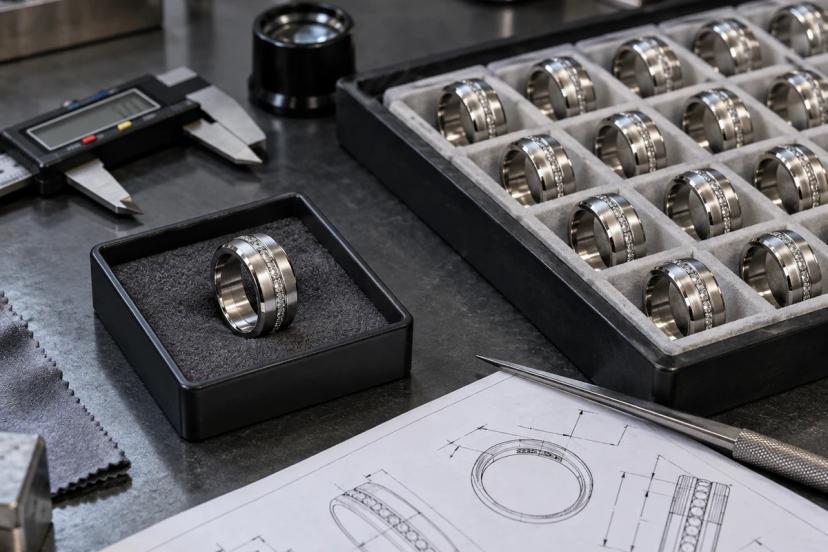
A typical custom stainless steel ring project at Jewins moves through a structured sequence: design or reference review, specification confirmation, sample development, buyer review, revisions if needed, sample approval, and then use of that approved sample as the bulk production reference.
Depending on the project, this can involve 304 or 316L stainless steel, PVD finishing, CZ or moissanite stone options, and custom logo or engraving work, developed under an OEM or ODM arrangement. The goal of sampling is not only to make one acceptable ring. It is to turn the approved design into a written, measurable specification and an approved sample that can be checked again during bulk production and future repeat orders. At each stage, the approved sample remains the production reference rather than a one-time visual sign-off.
FAQ
What information should I send a custom ring manufacturer?
At minimum, provide a reference image or drawing, the sizing system and target size, key dimensions (inner diameter, band width, band thickness), the intended ring profile, material (such as 304 or 316L stainless steel), stone details if applicable, the desired surface finish, and logo or engraving requirements. If material selection is still open, Jewins' 304 vs. 316L stainless steel jewelry guide explains the sourcing differences. The more of this that is written down rather than implied, the fewer interpretation gaps appear during sampling.
Should I specify ring size or inner diameter?
Ideally, both. A recognized size designation communicates the intended fit within a known sizing system, while a measurable inner diameter or circumference gives the factory a physical value that can be checked directly during sampling and production, rather than one that depends on interpreting a size chart correctly.
Does band width affect ring fit?
Yes, it can. A wider band places more surface area against the finger and may feel tighter than a narrow band at the same nominal size. The effect depends on the band profile and design, so width and fit should be confirmed together on the physical sample.
How should brands specify ring size tolerance?
There is no single number that applies to every ring. The brand and manufacturer should agree on acceptable variation for critical dimensions based on the specific design and manufacturing method being used, ideally before the sample is approved rather than after a bulk order has already shipped.
Should an approved ring sample be kept as the bulk-production reference?
Yes. Retaining an approved sample, along with its documented specifications, gives both sides a concrete standard to compare bulk production and future repeat orders against. This does not guarantee perfect consistency across every unit, but it substantially reduces ambiguity compared to relying on an early reference image or memory alone.
A successful ring sample starts with measurable specifications rather than a reference image alone. The more clearly a brand defines sizing, dimensions, profile, branding, stone setting, and finish before sampling begins, the easier it becomes to evaluate the resulting sample and establish a repeatable standard for bulk production.
Planning a custom stainless steel ring collection?
Jewins can review your design or reference, help clarify the key specifications, develop a sample, and prepare the approved design for bulk production.