
OEM jewelry manufacturing fits brands that already have their own design and want stronger control over design ownership, tooling, and exclusivity — but those rights should be confirmed in the manufacturing agreement. ODM fits brands that want to launch faster from a manufacturer's existing styles, usually with lower development cost and lower MOQ, but the base design is often non-exclusive. Most growing jewelry brands use both models by SKU role instead of choosing one permanently.
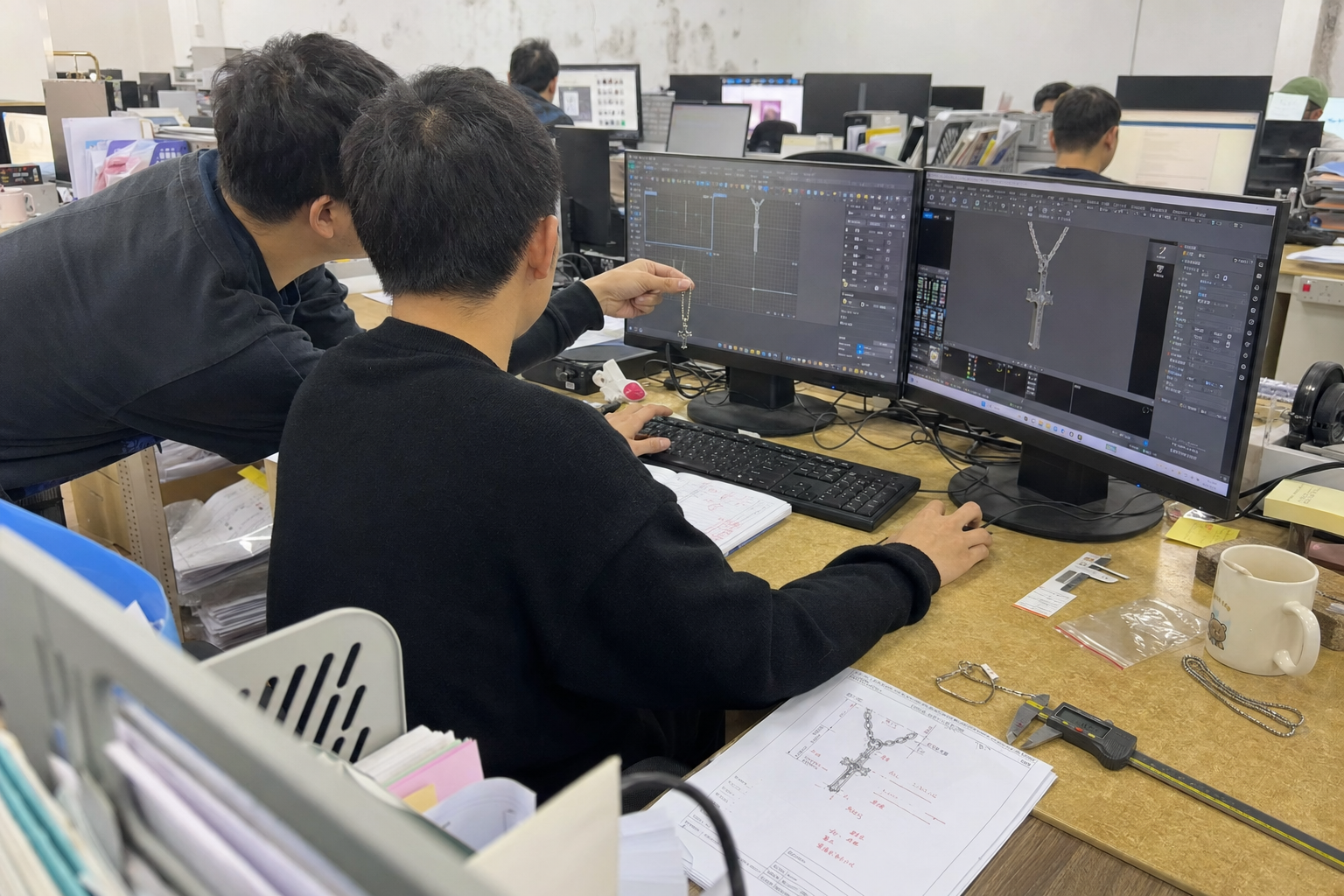
OEM jewelry manufacturing is the custom design route: your brand provides the design, and the manufacturer produces it to your specifications.
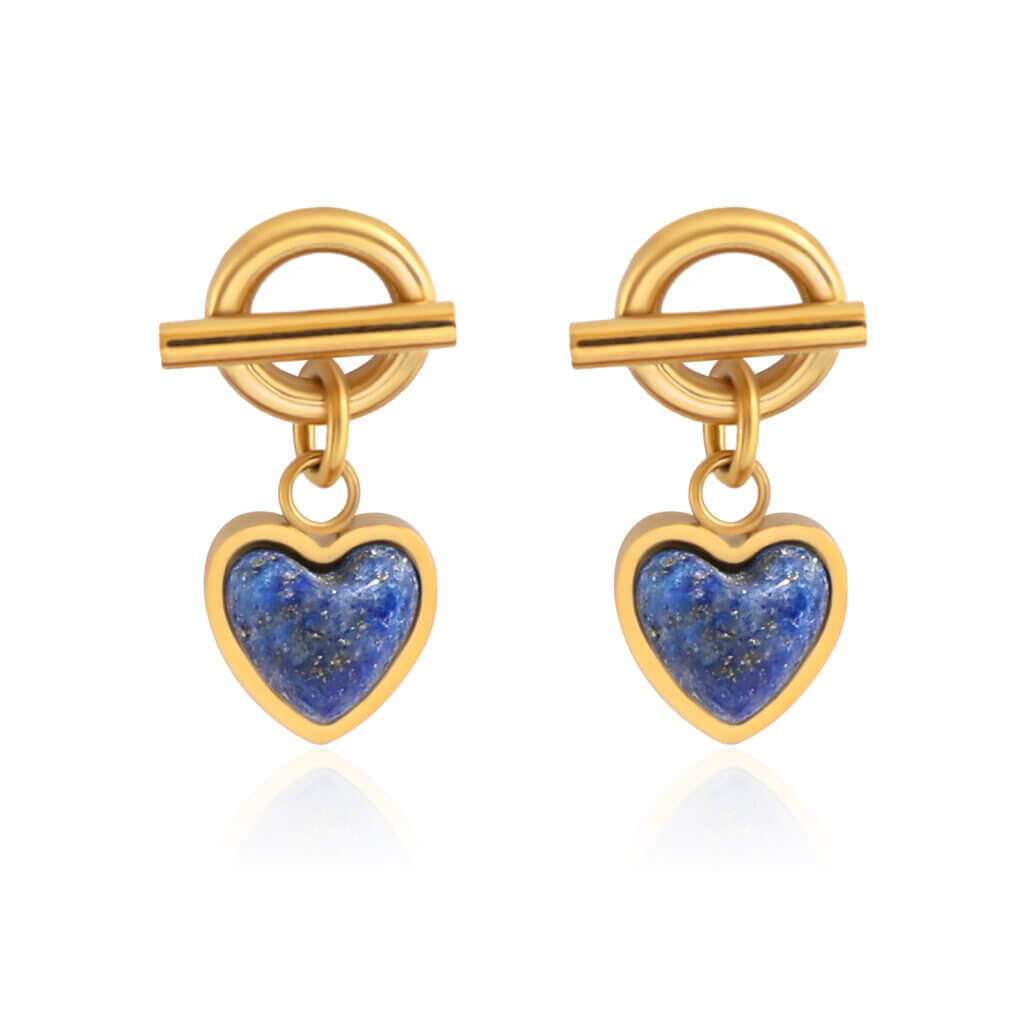
ODM jewelry manufacturing is the existing design route: the manufacturer provides ready or semi-ready styles that your brand can customize and sell under its own label.
The key difference is control versus speed: OEM gives stronger control over design and exclusivity, while ODM usually supports faster launch, lower development cost, and lower MOQ testing.
Key Takeaways: OEM vs ODM Jewelry Manufacturing
- Most brands that scale don't pick one model for everything — they run OEM for signature or hero pieces and ODM for trend-testing or seasonal capsules.
- Many growing jewelry brands start with ODM to validate demand, then move proven bestsellers into OEM development once a style earns a permanent place in the collection.
- MOQ, sample time, tooling cost, and IP terms should be confirmed per SKU, not assumed across the whole order — as a reference, Jewins supports MOQs from 30 pieces per style for selected stainless steel designs, with custom packaging typically starting around 200 pieces.
- Design exclusivity (for OEM) and sample-to-bulk consistency (for both models) are where most disputes start — get them confirmed in writing before sampling.
- Before sampling, confirm material grade, finish standard, packaging options, QC checkpoints, and reorder lead time in writing.
OEM and ODM Aren't Just Definitions — They're a Cost and Control Trade-off
Most explanations of OEM and ODM stop at the dictionary definition: OEM means you provide the design, ODM means the factory already has one. That's accurate, but it skips the part that actually matters for a growing brand — what you're trading away in each direction.
Every time you choose between OEM and ODM for a SKU, you're really deciding between four things at once:
- Design ownership versus speed to market
- Exclusivity versus lower development cost
- Long-term differentiation versus short-term flexibility
- Higher upfront investment versus lower financial risk
Neither side of that trade-off is "better." It depends on what that specific product needs to do for your brand — and that's the question most comparison guides skip.
OEM (Original Equipment Manufacturer): What You're Really Signing Up For
In jewelry manufacturing, working with an OEM jewelry manufacturer means the factory builds the piece to your specifications. You bring the design; the manufacturer brings the production capability.
What you typically need to provide:
- A finished design, sketch, or CAD file
- Material and finish specifications (metal grade, plating type, stone type if applicable)
- Sizing and packaging requirements
What you get in return:
- A product that is, in principle, yours alone — not sold to other brands under the same design
- Production built to your exact tolerance and finish standard, once it's confirmed in sampling
- A stronger basis for building a recognizable, hard-to-copy product line over time
The real cost of that control:
- Sampling and mold/tooling development usually takes longer than picking from an existing catalog
- MOQs are often higher, since the factory is setting up production specifically for your design
- You need either in-house design capability or a clear, detailed brief — vague direction leads to rounds of costly revisions
OEM is not inherently "premium" — it's a model that rewards brands that already know exactly what they want and can afford to wait for it. If you want a broader view of how the entire custom jewelry manufacturing process works before narrowing down to OEM specifically, that's a useful starting point.
ODM (Original Design Manufacturer): What You're Really Signing Up For
ODM means the factory already has a design — sometimes a full catalog of them — and you select, customize, and rebrand it. In simple terms, ODM jewelry is manufacturer-designed jewelry that a brand can select, adjust with finish, logo, or packaging choices, and sell under its own brand name.
What you typically need to provide:
- A style direction or reference (not a from-scratch design)
- Target price point
- Branding details: logo placement, packaging, finish/color preferences
What you get in return:
- Faster development, since the structural design and tooling already exist
- Lower MOQs in most cases, because the factory isn't building a brand-new production setup just for you
- A practical way to test a market or launch a collection without a large design budget
The real cost of that speed:
- The base design is usually not exclusive to your brand — the same or a very similar SKU may be sold to other buyers
- Customization is bounded by what the factory's existing tooling and catalog allow
- It's harder to build long-term brand differentiation around a product another brand can also carry
ODM isn't a "lesser" option — it's the right tool for testing, fast iteration, and getting product into market while you're still validating demand.
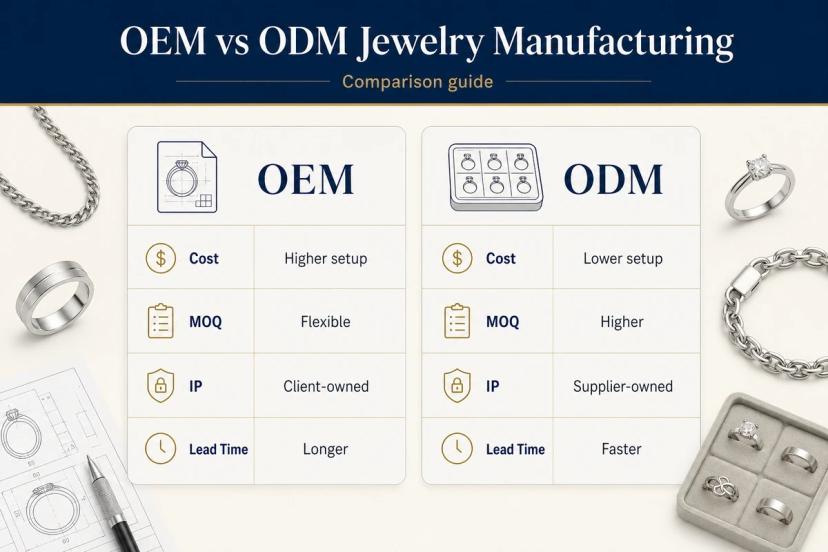
OEM vs ODM Jewelry Manufacturing Comparison: Cost, MOQ, IP, and Lead Time
| Dimension | OEM | ODM |
|---|---|---|
| Design ownership | Belongs to your brand | Usually non-exclusive, shared with the factory's catalog |
| Development cost | Higher — covers design refinement, tooling, sampling | Lower — built on existing structures and molds |
| Typical sampling cycle | Longer, especially for first-time designs | Shorter, since base design exists |
| Typical MOQ | Generally higher | Generally lower |
| Brand differentiation potential | Higher | Lower, unless heavily customized |
| Best suited for | Signature SKUs, hero products, IP-sensitive collections | Trend testing, fast launches, early-stage validation |
These are general patterns, not fixed rules — actual MOQ and lead time vary by manufacturer, material, and finish complexity. Always confirm specifics in writing before committing to a production plan.
As a concrete reference point: Jewins supports MOQs starting from 30 pieces per style for selected stainless steel jewelry designs, while custom packaging typically starts around 200 pieces, depending on packaging type, logo method, and customization requirements. Figures like these are exactly what you should be asking any manufacturer to confirm before sampling.
Decision rule: choose OEM when the design itself is strategic, IP-sensitive, or central to long-term brand identity; choose ODM when faster launch, lower MOQ, and market testing matter more than exclusivity.
Which Model Fits Your Brand's Growth Stage
The "right" answer to OEM vs ODM usually changes as a brand grows. Treating it as a one-time decision is one of the more common sourcing mistakes.
Early-stage / startup brands
Prioritize ODM to validate demand with lower upfront risk. A from-scratch OEM design before you know which styles actually sell can tie up budget in a product that never finds its market.
Growing brands with early bestsellers
This is usually the point to start introducing OEM — specifically for the SKUs that are already proving themselves. Locking in a design exclusively reduces the risk of a near-identical version showing up on a competitor's storefront a few months later.
Scaling brands managing multiple SKUs
A mixed strategy tends to work best: signature, margin-protecting styles on OEM, while trend-driven or seasonal styles stay on ODM for speed. Trying to put an entire growing catalog on OEM usually slows the business down more than it protects it.
Mature brands with established collections
OEM typically becomes the default for anything tied to brand identity, supported by clearer contracts, NDAs, and documented design ownership — since the cost of a copied design is much higher once a collection has real market recognition.
The Hybrid Approach: How Most Real Brands Actually Operate
In practice, very few brands run 100% OEM or 100% ODM across their entire catalog. The more common pattern is splitting by SKU role — and this same logic applies whether you're working with a generalist factory or a dedicated stainless steel jewelry manufacturer; the SKU-by-SKU split doesn't change based on material:
- Hero / signature products → OEM, to protect what makes the brand distinct
- Trend-testing or seasonal capsules → ODM, to move fast and limit downside if a trend doesn't land
- Core, steady-selling basics → Often ODM with brand-specific finishing, balancing cost control with a consistent look
A simple way to decide which bucket a new product belongs in:
- Will this product still represent the brand in two years? If yes, lean OEM.
- Are you testing a trend with an unproven shelf life? If yes, lean ODM.
- Does the budget and timeline support a full design cycle right now? If no, ODM first — you can transition a proven ODM bestseller to an OEM version later.
This is also where ODM-to-OEM transitions are common: a brand validates a style through ODM, then works with the same or a different manufacturer to develop an OEM version with brand-exclusive tooling once the SKU has proven demand.
Service Specifications to Confirm Before You Commit
Whichever model you choose, get the following confirmed in writing before sampling begins — this is where most quality and timeline disputes start:
| Specification | Why it matters |
|---|---|
| Service type (OEM, ODM, or hybrid per SKU) | Defines design ownership and customization limits |
| Minimum order quantity | Often differs by material, finish, and design complexity |
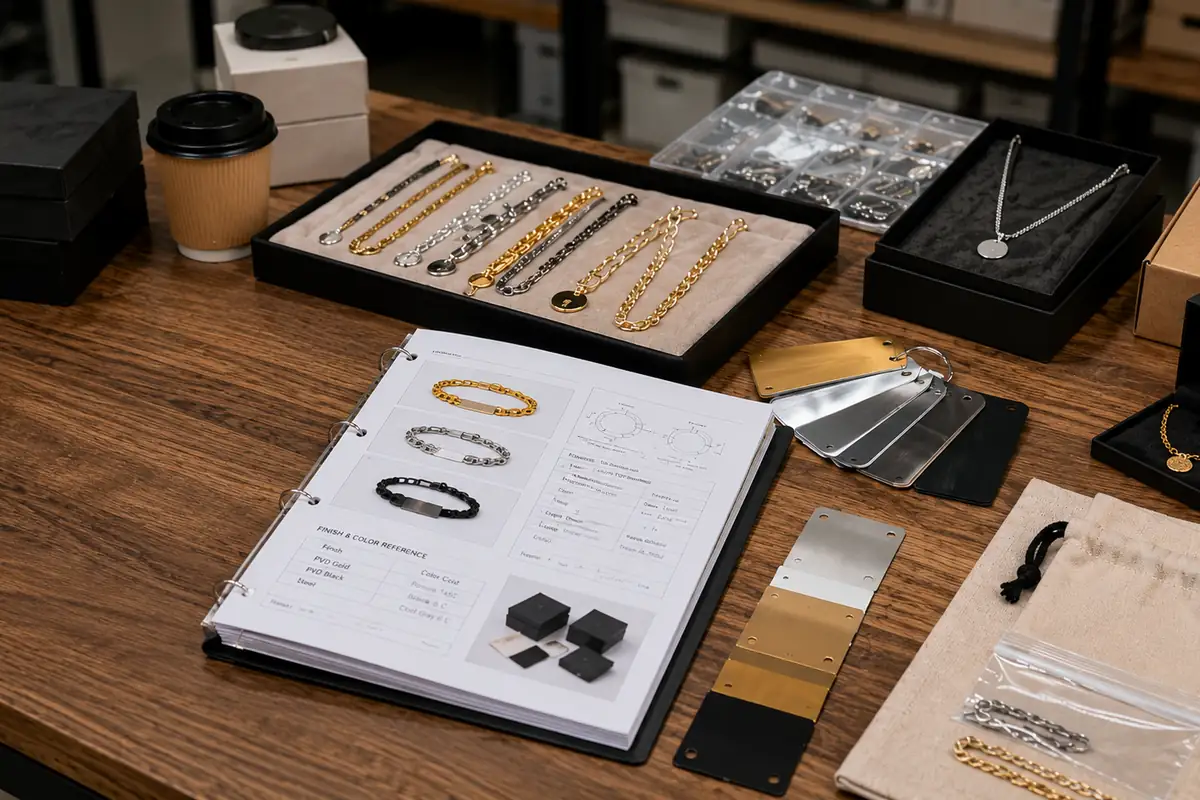
| Materials and finish options | Confirms grade (e.g., stainless steel grade), plating type, and consistency standard |
| Sample lead time | Sets expectations for development before bulk commitment |
| Bulk production lead time | Affects launch planning and inventory timing |
| Reorder lead time | Matters most for ODM basics and repeat OEM hero SKUs |
| Packaging and private label options | Confirms what level of branding customization is actually available |
| Quality control checkpoints | Clarifies what's inspected, and at which stage of production |
For more detail on what's typically included in private label jewelry packaging, it's worth reviewing the packaging options before finalizing your specification sheet.
Buyer Risk Checklist Before You Sign
- Is design exclusivity (for OEM) written into the agreement, not just implied verbally?
- For ODM, is it clear whether — and to whom — the same or a similar design might also be sold?
- Has a sample-to-bulk consistency process been defined, so the bulk order actually matches the approved sample?
- Are MOQ and lead time confirmed in writing for both the first order and reorders?
- Does the manufacturer support the level of packaging or private-label customization your brand actually needs — for both models?
How Jewins Helps Brands Choose and Produce the Right Model
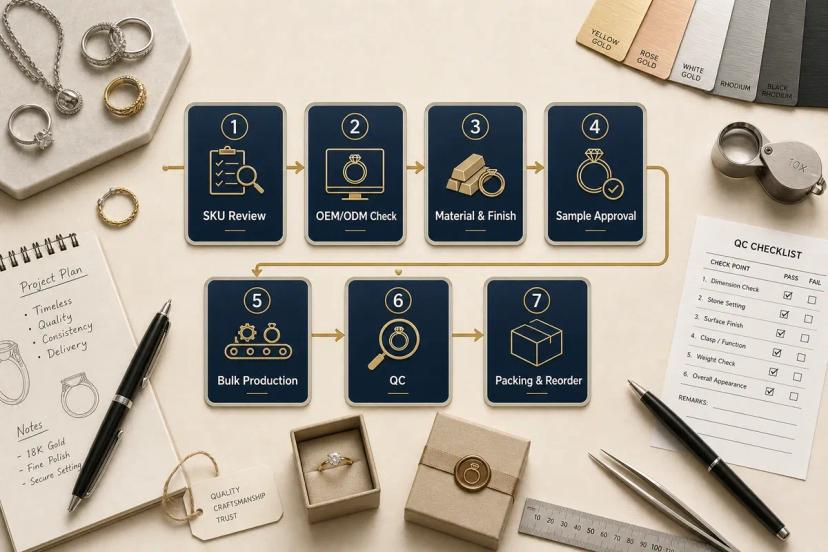
Jewins does not treat OEM and ODM as fixed labels. As part of Jewins' OEM/ODM jewelry services, the more useful approach for growing brands is to decide SKU by SKU — based on product role, launch timeline, order size, and exclusivity needs — and then carry that decision through an actual production plan, not just a one-time sourcing choice.
A typical OEM/ODM planning process with Jewins includes:
- SKU role review — identify which styles are hero products, trend tests, or repeat basics.
- ODM selection or OEM feasibility check — decide whether an existing 3D design, a modified catalog style, or a new custom design fits the goal.
- Material and finish specification — confirm 316L stainless steel, titanium, PVD color, polishing, plating, stone, and packaging requirements.
- Sample approval standard — lock the approved sample, finish, size, logo placement, and packaging details before bulk production begins.
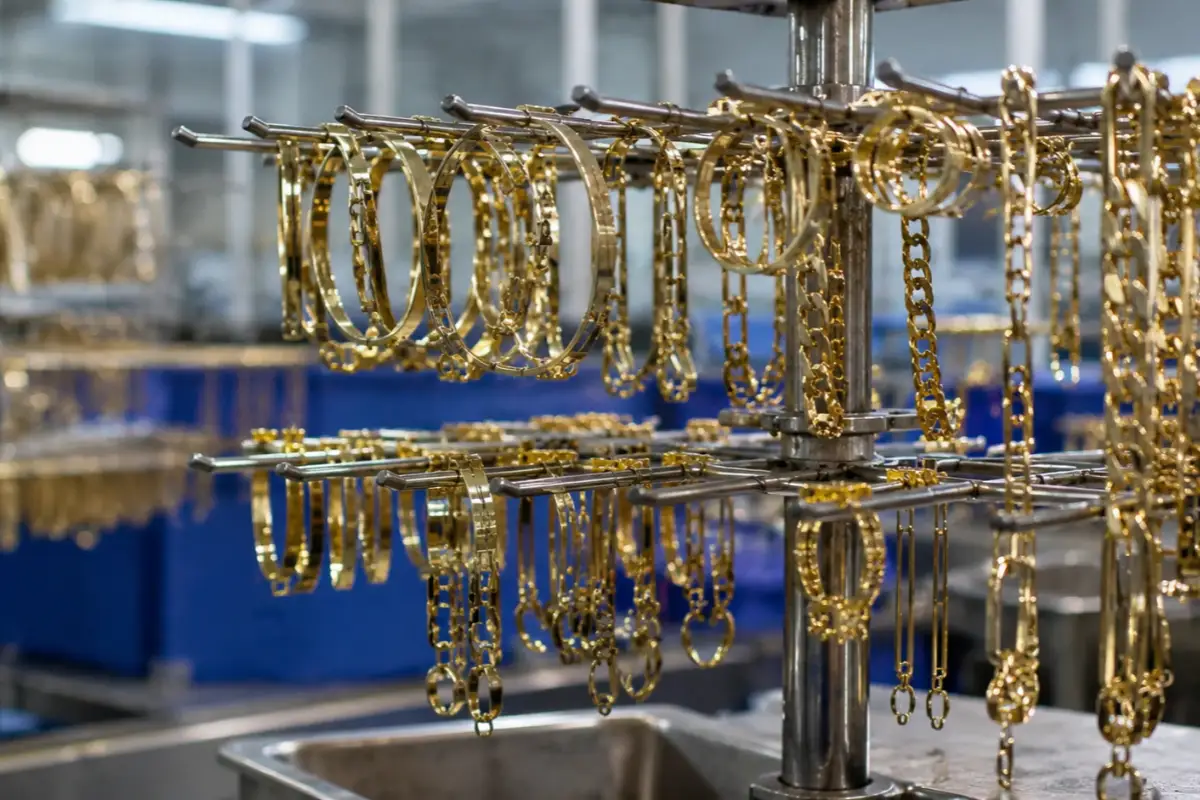
- Bulk production and reorder control — use QC checkpoints and repeat-order records to reduce sample-to-bulk mismatch.
Steps 3–4 draw on the same logic as Jewins' Brand Quality Standard Program, and step 5 follows the same checkpoint structure as the Traceable Quality Control System. This process is supported by 15 years of experience in high-mirror polishing and PVD plating, a library of 1,500+ proven custom 3D designs for ODM-style selection, and a managed monthly capacity of 10,000 pieces across 50+ brand partners.
Jewins supports selected stainless steel jewelry styles from 30 pieces per style, while custom packaging usually starts around 200 pieces, depending on packaging type, logo method, and customization requirements.
This approach helps reduce the risk of inconsistent batches, supports clearer sample-to-bulk standards, and gives growing brands a more structured way to decide — SKU by SKU — when it's time to move from a fast ODM launch to a protected OEM investment.
FAQ
What is OEM jewelry?
OEM jewelry is jewelry produced by a manufacturer based entirely on a brand's own design, specifications, and material choices. The manufacturer handles production; the brand retains ownership of the design and is responsible for branding, marketing, and sales.
What is ODM jewelry?
ODM jewelry is jewelry based on a manufacturer's existing design, which a brand can usually customize with finish, logo placement, packaging, or minor style details. It is commonly used for faster launches, lower-MOQ testing, and private label jewelry collections, but the base design is often not exclusive.
What's the main difference between OEM and ODM jewelry manufacturing?
OEM means you provide the design and the manufacturer produces it to your specification, so you generally hold exclusive rights to that design. ODM means the manufacturer already has a design — often from an existing catalog — which you customize and brand as your own, typically without exclusivity.
What are the benefits of working with an ODM jewelry manufacturer?
The main benefits are speed and lower upfront cost: there's no need to develop tooling or a design from scratch, sampling is usually faster, and MOQs tend to be lower — which makes ODM a practical way to test a new style before investing further.
How do I find a low MOQ jewelry manufacturer?
Ask directly for the MOQ per design and per color or finish variant, since these can differ. Many manufacturers offer lower MOQs for ODM (catalog-based) styles than for fully custom OEM designs, so confirm which model a quoted MOQ applies to before comparing suppliers. As a reference point, Jewins supports MOQs starting from 30 pieces per style for selected stainless steel jewelry designs, with custom packaging typically starting around 200 pieces depending on packaging type, logo method, and customization requirements.
Can a jewelry brand combine OEM and ODM for different products?
Yes — this is common in practice. Many brands use ODM for trend-driven or testing SKUs and reserve OEM for signature pieces meant to stay in the collection long-term, rather than committing the entire catalog to one model.
When should a jewelry startup choose ODM first?
Generally when the brand hasn't yet validated which styles will sell. Starting with ODM limits financial exposure while testing demand, with the option to move a proven bestseller to OEM later.
When is OEM worth the higher sampling cost?
When a design is core to the brand's identity, or when a SKU has already proven itself and protecting it from being copied or sold to competitors becomes more valuable than the time and cost saved by ODM.
How do MOQ and lead time differ between OEM and ODM jewelry manufacturing?
As a general pattern, OEM tends to carry higher MOQs and longer sample-to-bulk lead times, since tooling and design are built specifically for that brand. ODM tends to have lower MOQs and shorter lead times because the base design and production setup already exist — but exact figures vary by manufacturer and should always be confirmed directly.
Who owns the design and IP in OEM vs ODM jewelry manufacturing?
In OEM, design ownership generally stays with the brand that commissioned it, provided this is documented in the manufacturing agreement. In ODM, the manufacturer typically retains rights to the base design, even after a brand has customized finishes, branding, or minor details.
Last reviewed on June 29, 2026, by the Jewins Jewelry Technical & QA Department.
Related Reading
Top Reliable Jewelry Manufacturers for BrandsWhat Is Custom Jewelry Manufacturing? The Complete GuideTurn Supply Chain Pressure Into a More Reliable Growth SystemNot Sure Whether OEM or ODM Fits Your Next Collection?
Talk to Jewins about your product roadmap — we can help you map out which SKUs are worth protecting with OEM and which are better suited to a faster ODM launch.
Contact Us →