
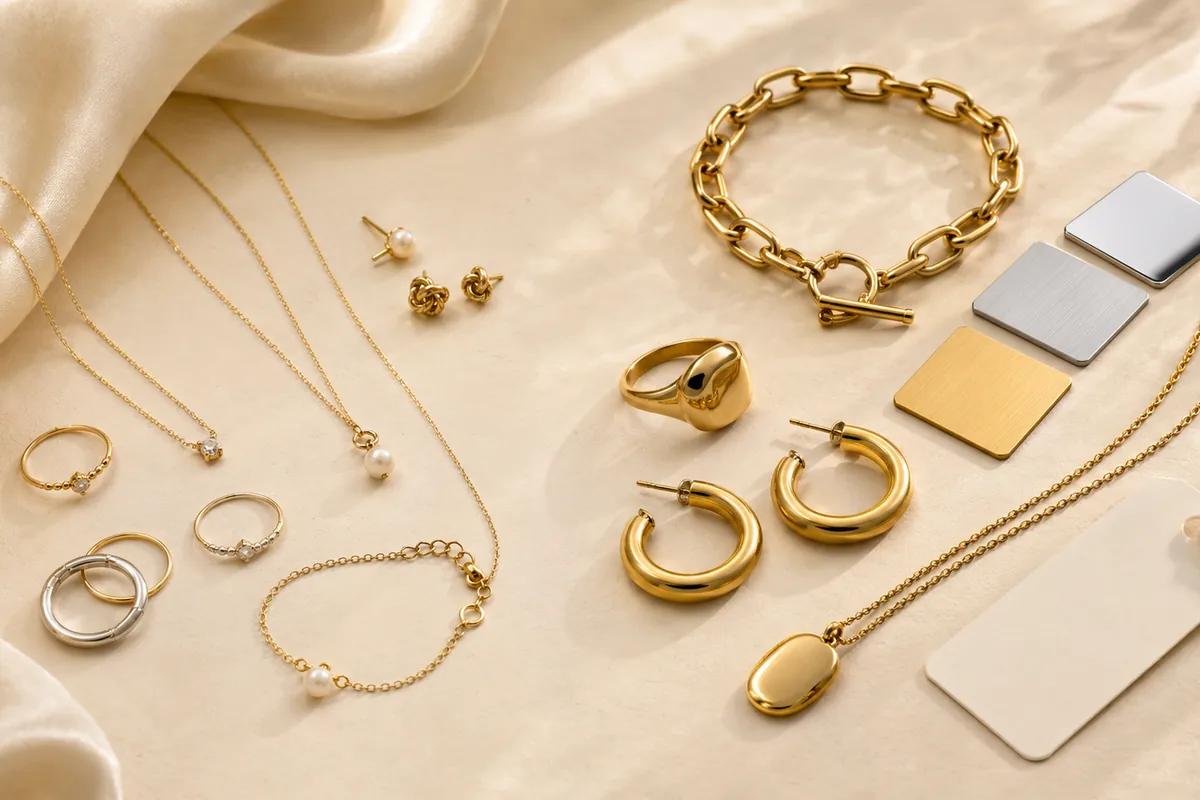
Approving a jewelry sample means authorizing a specific, documented version of a design for bulk production, not just saying you like how it looks. Inspect the sample against your written specification (materials, finish, dimensions, construction, stones), then record one of three decisions: approve, revise and re-inspect, or hold. Keep the approved physical sample and a written record, because that pair is what the first bulk run gets compared against.
Quick Answer: Approving a jewelry sample means authorizing a specific, documented version of a design for bulk production, not just saying you like how it looks. Inspect the sample against your written specification (materials, finish, dimensions, construction, stones), then record one of three decisions: approve, revise and re-inspect, or hold. Keep the approved physical sample and a written record, because that pair is what the first bulk run gets compared against.
Key Takeaways
- Approval should authorize a defined version (SKU, specification revision, finish, size), not a general impression of the piece.
- Visual acceptance and material evidence are separate. A sample that looks right but has no confirmation of steel grade or finish requirements should be held, not approved.
- Every failed finding needs a named correction, an owner, and a retest scope. Fixing one defect can disturb adjacent features.
- A concise written record (version, specs, photos, exceptions, decision, approver) helps prevent disputes over what was approved.
- Sample approval does not replace in-process or shipment inspection. It gives those checks something to compare against.
What Does Jewelry Sample Approval Actually Authorize?
Approval is a release decision. When you sign off on a sample, you are telling the manufacturer that this version, with these materials, this finish, and these dimensions, is the reference for bulk production. Differences that are not noticed or documented may become disputed later. That is why approval needs a defined scope rather than a quick "looks good."
If you need the wider picture of how sampling fits into OEM/ODM production, our custom jewelry manufacturing guide covers the full chain. This article starts at the moment the physical sample lands on your desk.
Development sample vs pre-production approval sample
A development sample answers the question "is this the design we intended?" It is usually reviewed for shape, proportion, general color, and feel, and it may still use provisional materials or a trial finish. A pre-production sample (PPS) should be made with the intended materials, finish, and construction methods and evaluated before the buyer authorizes bulk production. Approving a development sample's appearance does not mean you have approved its material, finish durability, or construction for volume. If the sample is still a development piece, say so in writing and treat the next sample as the true approval candidate.
What a buyer should identify before review
Before inspecting anything, make sure you can say exactly what you are reviewing. At minimum, identify the SKU or style name, a physical sample ID (for example, on the sample bag or tray), the drawing or CAD revision it was built from, and every color, size, and finish variant the approval is meant to cover. Note who on your side is confirming the decision. Do not assume your supplier has a formal sign-off process; if none exists, your own record fills that gap.
Jewelry Sample Approval Checklist for Stainless Steel Pieces
The checklist below focuses on stainless steel jewelry, including PVD-finished and stone-set pieces. The right acceptance evidence depends on your product and market, so treat the table as a framework to adapt to your own specification rather than a universal standard.
Table 1: Sample Inspection & Evidence
Check Item | Acceptance Evidence | If It Fails | Decision Owner |
|---|---|---|---|
Steel grade (304 / 316L) | Material certificate or supplier declaration tied to this batch or component; independent analysis where the risk justifies it | Hold until grade is documented; do not rely on stamps or magnets | Buyer (quality/product lead) |
Component materials (clasps, jump rings, posts, findings) | Component list in the spec matched to the sample; material evidence for skin-contact parts | Revise component and re-inspect affected parts | Buyer with supplier |
Design match | Side-by-side comparison with the approved drawing/CAD revision; photos from fixed angles | Revise; re-inspect against the same revision | Buyer (product developer) |
Dimensions and fit | Measurement of agreed points with a recorded method; comparison against the buyer's specified targets and tolerances | Revise; remeasure all critical points, not only the failed one | Buyer, confirmed by supplier |
Surface finish (polish, brushing, texture) | Comparison against a physical reference or agreed finish sample under consistent lighting | Revise finish; recheck adjacent surfaces | Buyer |
PVD color and coverage | Physical color sample; inspection of edges, recesses, and engraved areas; any agreed adhesion or wear testing noted with method | Revise or hold depending on whether evidence or the finish itself is deficient | Buyer with supplier |
Clasp, hinge, and connector function | Repeated open/close and load-handling check appropriate to the product; observation of fit and alignment | Revise mechanism; retest the full assembly | Buyer |
Stone setting and security | Visual check of seats, prongs or channels; visual and functional examination; use an agreed security test where the design warrants it; stone type and size match the spec | Revise setting; recheck neighboring stones and the metal structure | Buyer, with supplier explanation |
Sharp edges, burrs, and comfort | Handling inspection of all edges and inner surfaces | Revise polishing; recheck dimensions and finish | Buyer |
Packaging and labeling (if in scope) | Match to packaging specification and any required markings | Revise; separate from product approval if packaging is a separate sample | Buyer (brand/operations) |
Confirm steel grade and component materials
Stainless steel is not a single material. 304 and 316L behave differently in corrosion resistance and cost, and a sample cannot tell you which one you have by sight. A stamp on the piece or a magnet test is not proof of grade. Ask for documentation that links the material to this sample or component, and for higher-risk products or markets, consider independent analysis. Also confirm that clasps, posts, and small findings are the materials your specification calls for, because small components may use a different alloy from the main piece. Material testing providers such as Intertek's jewelry testing services describe the kinds of material and safety testing available; whether a given test is required depends on your product and sales market, and that is a decision for your own compliance process.
Review PVD color, finish, and agreed test evidence
PVD (physical vapor deposition) is a vacuum coating process used to apply color, such as black, gold, or rose tones, to stainless steel. Approve the color against a physical reference, not a screen image, and inspect edges, recesses, and engraved areas where coverage problems tend to appear. For durability, agree on a test method and acceptance criteria with the supplier before the sample is made; this article does not propose a universal coating thickness, test duration, or pass threshold, because the right values depend on the product and use case. If you want more detail on how PVD finishes are specified and evaluated, see our guide to black PVD stainless steel jewelry.
Measure fit, construction, clasps, and stone setting
Measure the points that matter for your design (ring inner diameter, pendant length, bail opening, and so on) using a method you can repeat, and record the numbers against your own specified targets. For ring-specific dimensional definitions, our guide to custom stainless steel ring specifications explains what to define before sampling. Test moving parts by operating them repeatedly, not once. For stone-set pieces, check the seats, prongs, or channels for evenness and security, and confirm stone type, size, and color against the spec. Insecure settings can lead to stone loss and customer complaints; see why stones fall out of jewelry for the underlying causes. Remember that any repair here can affect other features, which we return to in the correction section below.
Approve, Revise or Hold: How to Make the Decision
Use three outcomes, and define them before the sample arrives. Approve means all release-blocking requirements pass. Revise & Re-inspect means a specific, correctable deviation exists and the corrected sample must be checked again. Hold means there is not enough evidence to decide, or an unresolved issue could affect safety, material identity, or fundamental design. Severity, cost, and responsibility for corrections depend on your product requirements and commercial terms, so this framework does not set universal thresholds.
Table 2: Approval Decision & Retest
Finding | Why It Matters | Required Action | Retest Scope | Release Decision |
|---|---|---|---|---|
Sample looks correct, but no material evidence for steel grade | Appearance cannot confirm 304 vs 316L; wrong grade affects performance and risk | Obtain documentation or independent analysis | Material identity of the sample and any related components | Hold |
PVD color visibly off against physical reference | Color is part of the approved product identity; approving an off-color sample creates an ambiguous production reference | Supplier adjusts the finish process and resubmits | Color, edge/recess coverage, surface finish, and any agreed durability check | Revise & Re-inspect |
PVD color matches, but agreed durability test not yet performed | Appearance does not show wear or adhesion behavior | Run the agreed test method and record the result | The tested finish area, plus any area affected by rework | Hold until result is recorded |
Ring inner diameter outside the buyer's specified tolerance | Fit failures affect returns and customer experience | Correct tooling/process, remake the sample | All critical dimensions, not only the failed one | Revise & Re-inspect |
Loose or uneven stone setting | Stone loss is a functional and brand risk | Reset stones; review setting method | Every stone, neighboring structure, finish around the settings | Revise & Re-inspect |
Sharp edge or burr on skin-contact surface | Comfort and safety issue | Re-polish or rework the area | Edge condition, dimensions, finish consistency | Revise & Re-inspect |
Clasp function inconsistent | Product may fail in use | Replace or adjust clasp; confirm component source | Full assembly function, connected components, finish | Revise & Re-inspect |
Minor cosmetic variation within documented and pre-agreed tolerance | The agreed standard allows it | Record as an accepted exception | None beyond documentation | Approve (exception recorded) |
Design differs from approved CAD/drawing revision | Bulk would reproduce the wrong design | Confirm which revision is authoritative and correct | Full design comparison | Hold until revision is resolved |
Approve only when release-blocking requirements pass
Define in advance which requirements block release: often material identity where specified, relevant safety requirements, critical dimensions, and finish identity. Anything else can be an accepted exception, but only if it is written down. An unrecorded exception can cause disputes during bulk production.
Revise and re-inspect after product or finish changes
If a correction changes the product or its finish, the old inspection no longer fully applies. Specify what will be rechecked before the revised sample is made so the supplier knows the scope.
Hold when test evidence or material identity is missing
A hold is not necessarily a rejection: it means a required verification is incomplete or a release-blocking concern remains unresolved. Do not authorize bulk production until evidence required by the agreed specification is available.
If the Sample Fails: What Must Be Rechecked After Correction?
Document the mismatch and agree on the corrective action
Photograph the problem with a scale reference or tag, name the specification line it violates, and record who agreed to the fix. A short written exchange ("Finding, requirement, agreed correction, resubmission date") is enough to prevent later disagreement.
Recheck related features, not only the original defect
Corrections have side effects. The following is a hypothetical example for illustration, not a Jewins case: if a ring's inner surface is re-polished to remove a burr, the inner diameter may change slightly, so it should be remeasured. If a stone is reset, the surrounding setting and any PVD finish nearby may be affected. If a PVD finish is redone, color and surface texture should be compared against the physical reference again. Build the retest scope around what the correction could have touched, not just what was originally wrong.
When repeated failures require a process review
If the same defect returns repeatedly, another remake may not address the underlying cause. Ask the supplier to explain the root cause (tooling, process, or specification ambiguity) and agree on a process change before the next sample. Consider whether the specification itself is unclear.
The Minimum Sample Approval Record Before Bulk Production
What to retain: version, specs, photos, exceptions, and decision
A usable record does not need to be long. It should capture what was reviewed, what was found, and what was decided. Keep it with the identified approved sample or another controlled reference, since QIMA's sample management guidance treats reference samples as a way to keep production aligned with agreed requirements.
Which material or test evidence is relevant to this design?
Test evidence only counts if it covers what you are approving. Check that any report names the relevant material, component, finish, and style, and that it is not a report for a different product that simply looks similar. Ask what the evidence does and does not cover.
The template below is a suggested reference tool for buyers. It is not a record of any manufacturer's internal process, and the blank fields should be completed by your own team.
SAMPLE APPROVAL RECORD — BUYER TEMPLATE (NOT A JEWINS QC FORM)
Style / SKU: _________   Sample ID: _________   Date: _________
CAD / specification revision: _________   Variants: _________
Material grade and component evidence reference: _________
Finish / PVD color reference and required test evidence: _________
Key dimensions / tolerance / measurement evidence: _________
Stone setting, clasps, edges / functional checks: _________
Photos and inspection references: _________
Unresolved items / accepted exceptions: _________
Decision: APPROVE / REVISE & RE-INSPECT / HOLD
Correction owner and retest scope (if required): _________
Buyer approver / date: _________   Sample held by: _________
How the Approved Sample Carries Into the First Bulk Run
Identify the retained sample and approved revision
The buyer and supplier should be able to identify the same approved reference piece and specification revision. Identify the retained sample clearly and confirm which revision it represents. If your supplier keeps a comparison piece, ask how it is identified and stored.
What to compare at first-piece and in-process checks
Early production pieces should be checked against the approved sample for the same attributes you approved: design, materials, color, finish, key dimensions, and construction. SGS describes a During Production Check as an inspection during production against confirmed samples and specifications, among other criteria. Whether you use a third party or your own team, the point is to compare against the approved reference before the full run is complete.
Sample approval does not replace shipment inspection
Approval authorizes a standard; it does not prove that every unit matches it. Final inspection and the choice of sampling plan are separate decisions, outside the scope of this article.
How Jewins Supports Sample Review and QC Discussions
Jewins works with brands developing 304 and 316L stainless steel jewelry, including PVD-finished and stone-set products, with OEM/ODM sampling and bulk-order support. Before requesting production, buyers can share their design revision, target materials, finish reference, dimensions, and any unresolved sample issues so the requirements can be discussed with the Jewins team.
The approval framework in this guide is recommended buyer practice, not a claim that every Jewins project uses the same forms, tests, or written sign-off process. Confirm the review steps and evidence needed for your particular order with the team. Learn more about our jewelry manufacturing solutions.
Frequently Asked Questions
Can I approve a jewelry sample from photos alone?
Photos are useful for early design review and for documenting findings, but they cannot confirm material identity, finish durability, fit, or construction. For release to bulk production, review a physical sample, and use photos as a supporting record.
What is the difference between a design prototype and a pre-production sample?
A prototype checks whether the design concept works. A pre-production sample is made with the intended materials, finish, and methods, and serves as the reference for bulk production.
When does a jewelry sample need to be remade instead of repaired?
A localized issue may be repairable if the corrected sample can still meet every agreed requirement. A new sample may be necessary after a material, tooling, or structural change, or whenever the repair would invalidate earlier checks. Agree on the decision criteria and reinspection scope with your supplier in advance.
How do I know if the sample uses 304 or 316L stainless steel?
You cannot tell by sight, a stamp, or a magnet. Request material documentation tied to the product or component, and consider independent analysis when the risk or market requirements justify it.
Does an approved sample guarantee that bulk jewelry will match?
No. It sets the reference, but bulk consistency depends on process control and verification during and after production. Compare early production pieces against the approved sample and keep inspection in place through shipment.
Discuss Your Sample Approval With Jewins
If you have a sample under review, or a quality concern you have not resolved, contact Jewins. Send your sample photos, drawing, target materials, PVD finish, and unresolved quality concerns to discuss the next sampling or approval step.
Planning Your Next Jewelry Collection?
Share your product references, material, finish, quantity, branding and packaging requirements.