
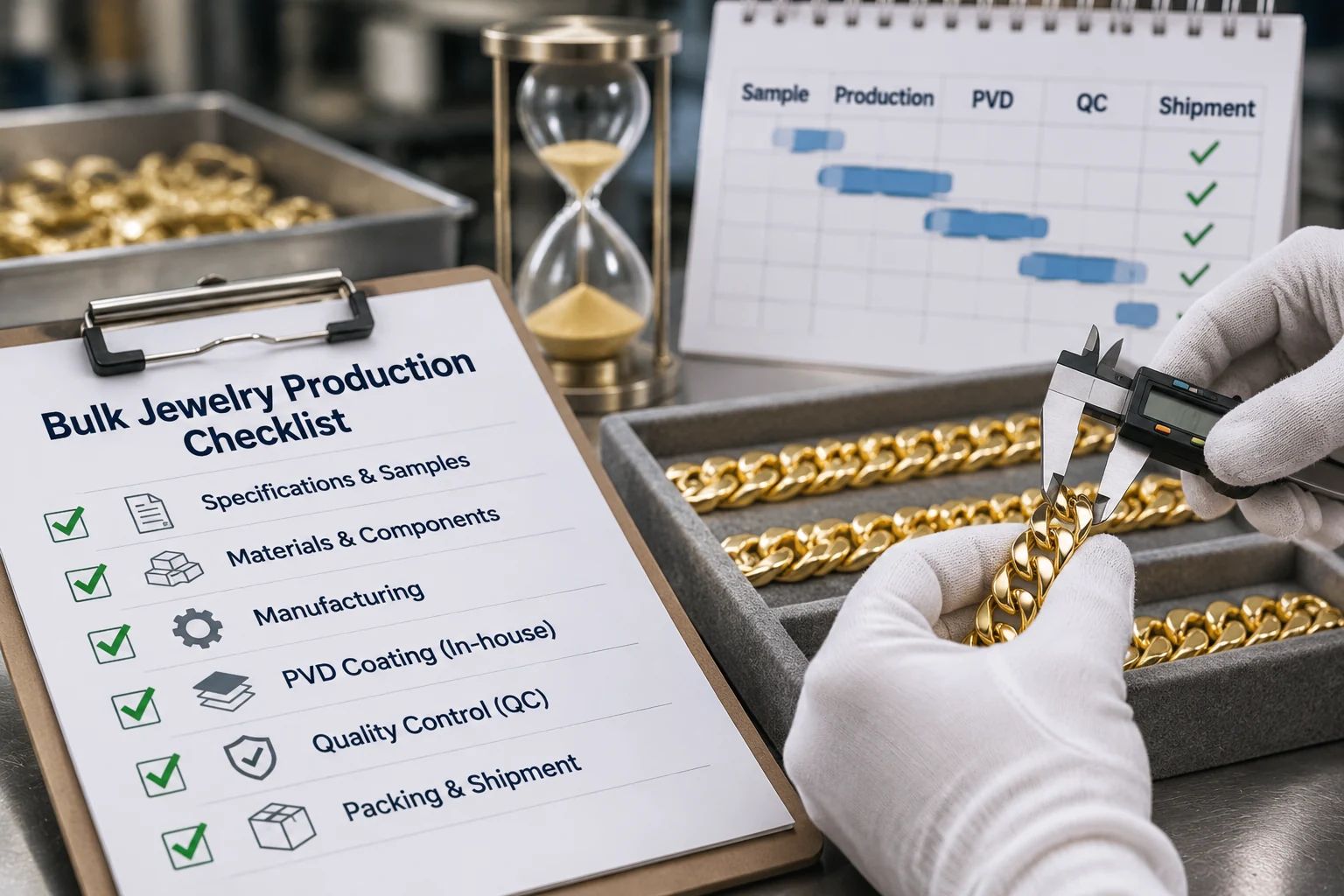
Prevent bulk jewelry production delays with a buyer's checklist for lead times, PVD handoffs, QC holds, rework, and shipment readiness.
Quick Answer
Bulk jewelry production delays often result from unclear specifications, late approvals, finishing schedules, QC findings, rework, and incomplete shipment-readiness information. These problems can accumulate across several production stages before buyers realize that an agreed delivery date is at risk.
To reduce that risk, define the production lead time in writing, agree on measurable milestones, track verified quantities by SKU instead of relying on a single completion percentage, and establish how schedule changes will be communicated.
For jewelry brands sourcing 316L stainless steel products, special attention should be given to finishing requirements, PVD scheduling, quality release, and the difference between completed products and units actually ready to ship.
Key Takeaways
- Define the lead time clearly. Confirm when the production clock starts, what the quoted period includes, and when the order is considered ready for shipment.
- Track manufacturing milestones. Ask for evidence at material preparation, fabrication, finishing, quality inspection, and packing stages.
- Monitor verified quantities. An order reported as 80% complete may still have important SKUs waiting for finishing, inspection, or rework.
- Account for specialized processes. PVD coating and other specialized operations can add production stages that need to be included in the manufacturing schedule.
- Treat QC findings as schedule risks. Document affected quantities, inspection decisions, and revised milestones without compromising agreed quality requirements.
- Use a written checklist. Agree on the evidence, responsibility, and update expectations before bulk manufacturing begins.
Why Do Bulk Jewelry Production Delays Happen?
Bulk jewelry manufacturing involves several connected activities. A delay in one stage can affect later production, inspection, packing, and shipment preparation.
For OEM and ODM orders involving 316L stainless steel jewelry, several issues deserve particular attention.
Unconfirmed or changing specifications
Changes to dimensions, engraving, finish color, stone setting, or packaging after production begins may require additional preparation, approval, or manufacturing work.
For example, if a brand changes the approved gold-tone finish after components have entered production, the manufacturer may need to review whether the existing production plan remains suitable.
Late sample approval
A sample may be physically complete but still awaiting confirmation of its appearance, dimensions, or functional details.
Until the required approvals are received, the supplier may be unable to proceed confidently with the affected production steps.
Material or component readiness
Even if the main stainless steel material is available, a project may depend on additional components such as clasps, decorative stones, logo parts, or custom packaging.
A shortage of one required component can prevent completion of an otherwise nearly finished SKU.
Specialized process scheduling
Some manufacturing processes require coordination between different production stages or specialist partners, depending on the manufacturer's setup.
PVD coating, for example, involves surface preparation, coating requirements, and inspection. Even when performed in-house, it needs to be included in the production schedule with sufficient time for processing and quality checks.
Jewins operates its own PVD coating facility for stainless steel jewelry. For applicable orders, the PVD stage should be included in the overall production timeline rather than treated as an external supplier dependency.
Quality findings and rework
Inspection may identify nonconforming units that need further evaluation, correction, or replacement.
If problems are discovered late, the required corrective work may affect packing and shipment dates.
Mixed-SKU complexity
An order containing multiple styles, colors, sizes, or finishes can have different completion statuses across its SKUs.
The manufacturer may report that most pieces are finished while a critical size or finish variation remains unavailable.
The important lesson is that production delays are not always caused by a single major failure. Several small deviations can accumulate when buyers and manufacturers lack a shared view of actual progress.
Define a Realistic Production Lead Time Before Ordering
A quoted production lead time is useful only when both parties understand what it covers.
Before placing a bulk jewelry order, buyers should confirm five things.
When Does the Production Clock Start?
Manufacturers may calculate lead time from different events, including:
- Receipt of the agreed deposit
- Final sample approval
- Confirmation of manufacturing specifications
- Completion of required artwork or packaging approvals
- Material readiness or a formally agreed production start date
These events do not always occur together.
A quotation stating "25 working days" is difficult to evaluate if the buyer does not know when those days begin.
The purchase order or production confirmation should therefore identify the agreed starting condition.
Production Completion vs. QC Release vs. Shipment
Buyers should also distinguish between several possible completion points.
Milestone | What it means |
|---|---|
Production complete | The relevant manufacturing operations have been completed |
QC released | Products have passed the applicable inspection and release requirements |
Packing complete | Approved products have been packed according to the agreed specification |
Ready for shipment | The required goods and shipping documents are prepared for the agreed handover |
Shipped | Goods have been handed over under the agreed transport arrangement |
Delivered | Goods have reached the agreed destination or delivery point |
These milestones are related but not interchangeable.
A manufacturer may finish production before the order passes final QC. Products may also be packed before the carrier collects them.
Production lead time is not necessarily the same as delivery time to the buyer's warehouse.
International freight transit, customs procedures, and destination handling can add time after factory shipment. Brands planning a product launch should confirm which logistics stages are included in the supplier's commitment and which are handled separately.
Confirm the Assumptions Behind the Schedule
A realistic production schedule should identify the conditions on which the dates depend.
Ask the manufacturer:
- Are the product specifications and approved samples final?
- Which materials and components must be available before production starts?
- Which manufacturing or finishing operations require additional scheduling?
- How are quality inspections and potential rework accounted for?
- How will the schedule be revised if approvals or requirements change?
Do not automatically apply a generic industry production average to a specific order.
Lead time depends on design complexity, manufacturing requirements, order quantities, finishing methods, and the supplier's current production commitments.
For a broader explanation of OEM/ODM project preparation, see Jewins' custom jewelry manufacturing guide.
For a specific Jewins project, request a lead-time assessment based on the confirmed specifications and order requirements.
Track the Right Manufacturing Milestones
Many jewelry brands monitor only two events: when they place an order and when the factory promises to ship it.
That leaves limited visibility into what happens between those dates.
A more useful approach is to agree on a small number of production milestones, each supported by evidence appropriate to the order.
Material and Component Readiness
Before manufacturing begins, buyers should confirm whether the required materials and components are ready.
For stainless steel jewelry, the approved material grade should be part of the order specification.
Jewins identifies 316L stainless steel as its standard material for stainless steel jewelry, with documented product-specific exceptions where applicable.
However, material grade alone does not establish whether every required component is ready for production.
Buyers should also consider:
- Clasps and connectors
- Stones and decorative components
- Custom logo parts
- Approved finish references
- Product-specific packaging components
The appropriate evidence may include material status confirmation, an approved component list, or another agreed manufacturing record.
Manufacturing, Assembly, and PVD Scheduling
The manufacturing stages depend on the jewelry design.
A stainless steel chain, ring, pendant, and stone-set bracelet may require different operations. Buyers should not assume every product follows the same production route.
For each applicable milestone, the supplier should clarify which products have completed the step and what remains outstanding.
For jewelry requiring PVD finishing, buyers should pay particular attention to the coating schedule and its position within the overall production timeline.
Useful questions include:
- How many pieces have been prepared for PVD coating?
- When is the in-house coating stage scheduled?
- What finish and color references were approved?
- When is the coating stage expected to be completed?
- What inspection is required after the finishing step?
Jewins operates its own PVD coating facility for stainless steel jewelry. For orders requiring PVD finishing, buyers should confirm the coating schedule, relevant production milestones, quality inspection requirements, and shipment readiness with the Jewins team.
The production plan should account for the applicable internal PVD processing stage rather than assuming that coating is automatically completed at the same time as other manufacturing operations.
Inspection, Packing, and Shipment Readiness
Physical manufacturing completion does not automatically mean an order is ready for shipment.
Quality inspection may cover dimensions, appearance, surface finish, construction, and other approved product requirements.
Some jewelry designs also require checks of stone retention, closures, or additional decorative elements.
For stone-set jewelry, Jewins' article on why stones fall out of jewelry explains several relevant quality risks.
After inspection, buyers should confirm which units have been released and whether packing materials, labels, and shipment documents are ready.
For each milestone, request evidence proportional to the risk and order complexity.
This might include counted product photographs, inspection summaries, packing lists, or an agreed progress report.
The objective is not to create unnecessary paperwork. It is to identify schedule problems while there is still time to respond.
Track Verified Quantities, Not Just Completion Percentages
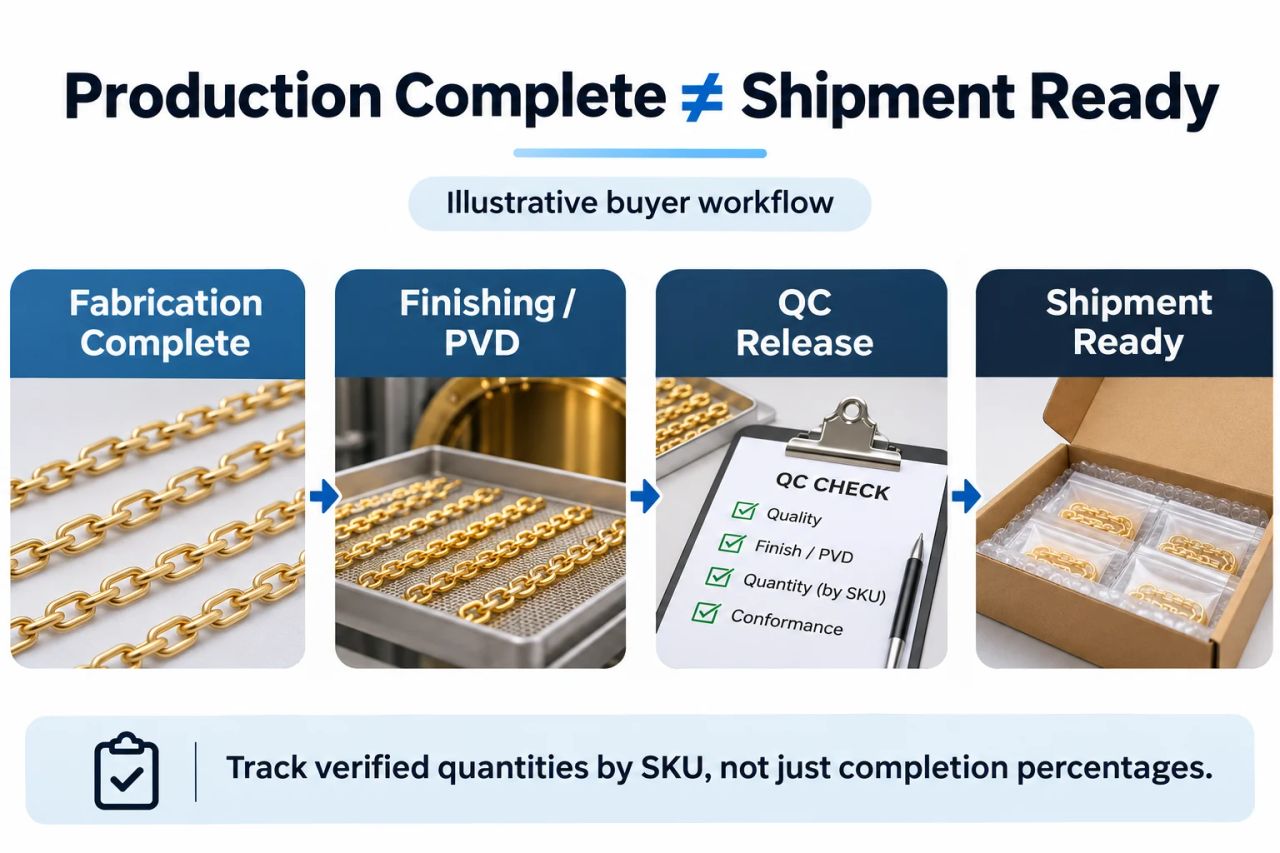
One of the most common weaknesses in production communication is the use of an overall completion percentage without supporting quantities.
Consider a manufacturer reporting:
"The order is 85% complete."
That information alone does not show whether the remaining products are low-priority items or essential SKUs needed for a planned launch.
It also does not establish whether the completed products have passed inspection.
What Should a SKU-Level Production Update Include?
For orders involving several styles, sizes, or finishes, buyers should consider requesting the following information:
- Ordered quantity for each SKU, size, and finish
- Quantity that has completed the applicable manufacturing operations
- Quantity currently awaiting or undergoing finishing
- Quantity that has completed finishing
- Quantity released after the required QC checks
- Quantity on hold for correction, further evaluation, or reinspection
- Quantity packed and ready for shipment
These records help distinguish physical production progress from actual shipment readiness.
An important counting rule: production-stage quantities must be clearly identified as either cumulative totals or mutually exclusive current statuses.
For example, a piece that has completed fabrication, finished PVD coating, and passed QC is still one physical unit.
Buyers should not add those cumulative stage totals together as if they represented separate products.
Where a status report uses mutually exclusive categories, each unit should appear in only one current category at a specified reporting time. The supplier and buyer should agree on how those categories are defined.
Why Do Verified Quantities Matter?
1. They reveal the actual bottleneck.
An order might be nearly complete overall while one required finish or ring size is still awaiting inspection.
SKU-level information helps identify which items create the greatest delivery risk.
2. They support better shipment decisions.
A jewelry brand may need certain SKUs for an upcoming marketing campaign.
Knowing exactly which products are released can help the buyer evaluate whether an approved partial shipment is practical.
3. They reduce confusion between production and release.
Products that have completed fabrication may still require coating, inspection, or packing.
These stages should not be treated as equivalent to shipment readiness.
4. They make revised timelines easier to evaluate.
A revised production date supported by affected SKU quantities, remaining operations, and inspection status is more useful than a general reassurance.
Verified evidence does not have to mean access to the manufacturer's entire internal production system.
The buyer and supplier can agree on the level of detail appropriate for the project.
The key is to request information that supports actual procurement decisions.
What Should Buyers Do When QC or Rework Delays an Order?
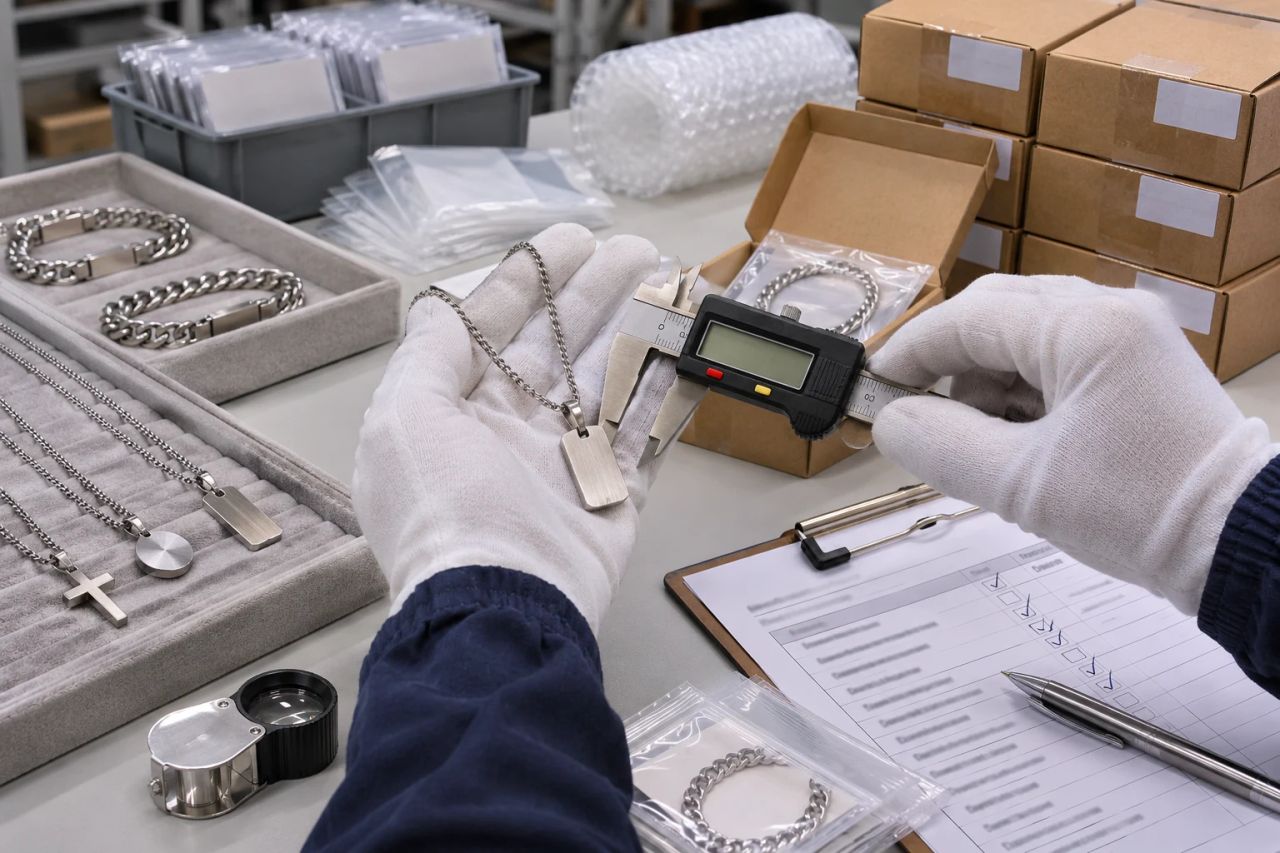
Quality inspections may identify nonconforming units that require rework, further evaluation, or replacement.
Such findings do not automatically mean the entire order has failed, but they should be assessed before the affected products are released.
When a quality issue threatens the schedule, buyers should follow a structured decision process.
1. Identify the Affected Products
Ask the manufacturer to specify:
- The defect or nonconformity
- The affected SKUs and quantities
- The relevant inspection findings
- Whether the problem appears isolated or may affect other units
- Which products remain unaffected
A vague statement such as "some products have quality problems" is not enough to evaluate the delivery impact.
2. Separate Released and Held Quantities
Confirm which products have passed the applicable QC requirements and which are still on hold.
This distinction is especially important for mixed-SKU orders.
A problem with one variation should not automatically be interpreted as proof that every product in the order is defective. Equally, unaffected products should not be assumed releasable without completing their own required checks.
3. Confirm the Corrective Action
Different defects can require different responses.
Depending on the problem, corrective action may involve:
- Additional inspection
- Component adjustment or replacement
- Surface refinishing
- Reworking affected units
- Replacing products that cannot meet the agreed requirements
For items requiring specialized finishing, corrective work may involve another production cycle or additional processing time.
Buyers should ask which operations are required and how they affect the remaining production schedule.
4. Request a Revised Milestone Date
Instead of accepting a general statement that the order will be delayed, ask for a revised date linked to a specific event.
For example:
- Corrective work completed
- Affected units reinspected
- Final QC release confirmed
- Packing completed
- Shipment ready
The revised schedule should also identify the responsible contact and the next update point.
5. Evaluate Shipment Options Without Compromising Quality
If some SKUs are released while others remain on hold, buyers may consider an approved split shipment.
However, partial delivery should be evaluated against:
- Confirmed released quantities
- The buyer's launch or inventory priorities
- Additional freight and handling costs
- Packing and documentation requirements
- Any applicable contractual or customer approval conditions
Quality requirements must remain in force.
A schedule problem is not a reason to release products that fail applicable safety, legal, or agreed mandatory quality requirements.
If a minor cosmetic deviation is being considered, it should be assessed against the agreed acceptance criteria. Any proposed change to those criteria should receive explicit written buyer approval where permissible, rather than being treated as an automatic concession to recover time.
6. Document the Final Decision
Maintain a record of the issue, affected quantities, agreed corrective action, revised milestones, and final release decision.
These records can also help improve the specifications and inspection requirements for future repeat orders.
The objective is not to eliminate every possible manufacturing issue. It is to establish a process for identifying risks, making informed decisions, and keeping the buyer's delivery plan realistic.
Bulk Jewelry Production Lead Time Checklist
The following template can help jewelry brands discuss production milestones and evidence requirements with a supplier.
Illustrative buyer template: This table contains no real order dates, quantities, or Jewins production records. The buyer and supplier should complete the relevant fields for their own project.
Milestone | Evidence to Request | Owner | Planned Date | Revised Date | Verified Quantity / SKU | Status |
|---|---|---|---|---|---|---|
Specifications and sample approved | Approved sample, drawings, finish reference | — | — | — | — | — |
Materials and components confirmed | Material and component status | — | — | — | — | — |
Manufacturing operations completed | SKU counts, relevant production evidence | — | — | — | — | — |
PVD coating scheduled, if applicable | Coating schedule and product quantities | — | — | — | — | — |
PVD coating completed | Completed quantities and inspection status | — | — | — | — | — |
In-process QC | Inspection findings and affected quantities | — | — | — | — | — |
Final QC and release | Released and held quantities by SKU | — | — | — | — | — |
Rework or corrective action, if required | Problem, corrective action, reinspection plan | — | — | — | — | — |
Packing completed | Packing list and quantity confirmation | — | — | — | — | — |
Ready for shipment | Final released counts and required shipping documents | — | — | — | — | — |
Not every order needs all these milestones, and not every supplier uses the same reporting format. Adapt the table to the actual product, manufacturing route, and commercial agreement.
Before Placing the Bulk Order
- ☐ Confirm the event that starts and ends the quoted production lead time.
- ☐ Approve final specifications, samples, finish references, and SKU quantities.
- ☐ Identify the production stages and applicable finishing requirements.
- ☐ Agree on production milestones and the evidence required.
- ☐ Define who provides updates and how schedule changes will be communicated.
- ☐ Confirm the QC acceptance and release requirements.
- ☐ Clarify whether partial shipments are permitted and who must approve them.
During Production
- ☐ Compare milestone updates against the agreed schedule.
- ☐ Check actual quantities by SKU, size, and finish.
- ☐ Distinguish cumulative production figures from current status quantities.
- ☐ Confirm the schedule and status of applicable PVD processing.
- ☐ Track products awaiting inspection, correction, or release.
- ☐ Document revised milestone dates and their reasons.
- ☐ Confirm packing, shipping documents, and released quantities before dispatch.
A checklist works best when both sides agree on its definitions before the first production update.
For brands managing several production orders or repeat collections, these practices can also support broader jewelry supply chain planning.
How Jewins Supports Bulk Order Coordination
Jewins works with overseas jewelry brands on OEM/ODM stainless steel jewelry development and bulk sourcing, including sample development, production coordination, quality inspection, and private label packaging support.
316L stainless steel is the standard material used across Jewins stainless steel jewelry, with documented product-specific exceptions where applicable.
Jewins operates its own PVD coating facility for stainless steel jewelry. This in-house capability allows PVD finishing to be included as a defined stage in the production schedule.
For buyers planning a new bulk jewelry order, these manufacturing and sourcing services provide an opportunity to discuss production requirements before the order begins.
Depending on the project, useful planning questions may include:
- Which specifications and samples need to be approved?
- What production steps apply to the selected jewelry design?
- Does the order require PVD coating or other specialized finishing?
- What QC requirements should be confirmed before production?
- Which production progress records can be shared?
- How will schedule changes and shipment readiness be communicated?
The exact milestones, reporting detail, and production schedule should be confirmed with the Jewins team for the specific order.
The SKU-level tracking methods and buyer checklist described in this article are recommended procurement practices. They should not be interpreted as a claim that Jewins automatically provides every listed report or maintains a particular internal tracking system for every project.
For growing jewelry brands, the purpose of clearer order planning is straightforward: reduce avoidable misunderstandings and create a stronger basis for managing production, quality, and delivery expectations.
Frequently Asked Questions
How long should bulk jewelry production take?
There is no single lead time that applies to every bulk jewelry order.
The schedule depends on design complexity, order size, finishing requirements, material readiness, production capacity, and inspection needs.
Ask your manufacturer to provide a project-specific lead time with clearly defined starting conditions, milestones, and completion terms. Confirm whether freight transit and delivery to your warehouse are included or separate.
What is the best way to track a bulk jewelry order?
Track production milestones and verified quantities rather than relying only on an overall completion percentage.
For multi-SKU orders, request updates that distinguish manufacturing progress, products undergoing finishing, QC-released quantities, held quantities, and shipment-ready products.
Make sure the reporting format avoids double counting units across production stages.
Why can PVD finishing affect jewelry production schedules?
PVD coating is a specialized surface-finishing process that requires appropriate preparation, coating conditions, and inspection.
For manufacturers with in-house PVD facilities, the coating stage still needs to be included in the overall production schedule, with sufficient time for processing and quality checks.
If finishing defects require corrective work, additional processing and reinspection may affect the expected completion date.
What should buyers ask when QC finds a problem?
Ask for the defect category, affected SKUs, quantities, inspection findings, corrective action, and revised milestone dates.
Confirm which products remain on hold and which have been released under the agreed requirements.
Do not authorize shipment of nonconforming units simply to meet a deadline.
Can a jewelry brand ship completed SKUs while other items are still in production?
A partial shipment may be possible when specific SKUs have passed the required inspections and are ready for dispatch.
However, the buyer and supplier must confirm that split delivery is permitted, agree on the released quantities, review additional logistics costs, and approve the shipment arrangement.
Products that remain under QC hold or require corrective work should not be treated as shipment-ready.
Plan Your Next Bulk Jewelry Order With Clearer Production Milestones
If your brand is planning a 316L stainless steel jewelry collection or a new OEM/ODM bulk order, clear production requirements can help reduce avoidable delays.
Share your design files or reference samples, expected quantities, SKU breakdown, material and finish requirements, packaging specifications, and target shipment window with Jewins.
The team can review your project requirements and discuss the applicable production and quality considerations, including the schedule and order updates that can be agreed for your project.
Planning Your Next Jewelry Collection?
Share your product references, material, finish, quantity, branding and packaging requirements.