
Does Stainless Steel Jewelry Have Nickel? Brand Compliance Guide
Yes, many stainless steel jewelry grades contain nickel, including common 304 and 316L stainless steel. So the word “stainless steel” does not automatically mean nickel-free.
For most jewelry brands, the more important issue is nickel release — how much nickel may migrate to skin during wear. A product can contain nickel and still be a lower-risk material choice when the grade, surface finish, corrosion resistance, and documentation are properly controlled.
The practical takeaway: confirm the material grade, understand release risk, and avoid unsupported “nickel-free” or “allergy-free” claims unless the material and testing can support them.
Stainless steel jewelry can contain nickel. That does not automatically mean the piece is unsafe, nickel-free, or hypoallergenic. So if you are asking "does stainless steel have nickel?" or more specifically "does stainless steel contain nickel?" — for most jewelry grades the honest answer is yes, but the amount that actually reaches skin depends on more than the alloy alone. For shoppers, the question is usually whether the jewelry may irritate skin. For jewelry brands, the bigger question is whether the material grade, nickel release risk, supplier documents, and product claims are controlled before bulk orders.
This guide explains what nickel in stainless steel jewelry really means, how 304 and 316L compare, why nickel release matters more than nickel content alone, and what brands should ask suppliers before launching a stainless steel jewelry line.
Does Stainless Steel Jewelry Have Nickel?
Short answer: often, yes.
Many shoppers also ask, “does stainless steel contain nickel?” In jewelry, the answer depends on the grade, but common 304 and 316L stainless steel usually do contain nickel.
Most stainless steel alloys used in jewelry, including 304 and 316L, contain nickel as part of their composition. Nickel helps improve corrosion resistance, strength, shine, and durability, which is why it appears in many stainless steel grades used for jewelry.
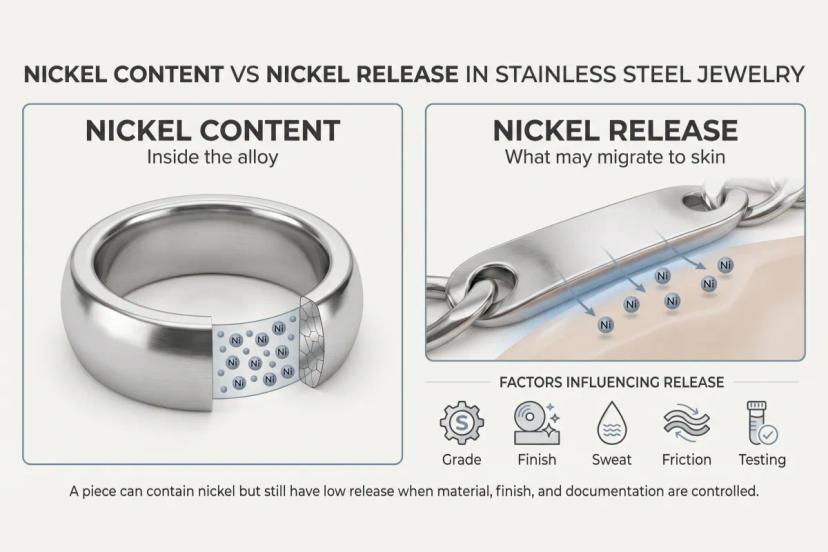
That does not mean every stainless steel piece will cause a skin reaction. Nickel inside the alloy is different from nickel that transfers to skin. The buyer question should not stop at “does it contain nickel?” A better question is: how stable is the material and how much nickel can actually be released during wear?
Is Stainless Steel Jewelry Nickel-Free?
In most cases, common stainless steel jewelry is not strictly nickel-free. Grades such as 304 and 316L usually contain nickel, so brands should be careful with product titles or packaging that claim “nickel-free stainless steel jewelry.”
Sometimes “nickel-free” means no intentionally added nickel. Sometimes it means nickel below a defined threshold. Sometimes it is only used as marketing language without enough documentation. For jewelry brands, that difference matters because unsupported claims can lead to customer complaints, returns, or compliance problems.
| Term | What It Usually Means | Safer Brand Use |
|---|---|---|
| Nickel-free | No intentionally added nickel, or nickel below a defined threshold depending on the market, standard, and test method | Use only when supported by material specifications and testing |
| Hypoallergenic | Less likely to trigger a reaction for most wearers | Use as lower-risk language, not as an allergy-free promise |
| 316L stainless steel | A quality stainless steel grade often used for jewelry, but still nickel-containing | Use as a grade indicator, not a nickel-free claim |
| Nickel release tested | Tested against a defined nickel release method or limit, such as EN 1811 in EU contexts | Stronger claim when backed by a test report |
For brands, “nickel release tested” is much more defensible than “nickel-free” when the material itself contains nickel.
What 304 vs 316L Means for Nickel Claims
Brands sourcing stainless steel jewelry often compare 304 and 316L because both grades affect how a product can be described. The key point for nickel claims is simple: both can contain nickel, but their corrosion resistance, supplier consistency, and documentation support may differ. (For a broader grade-by-grade overview beyond nickel — including 201 and 316 — see which stainless steel is best for jewelry.)
| Grade | Typical Nickel Content | Common Jewelry Use | Sourcing Notes |
|---|---|---|---|
| 304 stainless steel | Roughly 8–10.5% nickel | Budget to mid-range jewelry and fashion pieces | Lower cost, but supplier variation can be higher |
| 316L stainless steel | Roughly 10–14% nickel, plus molybdenum for added corrosion resistance | Mid-range to premium stainless steel jewelry | More corrosion-resistant and often used for sensitive-skin-friendly positioning |
| Unknown stainless steel | Cannot be confirmed | Low-cost or undocumented supply chains | Highest risk for any nickel-related or hypoallergenic claim |
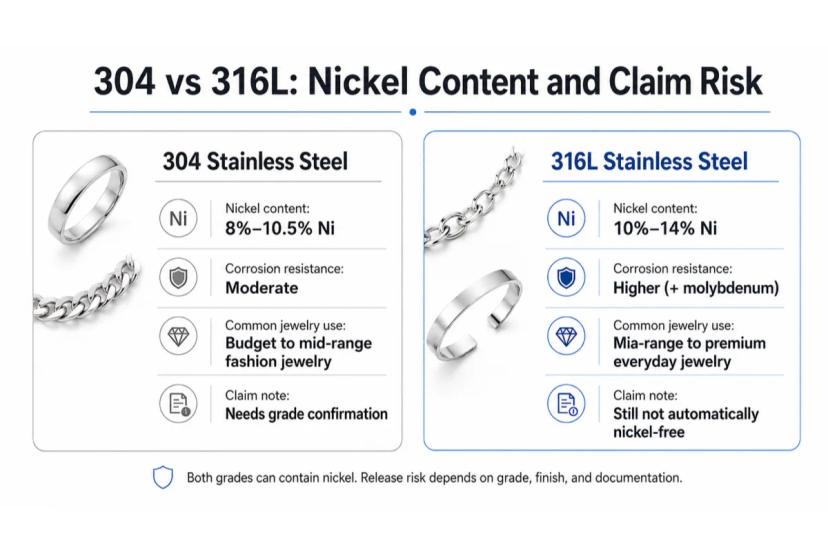
A common misunderstanding is that 316L is preferred because it has no nickel. In reality, 316L usually contains nickel too. Its advantage is stronger corrosion resistance and a more stable surface, which can help reduce release risk when the material, finish, and production process are well controlled.
Typical nickel ranges depend on the exact stainless steel specification, supplier documentation, and batch material records, so treat the figures above as general reference ranges rather than fixed values for every product.
This comparison is scoped to nickel only. For a fuller look at corrosion resistance, PVD compatibility, weldability, and cost trade-offs between the two grades, see the 304 vs 316L material guide.
Why Nickel Content Is Different From Nickel Release
Nickel content means how much nickel is inside the alloy. Nickel release means how much nickel may migrate from the jewelry surface to skin during wear. For skin contact and compliance, release is usually the more important concept.
Nickel release can be affected by:
- Surface finish and polishing — smoother, better-finished surfaces usually create less irritation risk than rough or poorly finished surfaces.
- Passivation and corrosion resistance — a stable protective surface layer helps reduce metal exposure at the surface.
- Sweat, moisture, and chemicals — perfume, lotion, chlorine, sweat, and cleaning agents can affect the surface over time.
- Friction points — rings, earring posts, clasps, and watch backs usually face more skin contact and wear than pendants.
- Plating or PVD wear — coatings can change surface behavior once high-friction areas begin to wear.
This is why two pieces both described as “316L stainless steel jewelry” can perform differently. Material grade matters, but the finished product, surface quality, and available test documentation matter too.
What “Hypoallergenic” Means When Stainless Steel Contains Nickel
Stainless steel jewelry is often marketed as hypoallergenic, especially when made with 316L stainless steel. For many wearers, well-made 316L is a sensitive-skin-friendly and lower-risk option compared with nickel-plated base metals or undocumented alloys.
But hypoallergenic does not mean allergy-free. People with strong nickel sensitivity may still react, especially with prolonged contact, sweat, or friction. Nickel sensitivity itself is not rare in the general population — studies cited by the Nickel Institute put it at up to 15% of women and up to 2% of men (Thyssen and Menné, 2010), though jewelry is only one of several common exposure sources, not the sole cause. For consumers, 316L is a reasonable starting point if they want stainless steel jewelry for sensitive skin, but a medical nickel allergy should be handled more carefully.
For brands, the safest wording is controlled: “sensitive-skin-friendly,” “lower-risk material choice,” or “nickel release tested” when supported. Avoid absolute claims such as “allergy-free,” “zero irritation,” or “100% nickel-free” unless the documentation truly supports them.
This article focuses narrowly on what hypoallergenic wording can and can't claim once nickel is in the alloy. For a broader look at how hypoallergenic claims, grade, and finish relate for sensitive-skin shoppers, see the hypoallergenic stainless steel jewelry guide — for brand and packaging wording specifically, the risk-language standard used in this article is the one to follow.
EN 1811, REACH, and Nickel Release Testing
For brands selling into nickel-regulated markets, EN 1811 and REACH are important compliance terms to understand.
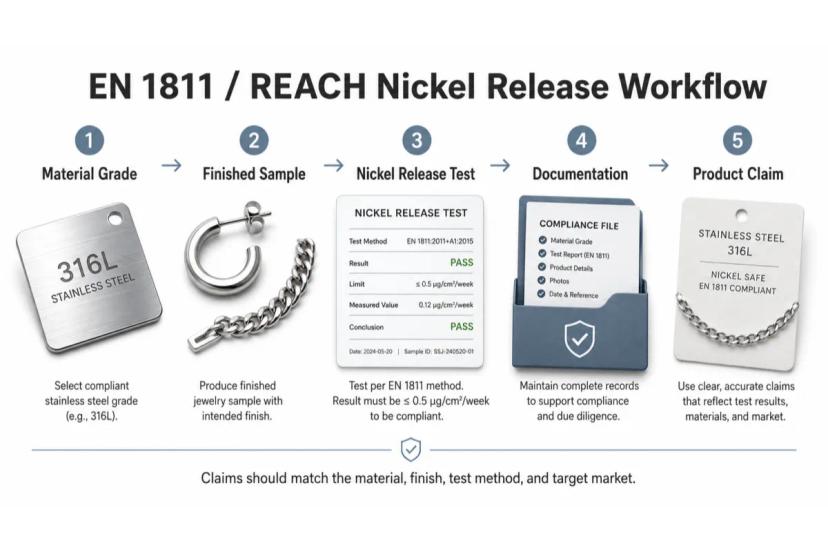
EN 1811 is a European test method associated with measuring nickel release from products intended for direct and prolonged skin contact, including jewelry. It is published by the European Committee for Standardization (CEN), and the current reference version is EN 1811:2023, adopted by the European Commission in December 2023. REACH is the EU chemical regulation framework, and the nickel restriction for skin-contact articles sits in Annex XVII, Entry 27.
One detail is worth pulling out because it is the heart of this whole article: the REACH restriction is written around nickel release rate, not total nickel content. The commonly referenced migration limits are around 0.5 µg/cm²/week for articles in prolonged skin contact (rings, bracelets, necklaces, watch parts) and a tighter 0.2 µg/cm²/week for post assemblies inserted into pierced ears or other piercings. A stainless steel piece can contain roughly 10% nickel and still release very little — which is exactly why "how much nickel does it contain?" is the wrong test, and "how much does it release?" is the right one.
This section is not legal advice, but brands should understand the sourcing implications:
- Requirements can vary by market and product type.
- Piercing or post assemblies face the stricter limit and can be treated differently from general skin-contact jewelry.
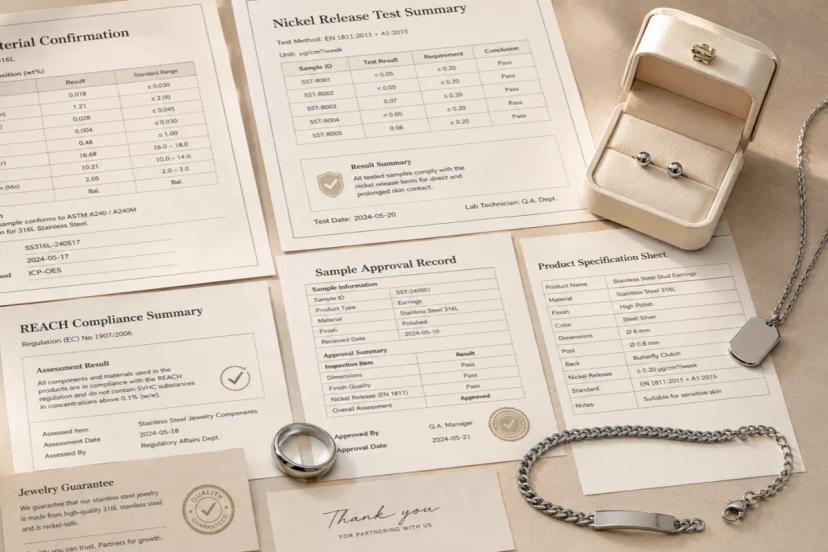
- A supplier's quality statement — or an XRF report showing only total nickel content — is not the same as a nickel release test report or REACH-related documentation.
- For EU-market jewelry, brands should confirm the current applicable standard and test method with a testing lab or compliance partner, because accepted standards can change (EN 1811 itself was updated to the 2023 version).
The practical question for brands is simple: before launching into a target market, ask what testing and documentation the supplier can support for that specific product, finish, and batch.
Supplier Questions for Nickel Claims and Compliance Documents
Before committing to wholesale stainless steel jewelry, OEM stainless steel jewelry, or a private label stainless steel jewelry line, brands should ask for clear answers in writing — especially when product pages will mention nickel-free, hypoallergenic, sensitive-skin-friendly, or REACH-related claims.
| What to Ask | Why It Matters for Nickel-Related Claims |
|---|---|
| What stainless steel grade is used? | A vague "stainless steel" claim gives no basis for any nickel-related wording at all |
| Can 316L be confirmed if claimed? | Grade confirmation is the floor — without it, "lower-risk" or "sensitive-skin-friendly" wording has nothing to stand on |
| Is nickel release testing available? | This is the strongest evidence behind any hypoallergenic or sensitive-skin claim, stronger than grade name alone |
| Can REACH or market-specific documentation be supported? | Needed before using any REACH-related or release-tested wording for that target market |
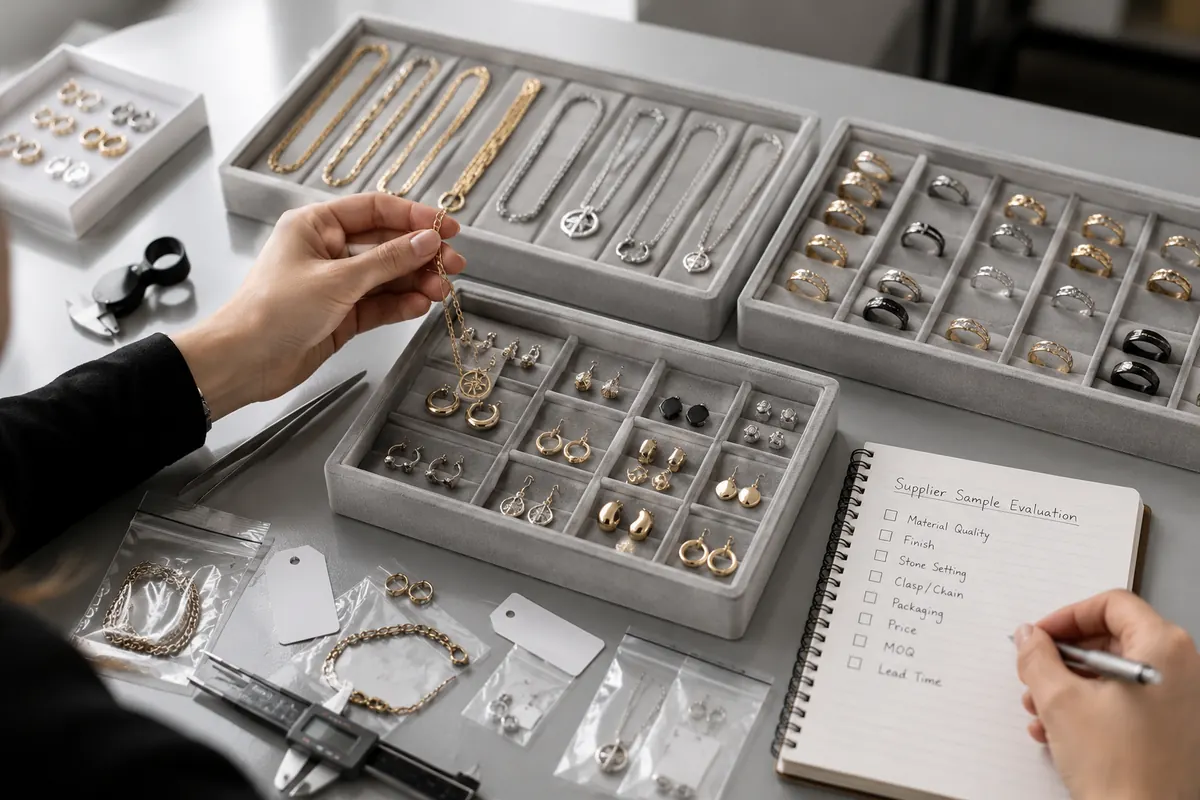
| Can samples be approved before bulk production? | Lets brands confirm the finish that will actually carry the claim, not just the alloy on paper |
| What finish process is used? | Polishing, PVD, and passivation affect nickel release risk, not just appearance |
| What QC process is used for repeat orders? | A claim that held up on the sample needs to keep holding up across every reorder batch |
| Can packaging and product claims be reviewed? | Keeps nickel-related wording aligned with what the material and testing actually support |
A supplier who can answer these questions with documents and samples is usually a safer long-term partner than one offering only low prices and broad promises.
Sourcing now? If you want a concrete starting point, ask a potential supplier for two things in writing: a 316L material confirmation and an EN 1811 nickel release test report for the actual finish you plan to sell. You can request both from Jewins as part of a sample request.
How Jewins Helps Brands Manage Nickel-Related Sourcing Risk
Jewins supports jewelry brands, wholesalers, and private label buyers as a stainless steel jewelry manufacturer from material direction to finished production. The table below focuses on the part of that support most relevant to nickel claims and documentation — for the full sample-to-bulk sourcing workflow (grade selection, PVD finish, QC, repeat production), see 316L stainless steel jewelry sourcing.
| Buyer Concern | How Jewins Supports |
|---|---|
| Unsure whether to use 304 or 316L for a nickel-sensitive claim | Material direction based on product category, price point, and target market |
| Worried about nickel-free or hypoallergenic claims | Helps align wording with material, finish, and available documentation |
| Selling into compliance-sensitive markets | Documentation support when required |
| Need samples or repeat-production support | See the full sourcing workflow linked above |
The goal is not to promise zero allergy risk, but to help brands reduce sourcing uncertainty through better material selection, documentation support, and claim-wording review before that wording reaches packaging or a product page.
In practice, the questions we hear most from brands during sample development are some version of "can I call this nickel-free?" and "what do I need before I sell into the EU?" — which is why we treat claim wording and documentation as part of the sourcing conversation, not an afterthought once production is finished. Getting that order right early tends to prevent the most expensive problems: relabeling stock, pulling listings, or fielding returns over a claim that was never documented.
Need Help With Nickel Claims and Stainless Steel Jewelry Sourcing?
If you are developing a stainless steel jewelry line and need help choosing 316L material, checking claim wording, preparing samples, or discussing documentation before wholesale production, contact Jewins before placing your bulk order. A good first step is to request a sample and ask what test documentation is available for your target market.
Contact Us →
Quick Checklist Before Launching Stainless Steel Jewelry
- Confirm the exact stainless steel grade in writing.
- Understand nickel content vs nickel release.
- Avoid unsupported “nickel-free” or “allergy-free” claims.
- Use 316L stainless steel where it fits the product and price point.
- Request samples before bulk production.
- Ask about documentation for your target market.
- Align packaging and product-page wording with actual material and test support.
FAQ
Does stainless steel jewelry have nickel?
Yes, many stainless steel jewelry grades contain nickel, including common 304 and 316L stainless steel. Nickel is part of the alloy and helps improve corrosion resistance and durability. The more important skin-contact question is not only whether nickel exists, but how much nickel may release during wear.
Is stainless steel jewelry nickel free?
Usually, no. Common stainless steel jewelry grades are not strictly nickel-free. Brands should not assume “stainless steel” means “nickel-free.” If a nickel-free claim is used, it should be supported by material specifications and, where relevant, testing.
Is 316L stainless steel nickel free?
No. 316L stainless steel usually contains nickel. It is often used for sensitive-skin-friendly jewelry because of its corrosion resistance and stable surface, not because it contains no nickel. For brand claims, grade confirmation and release testing are stronger than grade name alone.
If stainless steel contains nickel, can it still be called hypoallergenic?
It is often marketed that way, especially 316L stainless steel jewelry. For many wearers, it is a lower-risk choice than nickel-plated or undocumented alloys. But hypoallergenic means less likely to irritate, not allergy-free, so brands should avoid absolute promises.
Can stainless steel jewelry cause nickel allergy?
A stainless steel jewelry allergy is possible for some people with strong nickel sensitivity, especially with prolonged contact, sweat, or friction. Nickel sensitivity affects a meaningful share of the general population — up to 15% of women and up to 2% of men, according to dermatology research cited by the Nickel Institute — though jewelry is just one of several common nickel exposure sources. Risk is usually lower with well-made 316L stainless steel than with lower-quality alloys, but it is not zero.
What is nickel release testing for jewelry?
Nickel release testing measures how much nickel may migrate from jewelry to skin under defined conditions. EN 1811 is commonly referenced in EU contexts. A release test report is usually stronger support for skin-contact claims than simply saying a piece is stainless steel or 316L.
What does REACH compliant jewelry mean?
For stainless steel jewelry brands, REACH compliant jewelry usually means the product has been reviewed against relevant EU chemical restrictions, including the nickel release limits under Annex XVII, Entry 27 (around 0.5 µg/cm²/week for prolonged skin contact, and 0.2 µg/cm²/week for piercing posts). It should not be used as casual marketing language. Brands should ask what documentation, test reports, or third-party testing support is available for the target market and product type.
What documents support a nickel-related claim specifically?
For a nickel-free, hypoallergenic, or REACH-related claim, brands should ask for material certificates confirming the actual stainless steel grade used, available nickel release test reports (such as those referencing EN 1811), and documentation supporting REACH or other target-market compliance requirements. General QC paperwork or a mill certificate alone does not support a nickel-specific claim — the claim needs documentation that speaks to nickel content or release directly.
About Jewins
Jewins is a B2B stainless steel jewelry manufacturer working with jewelry brands, wholesalers, and private label buyers. We support OEM and ODM production with low MOQ, sample development, PVD and finish planning, QC, packaging, and documentation support — helping brands move from material selection to a launch-ready, well-documented product. This guide reflects how we approach nickel-related questions with the brands we work with, with regulatory references drawn from publicly available EU sources.
Authoritative references: EU nickel restriction under REACH Annex XVII, Entry 27; the EN 1811 nickel release test method published by the European Committee for Standardization (CEN); and nickel sensitivity prevalence data cited by the Nickel Institute (Thyssen and Menné, 2010). Brands should confirm current limits and methods with a qualified testing lab or compliance partner for their specific markets and products. This article is general sourcing guidance, not legal or medical advice. Last reviewed: June 2026.
Related reading: hypoallergenic stainless steel jewelry guide, stainless steel jewelry pros and cons, PVD jewelry guide, stainless steel jewelry wholesale, Jewins certification support. For sourcing, samples, or wholesale questions, contact Jewins.