
316L stainless steel with PVD coating can support demi-fine-inspired, affordable luxury, and premium everyday jewelry collections when brands disclose the material honestly.
It is not gold vermeil, gold-filled, solid gold, or traditional fine jewelry. The sourcing decision should depend on positioning, claim wording, sample standards, PVD color consistency, and repeat-production control.
Traditional demi-fine jewelry usually relies on sterling silver, gold vermeil, gold-filled metals, solid gold, and semi-precious stones.
316L stainless steel with PVD coating is better positioned as a demi-fine-inspired or affordable luxury option for premium everyday collections, not as gold vermeil or fine jewelry.
A reliable demi fine jewelry manufacturer should help brands choose not only materials, but also positioning, sample standards, claim wording, QC checkpoints, and repeat-production controls.
Key Takeaways: Demi Fine Jewelry Manufacturer Guide
Everyday gold-tone pieces, entry-price SKUs, trend-testing products, private label capsules, and repeat-order PVD stainless steel collections.
Gold vermeil, gold-filled, solid gold, bridal, heirloom, investment-value, or strict precious-metal positioning.
Confirm base metal grade, PVD finish standard, color reference, claim wording, MOQ by finish, packaging copy, and sample-to-bulk controls.
What Demi-Fine Jewelry Means for Brands
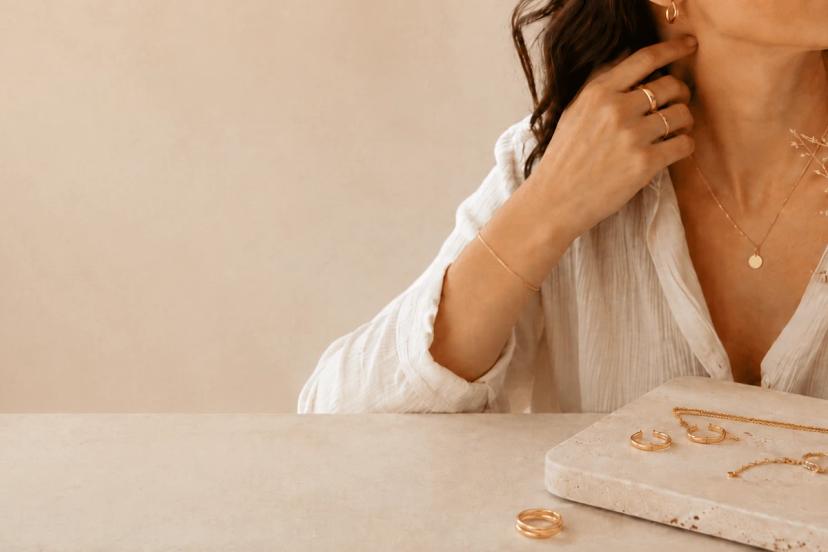
Demi-fine jewelry sits between fine jewelry and fashion jewelry. It typically uses sterling silver, gold vermeil, gold-filled metal, or solid gold in lower karats, sometimes paired with semi-precious stones — offering more metal content and durability than costume jewelry, at a price point below fine jewelry.
For a brand, "demi-fine" is not just a material spec — it's a pricing tier and a customer promise. Buyers expect jewelry that holds up to daily wear and keeps its color longer than plated fashion pieces. The definition matters less to sourcing decisions than what your customer expects the product to deliver at that price point.
This is the angle most manufacturer content skips: the material choice is a positioning choice, and it has to be defensible in your product copy, not just your cost sheet. (For the coating basics referenced throughout this guide, see our separate breakdown, What Is PVD Jewelry.)
What Brand Buyers Need Beyond the Demi-Fine Definition
Before choosing a material foundation, sourcing managers and brand owners need answers to questions that a general definition of demi-fine jewelry won't cover:
- Which material gives the most stable cost base for a growing catalog?
- Which material supports low MOQ sample testing before committing to bulk?
- What claims can the brand legally and honestly make about the finish?
- How consistent will the gold tone be across repeat production runs?
- What happens to margins if the underlying metal price moves?
These are sourcing and margin questions, not material-science questions. This is where comparing traditional demi-fine materials with 316L stainless steel and PVD becomes useful — not as an either/or debate, but as a decision framework tied to brand stage, price point, and claim tolerance.
For brands comparing a traditional demi fine jewelry manufacturer with a 316L stainless steel jewelry manufacturer, the key question is not only material cost, but whether the supplier can support honest positioning, PVD color control, sample approval, and repeat production.
Traditional Demi-Fine Materials vs 316L + PVD
For brands new to the base metal itself, our companion piece Is 316L Stainless Steel Good for Jewelry covers the material fundamentals in more depth; this section stays focused on how it compares to traditional demi-fine materials at the sourcing level.
For many startup brands, the decision starts with target retail price: a $40–$80 everyday piece usually needs a different material strategy than a $150–$300 traditional demi-fine piece.
How to use this table: Compare material positioning, claim risk, and MOQ fit before deciding whether a SKU should stay in traditional demi-fine materials or move into a demi-fine-inspired 316L + PVD line.
| Material | Common Positioning | MOQ Fit | Cost Stability | Durability Expectation | Claim Risk | Best Use Case |
|---|---|---|---|---|---|---|
| Sterling Silver | Traditional demi-fine, everyday luxury | Moderate to high MOQ for custom designs | Moderate; silver price fluctuates | Good; can tarnish without care | Lower, if 925 stamped and verified | Brands with an established demi-fine identity |
| Gold Vermeil | Traditional demi-fine, gold-layer claim | Higher MOQ, thicker gold layer standards apply | Sensitive to gold price movement | Good if gold layer meets minimum thickness | High if thickness/base metal not verified | Brands that need a defensible "vermeil" claim |
| Gold-Filled | Traditional demi-fine, mechanically bonded gold | Higher MOQ, fewer suppliers | More stable than vermeil, still gold-linked | Strong; more wear-resistant than plating | High if sold as vermeil or solid gold | Brands prioritizing verified gold content |
| Solid Gold (10K–18K) | Fine jewelry, investment-adjacent | High MOQ or made-to-order | Directly tied to gold spot price | Excellent | High if karat/purity not certified | Heritage, bridal, investment-positioned lines |
| 316L Stainless Steel + PVD | Demi-fine-inspired, affordable luxury, premium everyday | Low MOQ friendly | Stable; not tied to gold spot price | Strong for daily wear when properly specified | Moderate; must avoid vermeil/solid-gold language | Growth-stage brands testing gold-tone SKUs without gold-price exposure |
The comparison isn't about which material is "better." It's about which cost structure and claim profile match your brand's current stage and the promises you're prepared to stand behind in your product copy. If you're weighing gold-filled against gold-plated options as part of this decision, our Gold Filled vs Gold Plated guide breaks down that comparison separately.
Where 316L Stainless Steel and PVD Fit in Affordable Luxury Collections
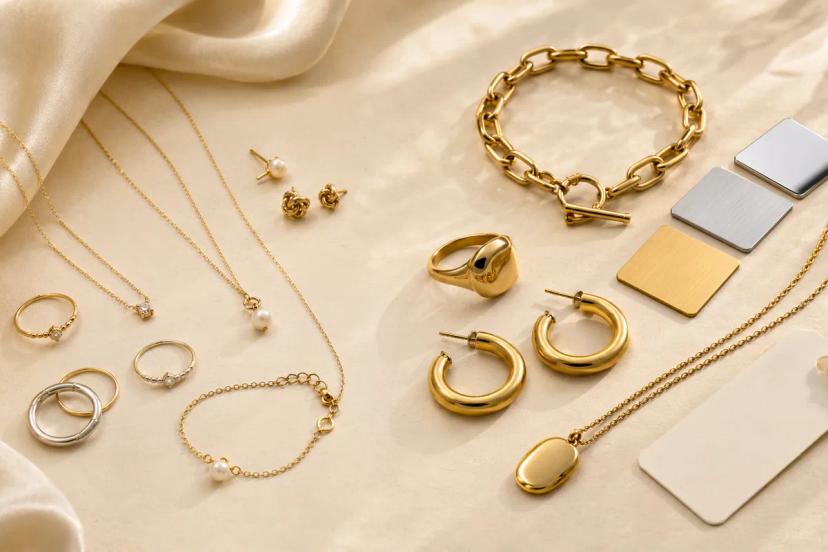
316L stainless steel with PVD coating works well for brands building a gold-tone catalog that needs to scale without the cost volatility of gold-based materials. It's a practical fit for:
This is especially relevant for brands sourcing PVD-coated stainless steel jewelry or gold-tone PVD stainless steel jewelry for everyday collections, where claim wording and finish consistency matter as much as unit cost.
- Everyday chains, stacking rings, and pendants where the brand's promise is "looks premium, wears well" rather than "verified gold content."
- Growing catalogs that need multiple SKUs tested at low MOQ before committing to bulk volume.
- Brands positioning collections as affordable luxury or accessible luxury, where the buyer understands they are getting a gold-tone finish, not a gold-content guarantee.
- Categories where PVD's coating density gives a real durability advantage over standard electroplating — useful for high-friction pieces like rings and bracelets, where thin gold layers wear fastest.
This is a cost-structure decision as much as a material decision. A brand already positioned around gold-tone everyday jewelry — not gold-content jewelry — gets a more predictable input cost by moving those SKUs to a PVD-coated stainless steel base.
When 316L + PVD Is the Right Fit — and When It Is Not
How to use this table: Use this as a SKU-level decision matrix. The goal is not to push every demi-fine brand toward stainless steel, but to separate suitable everyday SKUs from products that need precious-metal content.
| Brand Scenario | Is 316L + PVD a Good Fit? | Reason | What to Verify |
|---|---|---|---|
| Launching a gold-tone everyday jewelry line, no gold-content claim planned | Yes | Matches affordable luxury positioning without claim risk | PVD color consistency, coating specification or finish standard |
| Building a collection explicitly marketed as gold vermeil | No | Vermeil requires a verified gold layer on silver; stainless steel PVD cannot be sold as vermeil | Confirm the brand isn't using vermeil language for a PVD product |
| Growing brand testing new SKUs at low volume before bulk commitment | Yes | Low MOQ sampling fits stainless steel production more easily than gold-based metals | Sample sign-off process, minimum order quantities per finish |
| Brand positioning around heirloom, bridal, or investment value | No | Buyers in this segment expect verifiable precious-metal content | Whether the brand's customer expectations require solid gold or gold-filled |
| Brand wants to reduce exposure to gold price volatility on non-core SKUs | Yes | PVD-coated stainless steel cost base is not tied to gold spot price | Which SKUs can shift without disrupting brand identity |
| Brand needs a hypoallergenic claim for sensitive-skin customers | Depends | 316L is generally well tolerated, but claims still require documentation. Claims depend on target market requirements, nickel release testing, and individual sensitivity. Do not present 316L as zero-risk. | Nickel release requirements under EU REACH, relevant testing, and claim wording—not assumptions |
The purpose of this table is not to push every demi-fine brand toward stainless steel. It is to help brands decide which SKUs can use 316L + PVD responsibly and which SKUs should stay with precious-metal materials.
What to Ask a Demi Fine Jewelry Manufacturer Before Sampling
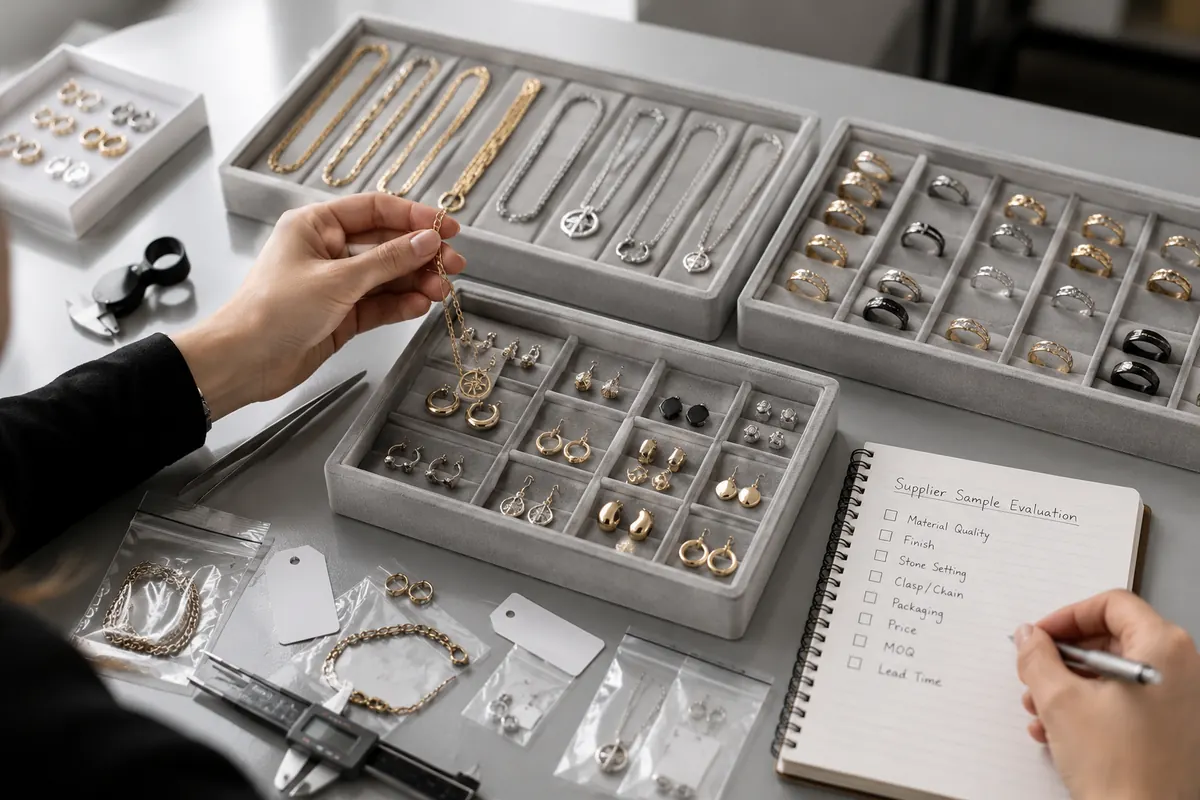
Choosing the right demi fine jewelry manufacturer at this stage means asking questions that go beyond price and lead time — the answers below determine whether your sample will hold up through repeat production.
How to use this table: Run through these checks before paying for samples, especially if the same gold tone must be reordered later.
| What to Confirm | Why It Matters | Jewins Support |
|---|---|---|
| Base metal grade (316L vs 304) | Affects corrosion resistance, nickel release, and PVD adhesion quality | Confirms grade in writing before sample development |
| Coating specification, finish standard, or thickness requirement when applicable | Thin coatings wear faster in high-friction categories like rings | Provides coating specification and category-based recommendations |
| Color consistency method (approved physical color sample, production photo reference, or color measurement method when required) | Prevents batch-to-batch gold-tone drift across repeat orders | Retains an approved reference sample for every SKU |
| Claim wording alignment | Protects the brand from vermeil, solid-gold, or "never fades" exposure | Reviews product copy language against the actual material spec |
| Sample-to-bulk consistency process | Approved samples don't always match early bulk runs without a locked standard | Defines a written quality standard before scaling |
| MOQ per finish/color | Testing multiple PVD colors can raise effective MOQ if not planned | Advises on SKU consolidation to manage MOQ across finishes |
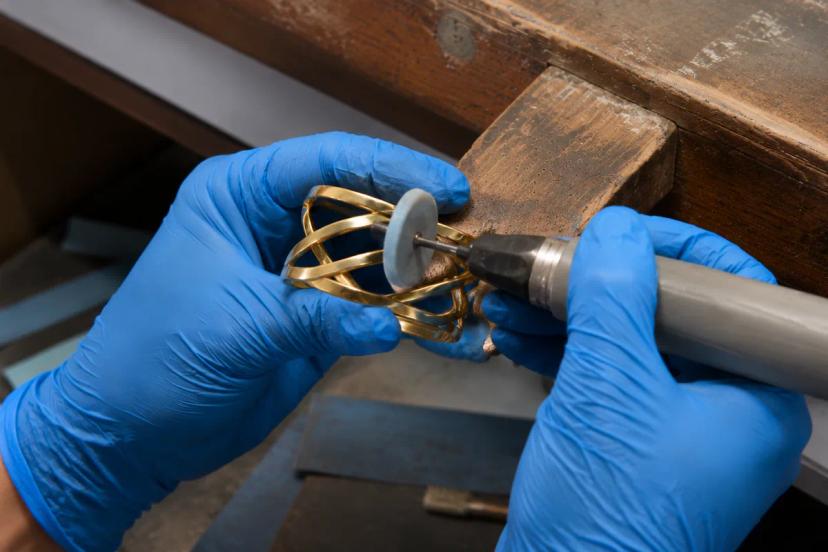
How to Describe Gold PVD Stainless Steel Jewelry Honestly
The material itself isn't the risk — the language around it is. Brands that blur the line between PVD-coated stainless steel and precious-metal demi-fine jewelry create returns, complaints, and policy issues later. The safer path is to describe the product for what it is, while still communicating its value clearly.
Claim risk note: The problem usually starts when brands describe gold PVD stainless steel as gold vermeil, gold-filled, solid gold, or fine jewelry. Keep the base metal and coating process clear.
How to use this table: Use the left column to identify risky product-page or packaging language, then replace it with wording that matches the actual material specification.
| Risky Claim | Safer Brand Wording | Reason |
|---|---|---|
| Gold vermeil stainless steel | 316L stainless steel with gold-tone PVD coating | Vermeil is a defined jewelry term under the U.S. FTC Jewelry Guides, requiring a sterling silver base and a qualifying gold layer; PVD stainless steel does not qualify |
| Solid gold look | Gold-tone PVD finish | Avoids implying gold content that isn't present |
| Fine jewelry alternative | Accessible everyday jewelry option | Keeps the product in its own category instead of borrowing fine jewelry's claim weight |
| Never fades | More wear-resistant than standard electroplating when properly specified and cared for | Avoids an absolute durability claim that can't be guaranteed |
| 100% waterproof | Designed for better daily water and sweat resistance than standard plating, depending on coating quality, use conditions, and care | Avoids an unconditional claim while still communicating a real advantage |
| Best manufacturer / best material | Suitable when positioned honestly for affordable luxury and premium everyday collections | Keeps the claim specific to fit rather than an unverifiable superlative |
The safest positioning language for this material combination is demi-fine-inspired, affordable luxury, accessible luxury, or premium everyday jewelry — not an unqualified claim that the product is traditional demi-fine jewelry.
Sample-to-Repeat Production Checklist for Demi-Fine-Inspired Collections
Most manufacturer content stops at material selection or supplier comparison. For a demi-fine-inspired collection, the harder part is what happens after the first sample is approved — keeping PVD color, finish, and packaging wording consistent as the brand moves into repeat orders.
How to use this table: Read this as a production handoff map. Each step should have an approved reference before the brand moves from low MOQ testing into repeat orders.
| Production Step | Buyer Risk | What to Confirm | Jewins Support |
|---|---|---|---|
| Collection tier definition | Wrong material chosen for the brand's claim level | Whether the line is traditional demi-fine, demi-fine-inspired, or premium everyday | Helps map product tier to material and claim strategy before sampling starts |
| Material and finish selection | 316L + PVD chosen without checking category fit (e.g., high-friction rings) | Base metal grade and coating specification, finish standard, or thickness requirement when applicable for the specific product category | Recommends coating specs by product category |
| PVD color and sample approval | Approved sample doesn't match later bulk batches | Approved physical color sample, production photo reference, or color measurement method when required | Retains an approved golden sample for every SKU and color |
| Low MOQ sample development | Committing to bulk before the finish is validated | MOQ per SKU and per PVD color | Supports low MOQ testing before bulk commitment |
| Quality standard lock-in | No written standard, so QC has nothing to check bulk production against | Written tolerance for color, coating specification or finish standard, and stone setting (if applicable) | Documents the standard once the sample is signed off |
| QC checkpoints in bulk production | Inconsistent quality discovered only after shipment | Checkpoints across raw material, plating, and pre-shipment stages | Runs staged QC checkpoints through production |
| Packaging and care-card wording | Claim language on packaging conflicts with the actual material | Care instructions and claim wording match the approved product spec | Reviews packaging and care-card copy against claim guidance |
| Repeat production and replenishment | Second and third batches drift from the original approved standard | Reorder process referencing the locked sample standard | Supports repeat orders against the original approved reference |
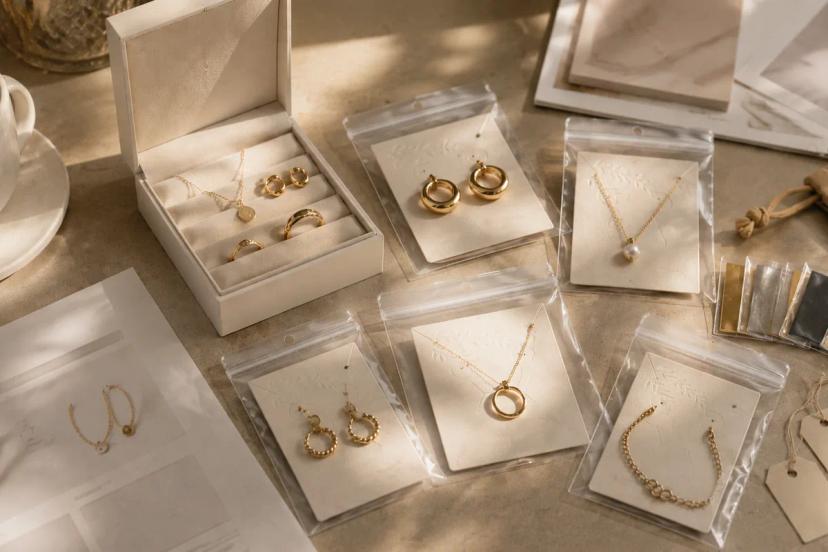
How Jewins Supports Demi-Fine-Inspired Affordable Jewelry Collections
Jewins works with growing jewelry brands through a structured process rather than a one-time order, which matters most for brands positioning collections as demi-fine-inspired or affordable luxury:
- Define the collection tier. Before any sampling starts, Jewins helps the brand clarify whether the line is traditional demi-fine, demi-fine-inspired, affordable luxury, or premium everyday — because that decision drives the material and claim strategy that follows.
- Confirm material fit. 316L stainless steel with PVD is evaluated against the specific product category and brand positioning, not applied as a default across every SKU.
- Review PVD color and finish options. Brands review gold-tone samples against an approved physical color sample, production photo reference, or color measurement method when required before approving a color for production.
- Develop low MOQ samples. New SKUs and finishes are tested at low volume — through OEM or ODM development, depending on whether the brand supplies its own design or works from existing styles — so the brand can validate fit, color, and feel before committing to bulk. (See OEM vs ODM Jewelry Manufacturing for how Jewins structures each path.)
- Lock the standard before scaling. Once a sample is approved, Jewins documents material, coating specification, color tolerance, and packaging wording as the reference standard for all future batches.
- Run QC checkpoints through production. Raw material, plating, and pre-shipment inspections are checked against the locked standard, not just the original sample.
- Support private label packaging and care-card wording. Jewins reviews packaging and care copy so it matches the actual material spec, avoiding vermeil, solid-gold, or unconditional durability claims. (For packaging structure and options, see Private Label Jewelry Packaging.)
- Support repeat production and replenishment. As bestsellers emerge, Jewins helps brands reorder against the original approved reference sample, keeping color and finish consistent batch after batch.
This process-based approach is part of Jewins' Growing Brand Success Program, which connects quality standards, traceable QC, and replenishment planning into one ongoing supply chain relationship rather than a single transaction.
FAQ
What is demi-fine jewelry?
Demi-fine jewelry is a category between fine jewelry and fashion jewelry, typically made from sterling silver, gold vermeil, gold-filled metal, or lower-karat solid gold, often paired with semi-precious stones. It's positioned to offer more durability and metal content than costume jewelry at a price point below fine jewelry.
What materials are commonly used in demi-fine jewelry?
Traditional demi-fine materials often include sterling silver, gold vermeil, gold-filled metal, lower-karat solid gold, semi-precious gemstones, pearls, moissanite, lab-grown stones, or cubic zirconia depending on the brand's positioning.
Can 316L stainless steel and PVD be used for demi-fine-inspired jewelry collections?
Yes, when positioned honestly. 316L stainless steel with a PVD gold-tone coating can support demi-fine-inspired, affordable luxury, or premium everyday collections, but it should not be marketed as traditional demi-fine jewelry, gold vermeil, or solid gold.
Is stainless steel considered demi-fine jewelry?
Not in the traditional sense. Demi-fine jewelry is generally defined by precious-metal content. Stainless steel with PVD coating is better described as a demi-fine-inspired or affordable luxury alternative rather than demi-fine jewelry itself.
Can gold PVD stainless steel jewelry be called gold vermeil?
No. Gold vermeil specifically requires a gold layer of defined thickness over sterling silver. PVD-coated stainless steel does not meet that definition and should be described as gold-tone 316L stainless steel with PVD coating instead.
What should brands ask a demi fine jewelry manufacturer before sampling?
Confirm the base metal grade, coating specification or finish standard, color consistency method, claim wording alignment, sample-to-bulk quality process, and MOQ per finish or color before moving into sample development.
When should a brand not use 316L stainless steel and PVD for demi-fine-inspired positioning?
When the brand's positioning requires verified precious-metal content — such as gold vermeil, gold-filled, or solid gold claims — or when the collection targets heirloom, bridal, or investment-value customers who expect documented metal content.
What should brands check before sourcing PVD stainless steel jewelry?
Before sourcing PVD stainless steel jewelry, brands should confirm the base metal grade, coating specification or finish standard, approved gold-tone reference, sample-to-bulk control process, MOQ per color, packaging wording, care instructions, and any testing needed for the target market.
Compliance note: Terms such as gold vermeil, gold-filled, waterproof, hypoallergenic, and nickel-free should be checked against the target market's jewelry advertising and compliance requirements before use in product pages, packaging, or care cards. For U.S. precious-metal terminology, review the FTC Jewelry Guides; for EU nickel restrictions, use the ECHA REACH reference linked in the supplier checklist above.
Last updated on July 10, 2026.
Related Reading
What Is PVD Jewelry Is 316L Stainless Steel Good for Jewelry? Gold Filled vs Gold Plated: Which Jewelry Finish Should Brands Choose? Stainless Steel Gold Jewelry: From Low MOQ to Bulk Orders OEM vs ODM Jewelry Manufacturing: Which Model Does Your Brand Need? Private Label Jewelry PackagingNeed Help Building a Demi-Fine-Inspired Affordable Luxury Collection?
Not sure whether 316L + PVD fits your demi-fine-inspired collection? Send your target price point, product category, and finish requirement to Jewins. We can help review material fit, claim wording, sample planning, packaging wording, and repeat-production control before you sample.
Contact Us →