
Gold Filled vs Gold Plated: A B2B Finish Guide for Jewelry Brands
Compare gold filled, gold plated, and Gold PVD finishes from a sourcing perspective, including cost, durability, product fit, supplier QC, claim language, and bulk order risks.
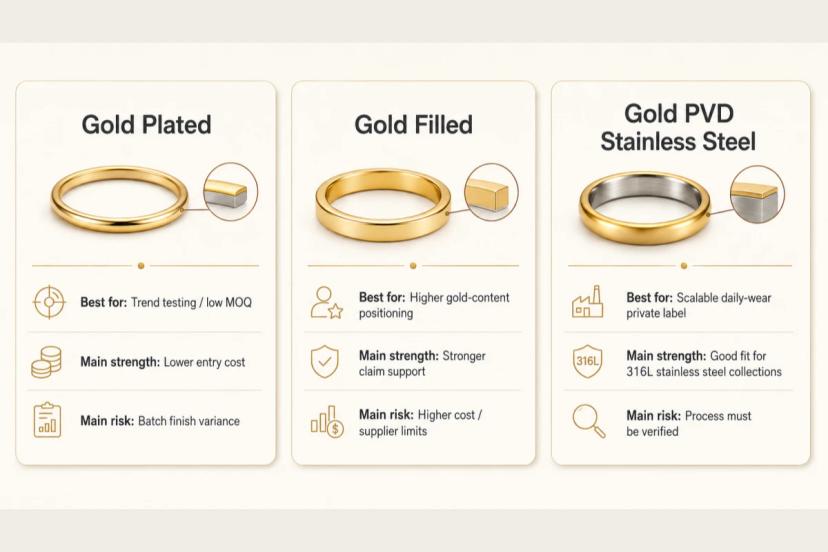
For gold filled vs gold plated, gold filled can support stronger gold-content positioning when the standard and supplier process are verified, while gold plated is usually better for flexible, lower-entry wholesale testing. For stainless steel jewelry brands, Gold PVD also belongs in the shortlist when daily-wear positioning, color consistency, and scalable private label production matter.
What Gold Filled And Gold Plated Actually Mean
Gold filled refers to a mechanically bonded gold layer, while gold plated refers to an electroplated surface layer. For sourcing teams, the real risk is not the name alone but the confirmed specification, base metal, and claim language the supplier can support.
The confusion between these two finishes is one of the most common sourcing errors in jewelry wholesale. Using them interchangeably in supplier communication or product copy creates both quality and claim risk.
Gold Filled: Construction, US Federal Standard, And What That Means For Suppliers
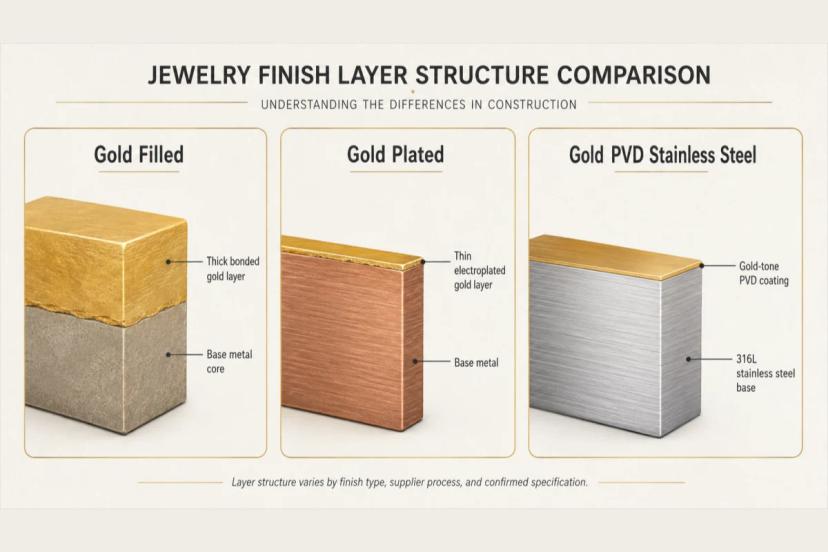
Gold filled jewelry is produced by mechanically bonding a layer of gold alloy to a base metal core — typically brass or copper — under heat and pressure. In the US market, a piece can only be labelled "gold filled" if the gold layer represents at least 1/20 of the item's total weight by federal standard.
The mechanical bonding process is more stable than electroplating, which reduces finish variance between production runs. The regulated threshold also creates a verifiable baseline that marketing claim language can reference. The trade-off: fewer factories offer genuine gold filled production, and minimum order quantities tend to be higher than gold plated.
Gold Plated: Electroplating Basics, Micron Range, And Why "Gold Plated" Is Not One Consistent Spec
Gold plated jewelry is produced by electrodeposition — an electrical current bonds a thin layer of gold onto a metal base. The process is widely available, which is why gold plated jewelry wholesale is common for trend testing, but the output varies significantly by specification.
Micron thickness, gold purity in the plating solution, base metal choice, and pre-plating preparation all affect how the finish performs in use. Buyers who submit an RFQ using only the term "gold plated" without specifying these parameters will receive inconsistent product — across factories and often across reorders from the same factory.
Before placing a gold plated order, confirm: plating type, micron thickness, base metal, gold purity of the plating bath, and what claim language the supplier can support in writing.
Terminology and standards for gold filled and gold electroplated products in the US market are defined under the FTC Jewelry Guides (16 CFR Part 23). Brands selling into the US market should review these definitions before finalizing product claim language.
Where Gold PVD Fits In A Modern Brand Sourcing Shortlist
For brands already sourcing from stainless steel factories, Gold PVD jewelry (Physical Vapor Deposition) is a third finish path worth understanding. It uses a different application process than electroplating and is available on a 316L or 304 stainless steel base. See our guide to PVD jewelry for a full production-level breakdown.
PVD is a vacuum-based thin-film coating process in which material is vaporized and deposited onto a substrate surface. For a technical reference, see Semicore’s explanation of PVD coating.
Comparison Table: Gold Filled vs Gold Plated vs Gold PVD
All wear expectations are indicative. Actual performance varies by use environment, care frequency, supplier process, and confirmed specification.
| Field | Gold Filled | Gold Plated | Gold PVD (Stainless Steel) |
|---|---|---|---|
| Base Material | Brass or copper core | Variable — brass, copper, zinc alloy, or stainless depending on supplier | 316L or 304 stainless steel base |
| Finish Process | Mechanical pressure bonding | Electroplating | Physical Vapor Deposition |
| Gold Layer / Content Standard | Regulated — must meet the 1/20 gold-content weight ratio standard in the US market | Highly variable; confirm micron thickness, plating type, and gold purity in every RFQ | Thin coating layer; adhesion and thickness depend on supplier process — specify and verify before bulk |
| Wear Expectation (High-Friction Use) | Generally longer wear life under daily friction when US standard is met | Variable — depends on confirmed micron, base metal, and electroplating process consistency | Generally stronger wear performance than standard flash plating when the base material is verified 316L and the PVD process is confirmed with the supplier |
| Tarnish And Fade Risk | Lower on the gold layer when properly produced; exposed base metal at edges or joins may be affected over time | Higher risk, particularly at thinner specifications or with less stable base metals | Low to moderate when base material is verified 316L stainless and finish is applied by a qualified process |
| Hypoallergenic Claim Supportability | Conditional — depends on base metal used and whether testing has been completed | Generally difficult to support; confirm base metal and any testing your supplier can provide | May be supportable when verified 316L stainless base is confirmed and backed by supplier testing; not an automatic claim |
| Supplier Availability (B2B) | More limited; fewer factories offer true gold filled production | Widely available; quality varies significantly between suppliers | Available through stainless steel PVD specialists; supplier qualification is important |
| MOQ Fit | Higher MOQ typical; less flexible at early brand stage | Lower MOQ entry point; more flexibility for test assortments | Moderate; confirm minimums with each supplier |
| Reorder Consistency | Generally higher consistency when the mechanical bonding process and standard are verified | Variable — electroplating bath chemistry can shift between production runs | Generally strong process consistency when supplier uses controlled PVD equipment |
| Typical Price Position (Wholesale) | Higher COGS than plated | Usually the lowest wholesale entry point among the three | Mid-range — typically higher than gold plated, broadly comparable with gold filled depending on specification |
| Marketing Claim Risk | Lower when US gold filled standard is met and disclosed | Higher when micron thickness and base metal are not specified and disclosed in product claims | Lower when base metal, PVD process, and finish spec are verified and disclosed accurately — requires confirmation, not assumption |
| QC Sensitivity | Moderate — mechanical process is stable, but edge and join quality still require sample review | High — batch-to-batch variance from electroplating is the primary reorder risk | Lower batch variance when supplier PVD process is well-controlled; sample approval still required |
Which Finish Fits Which Brand Stage
Match the finish to the brand stage. Gold plated often fits early product testing, while gold filled or verified Gold PVD may make more sense for higher-value SKUs, repeat orders, or stronger material positioning.
Finish choice affects reorder reliability, claim language, return rate risk, and how a brand describes its products. The right finish at launch may not be the right finish at scale.
Early-Stage Brands: Testing Product-Market Fit
Gold plated offers the most accessible entry point for brands in initial launch. Lower MOQ, wider supplier availability, and lower unit cost allow product-market fit testing without heavy upfront commitment. The key condition: specify a minimum micron thickness in every purchase order. Without a confirmed specification, reorders may not match samples — and expectations built on the first batch become a return risk on the second.
Scaling Brands: Managing Reorder Consistency And Customer Expectations
As order volumes grow, electroplating variance in gold plated production becomes a more significant operational problem. Slight changes in bath chemistry, plating time, or base metal consistency can produce visible differences between production runs. Brands at this stage may find it worth evaluating gold filled or gold stainless steel production for highest-velocity SKUs, while continuing with gold plated for lower-friction lines.
Premium And DTC Brands: Finish As A Brand Claim
For brands building around durability or material transparency, finish choice directly affects what can be stated on product pages and packaging. Gold filled, when it meets the regulated standard and is documented properly, gives brands a more verifiable claim to reference. Gold PVD on a confirmed 316L stainless steel base may support certain skin-sensitivity positioning — provided supplier testing is completed and the claim reflects the actual specification. Gold plated without a disclosed spec creates claim risk that grows with brand visibility.
How Finish Choice Changes By Product Category
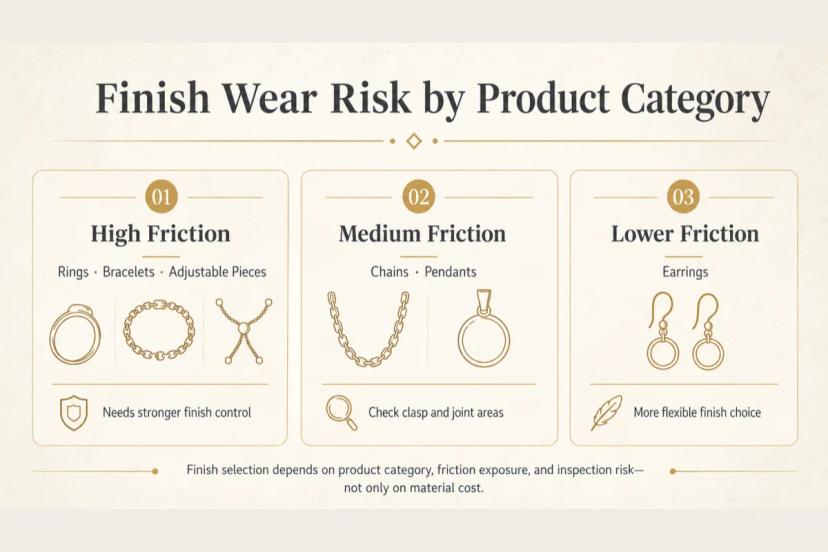
Not every piece in an assortment experiences the same daily wear. Finish selection should match friction exposure by product type, not just price point.
High-Friction Categories: Rings, Bracelets, Adjustable Pieces
Rings and bracelets are in constant contact with surfaces, skin, water, and clothing. Adjustable pieces add mechanical stress at the adjustment point. For these categories, a thinner or less stable gold finish shows wear earlier and more visibly. Gold filled or a confirmed PVD finish on a stainless steel base generally holds up better under daily use than a standard-specification gold plated finish.
For more on how stainless steel base materials perform under daily wear conditions, see does gold stainless steel tarnish.
Lower-Friction Categories: Earrings, Pendants, Chains
Stud earrings, pendant necklaces, and lightweight chains experience significantly less daily friction. For these categories, a well-specified gold plated finish can remain appropriate even for brands that choose gold filled or PVD for higher-friction pieces — supporting a mixed-finish assortment strategy that manages COGS without compromising the SKUs that matter most.
| Product Category | Daily Friction Level | Finish Guidance |
|---|---|---|
| Stacking rings / statement rings | High | Gold filled or PVD on 316L stainless; gold plated at confirmed higher micron spec |
| Cuff bracelets / bangles | High | Gold filled or PVD on 316L stainless; gold plated at confirmed higher micron spec |
| Adjustable pieces | High + mechanical stress | Gold filled or PVD preferred; gold plated requires careful QC at adjustment points |
| Pendant necklaces | Low to moderate | Well-specified gold plated appropriate; gold filled or PVD also suitable |
| Stud earrings | Low | Well-specified gold plated appropriate for most brand stages |
| Chains | Low to moderate | Confirm clasp and link joint treatment regardless of finish chosen |
Guidance is general. Confirm finish spec and wear expectation with your supplier before making product claims.
Common Sourcing Mistakes
Mistake 1: Accepting "Gold Plated" Without Specifying Micron Thickness
"Gold plated" in an RFQ without a confirmed micron spec is an open instruction. Different suppliers interpret it differently, and the same supplier may vary between runs. Always specify micron thickness, plating type, gold purity, and base metal in writing before sampling.
Mistake 2: Using "Gold Filled" And "Gold Plated" Interchangeably In Product Copy
These are not synonyms. Describing a gold plated piece as "gold filled" creates customer expectation mismatch and claim risk — particularly in markets where finish terminology is subject to consumer protection standards. Use only the language your confirmed specification supports.
Mistake 3: Choosing Finish Without Checking Base Metal Compatibility
Gold filled production usually requires compatible base materials; confirm this with the supplier before sampling. Zinc alloy bases are generally not compatible with gold filled construction and may create adhesion issues under electroplating as well. Base metal choice also affects skin sensitivity claims and regulatory compliance in target markets. For a broader view of base material trade-offs, see pros and cons of stainless steel jewelry.
Mistake 4: Skipping Sample Approval On Reorders
A reorder is not a guaranteed repeat of the original sample. Bath chemistry, plating time, and base metal batch differences can all produce visible color and wear variation between runs. Request and approve a production sample on every reorder before releasing bulk — not just on the first order.
Supplier QC Checklist Before Sampling Or Bulk Order
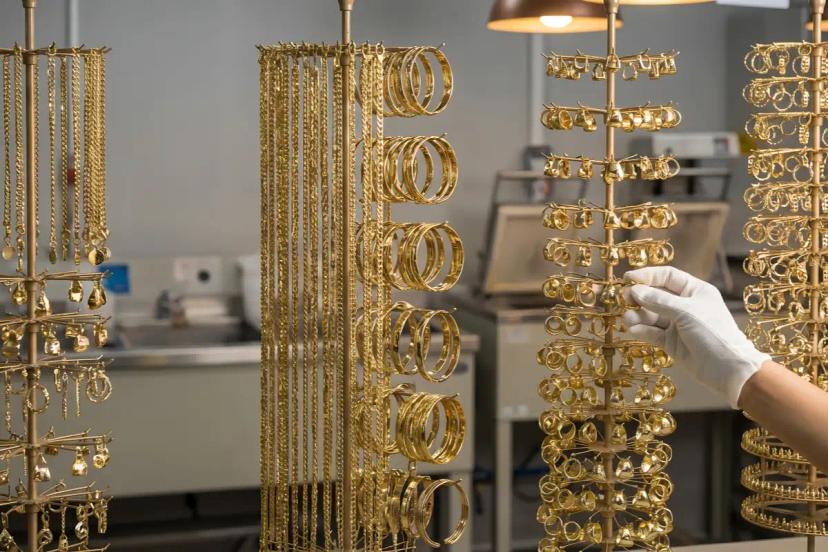
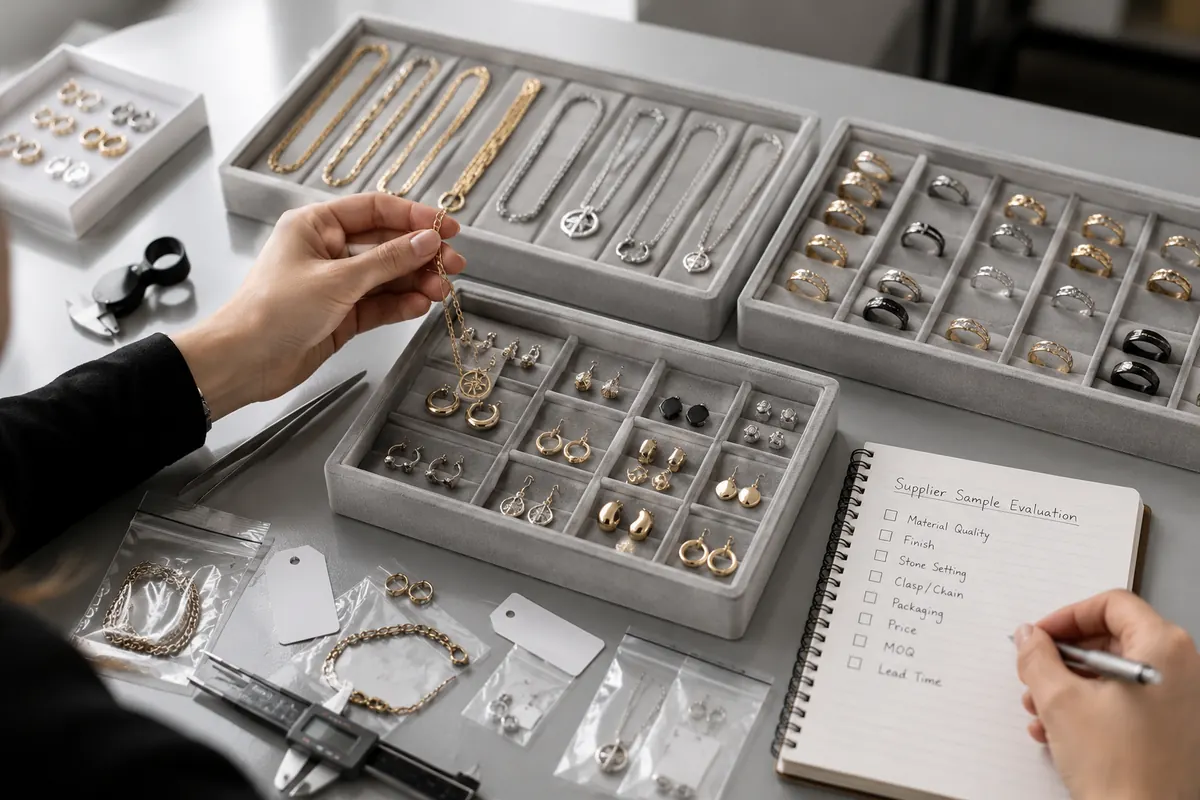
Before bulk production, confirm base metal, finish method, micron thickness or finish specification, sample approval process, supported claim language, packaging wording, and reorder color-control process.
Questions To Ask Your Supplier Before Sampling
- What is the confirmed micron thickness, and can you provide it in writing on the specification sheet?
- What is the base metal, and does it vary between product types in this range?
- What gold purity is used in the plating bath?
- For gold filled: can you confirm this piece meets the 1/20 weight standard?
- For PVD: what stainless steel grade is used, and what equipment is used for the PVD process?
- What internal checks are run on finish consistency within a production run?
- What claim language can you support in writing — and what language falls outside your testing scope?
What To Check On A Finish Sample Before Approving Bulk
- Color consistency: Check across multiple pieces. Color tone should be uniform.
- Edge and join coverage: Inspect clasps, jump rings, join points, and adjustable sections — where finish failure typically starts.
- Surface quality: Look for pitting, streaking, or uneven texture under good lighting.
- Stress-point response: For rings and bracelets, flex or wear-test the piece and inspect finish at stress points after use.
- Packaging alignment: Confirm finish terminology in packaging and labeling matches the confirmed specification. For support reviewing packaging content, see our packaging options and valued services.
Frequently Asked Questions
These FAQs answer common sourcing questions around gold filled vs gold plated, Gold PVD, tarnish expectations, and supplier claim language.
Is gold filled better than gold plated?
Neither is universally better. Gold filled can offer stronger wear performance and more verifiable claim language when the standard and production process are verified, but it usually comes at higher cost and with more limited supplier access. Gold plated is more flexible at early brand stage, provided the specification is confirmed in detail. The right choice depends on product category, brand positioning, and stage of growth.
Does gold filled jewelry tarnish?
The gold layer on a properly produced gold filled piece is less likely to tarnish in the way exposed base metals can. However, exposed base metal at edges, joins, or areas of heavy wear can show tarnishing over time. Base metal matters, not just the gold surface.
Does gold plated jewelry tarnish?
It depends on the specification. A well-plated piece on a stable base metal at sufficient micron thickness can maintain its appearance under regular wear. Thinner plating or an unstable base metal will show wear and fading more quickly. Micron spec and base metal must be confirmed before ordering, not assumed.
How can you tell gold plated from gold filled?
Stamps and hallmarks can help — gold filled pieces are often marked "GF" or "1/20 14K GF," while gold plated pieces may carry a "GP" stamp. However, stamp conventions vary by country of origin and supplier, and visual inspection alone is not a reliable verification method. Brands should request written supplier documentation confirming the finish type, specification, and supported claim language rather than relying on visual cues only.
Is gold PVD better than gold plated for wholesale jewelry?
PVD on a stainless steel base offers a different set of trade-offs, not a straightforward upgrade. It may offer stronger wear performance for high-friction categories and may support certain material claims when the base metal and process are verified — but it requires a stainless steel production path and a specialist supplier. See our PVD jewelry guide for a full comparison.
What should brands ask suppliers before ordering gold-tone jewelry?
Brands should confirm base metal, finish method, micron thickness or finish specification, sample approval process, supported claim language, packaging wording, and reorder color-control process before moving into bulk production.
Can I use the term "gold filled" on my product listing if my jewelry is gold plated?
No. Using "gold filled" to describe a gold plated product misrepresents the finish to customers and creates claim risk in markets where finish terminology is regulated. Confirm what terminology your confirmed specification supports, and use only that language.
If your team is comparing gold plated, gold filled, and Gold PVD options, Jewins can help turn that finish decision into a clearer production specification. We focus on stainless steel jewelry manufacturing, Gold PVD finish options, OEM/ODM development, sample approval, bulk production coordination, and private label packaging support.
- Finish specification review: confirm base metal, finish method, color direction, and claim wording before sampling.
- 316L stainless steel + Gold PVD sourcing: evaluate whether a stainless steel PVD production path fits your daily-wear or wholesale collection.
- Sample approval support: review color consistency, edge coverage, surface finish, and category-specific friction points before bulk order.
- OEM/ODM and private label support: connect finish choice with product design, packaging wording, and reorder requirements.
Need Help Choosing A Gold-Tone Jewelry Finish?
If you are comparing gold plated, gold filled, and Gold PVD options for a new collection, Jewins can help you review the finish specification, base metal choice, sample approval process, and bulk production requirements before you place an order.