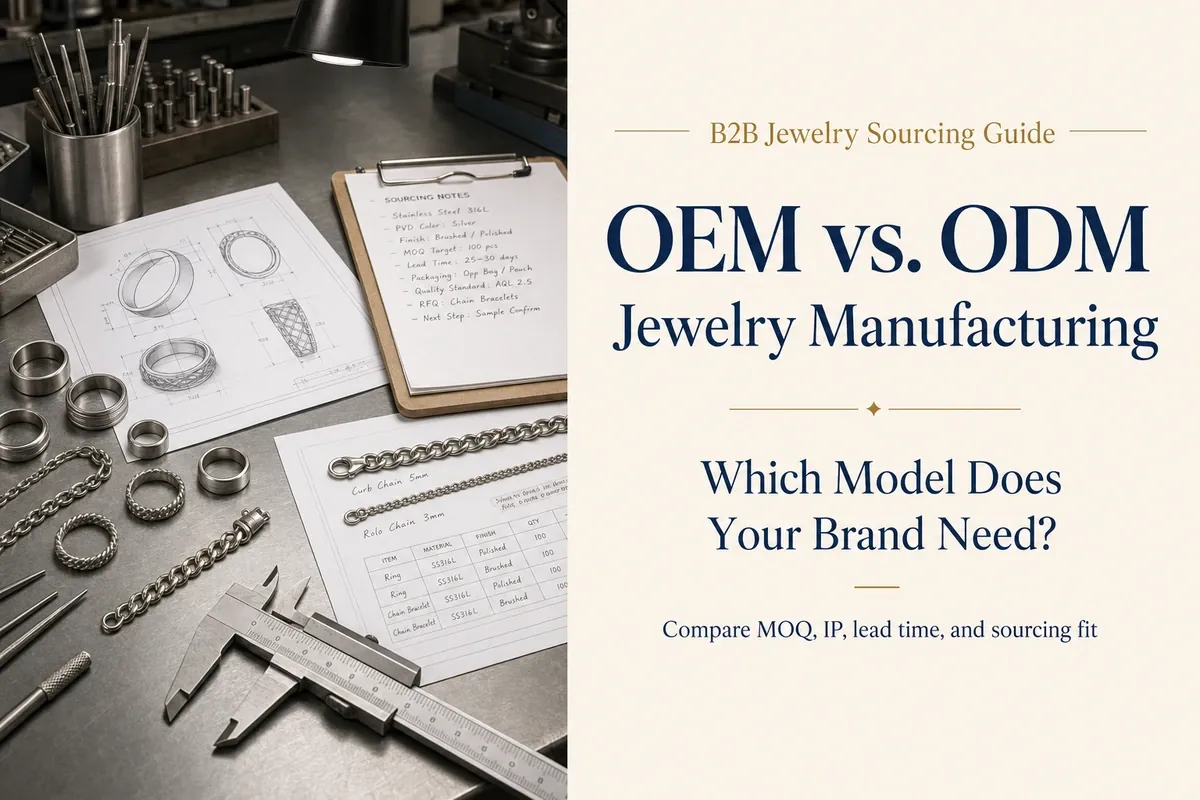

Before ordering stainless steel jewelry wholesale, define the sourcing model, verify material and test evidence against the actual SKU or batch, approve a version-controlled sample and written specification, and put bulk inspection, defect handling, total cost, and reorder controls into the RFQ or PO. The goal is not to find the cheapest supplier, but to create an order that can be checked, accepted, corrected, and repeated.
Key Takeaways
Supplier documents must be tied to the product, sample, method, date, and relevant batch.
The approved sample and written specification should work together as the production baseline.
Bulk acceptance and defect responsibility must be agreed before production starts.
Repeat orders need version, color, material, process, and change-control records.
Before you place an order, locating a supplier is only the beginning. The real risk shows up later, when material claims, finish expectations, sample approval, bulk inspection, defect responsibility, and reorder requirements are still verbal agreements instead of written ones. This guide is for jewelry brands, wholesalers, and private-label or DTC buyers who are past browsing and preparing to send an RFQ, approve a sample, or place a bulk purchase order for stainless steel jewelry wholesale. A reliable stainless steel jewelry supplier should be evaluated through evidence and written controls, not only price, product photos, or general certificates that may not apply to your SKU or batch. Working through the seven checks below helps reduce ambiguity and sourcing risk, but it does not eliminate the possibility of defects or delays — it gives you a structure for asking better questions and putting the right terms into your RFQ or PO before production starts.
Quick Checklist: 7 Supplier Checks Before You Place an Order
- Confirm the sourcing model and responsibility boundaries.
- Verify material evidence and batch traceability.
- Lock finish specifications and color standards.
- Approve a production-ready sample and written specification.
- Define bulk inspection and defect handling.
- Compare total sourcing cost and delivery risk.
- Confirm reorder consistency and replenishment capability.
1. Confirm the Sourcing Model and Responsibility Boundaries
Ready-Made, Private Label, OEM, and ODM Do Not Use the Same Controls
Not every wholesale stainless steel jewelry order carries the same responsibility split. Ready-made wholesale means buying existing designs with limited ability to change specifications. Private Label keeps the base product close to the original but adds your branded packaging, logo, or labeling. OEM shifts more control to the buyer, who supplies the design or specification and asks the supplier to produce it. ODM goes further, with the supplier contributing more of the product development itself. Each model changes who owns design, material choice, finish, packaging, testing, and repeat-order specifications — see our OEM vs ODM responsibilities and trade-offs comparison for a fuller breakdown.
What Must Be Confirmed in the RFQ
Regardless of model, your RFQ should state: design and IP ownership; who is responsible for material and finish; what sample type triggers approval; how MOQ is calculated (per style, color, finish, or packaging component); who handles packaging and labeling; who is responsible for testing and inspection; what triggers the lead-time clock; and who must notify whom before a reorder change. Leaving these unwritten is a potential source of dispute once bulk production begins.
| Sourcing Model | Buyer Supplies / Approves | Supplier Controls | Sample / Approval Need | Main Risk | RFQ / PO Field |
|---|---|---|---|---|---|
| Ready-made wholesale | Order quantity, packaging preference | Design, material, finish | Confirmation sample | Limited spec control | Product code, quantity, packaging |
| Private Label | Logo, brand packaging, labeling | Base product, production | Packaging and label proof | Brand consistency across batches | Logo file, packaging spec, label placement |
| OEM | Design, specification, materials | Production to buyer spec | Pre-production and approved sample | Spec drift if not written down | Drawing/BOM version, tolerances, sample sign-off |
| ODM | Requirements, target price, market | Development, design, production | Development and approved sample | Unclear ownership of design changes | Development scope, IP terms, sample milestones |
2. Verify Material Evidence and Batch Traceability
Separate Supplier Statements From Independent Test Evidence
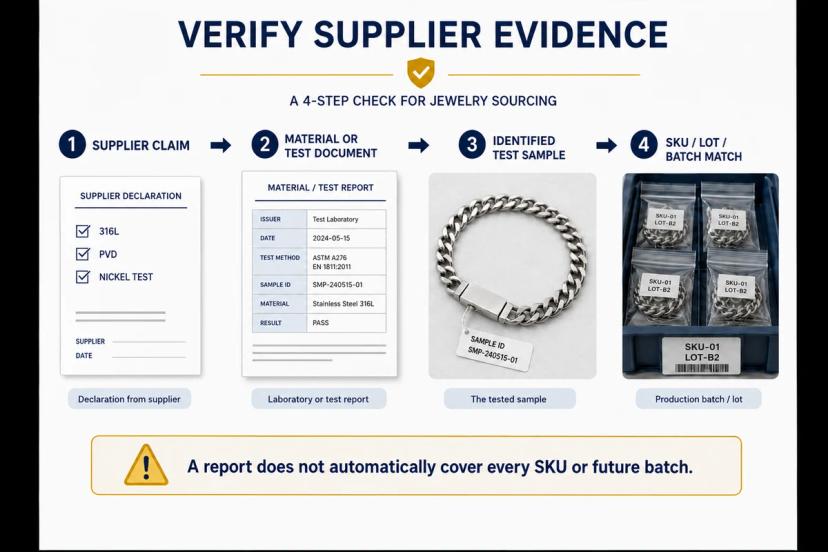
Not all evidence supports the same conclusion. A supplier declaration is a self-issued material statement, while a steel inspection document generally concerns the delivered steel rather than the completed jewelry SKU. A third-party composition test following a method such as ASTM E1086-22 supports the reported composition of the sample identified in that report; it does not automatically cover every component, SKU, material source, or later batch. Use our 316L vs 304 material verification guide for the grade comparison, then use the checks below to judge whether the evidence applies to the order you are buying.
Check Whether the Report Matches the Product You Are Buying
Verify the issuer, report date, test method and version, sample description, and the connection to your SKU, lot, batch, or heat number where applicable. Compare the result with the target-market requirement and confirm that the material, structure, finish, production source, and tested configuration have not changed. For laboratory claims, first confirm that the accreditation body is an ILAC MRA signatory, then verify the laboratory, location, method, and current scope in that accreditation body's official registry. ISO/IEC 17025 provides the competence framework; a logo alone does not establish that every reported parameter is within scope. Jewins' certification page shows examples of available material and compliance documentation, not proof that every document applies to every SKU.
Use Market-Specific Compliance Language
For relevant EU jewelry, REACH Annex XVII Entry 27 sets nickel-release limits below 0.2 μg/cm²/week for piercing post assemblies and no more than 0.5 μg/cm²/week for items intended for direct and prolonged skin contact. These limits concern release, not total nickel content or universal suitability for every wearer. Do not treat nickel-free, hypoallergenic, nickel-safe, and REACH nickel-release compliance as equivalent claims. RoHS applies to electrical and electronic equipment, so it is not a universal requirement for ordinary non-electronic jewelry.
| Evidence | What It Can Support | What It Does Not Prove | Buyer Verification |
|---|---|---|---|
| Supplier declaration | Supplier's own statement about material or spec | Independent testing or accreditation | Cross-check against inspection or test documents |
| Steel inspection document | Material information supplied at delivery, tied to an order | Automatic coverage of every SKU, component, or later batch | Confirm order reference, standard used, and traceability |
| Third-party composition test | Tested elements, method, sample, and date on the report | Compliance of untested SKUs, batches, or later production | Match sample ID to your SKU/lot; check lab accreditation scope |
| Nickel-release / market compliance report | Result for the tested configuration and market requirement | Suitability for every wearer or all skin-contact scenarios | Confirm contact type, method, report date, and current SKU match |
| Coating or performance test report | Lab result under the stated test conditions | Real-world wear duration or universal durability | Confirm method, sample, load/duration, and acceptance rule |
3. Lock Finish Specifications and Color Standards
A Finish Name Is Not a Complete Specification
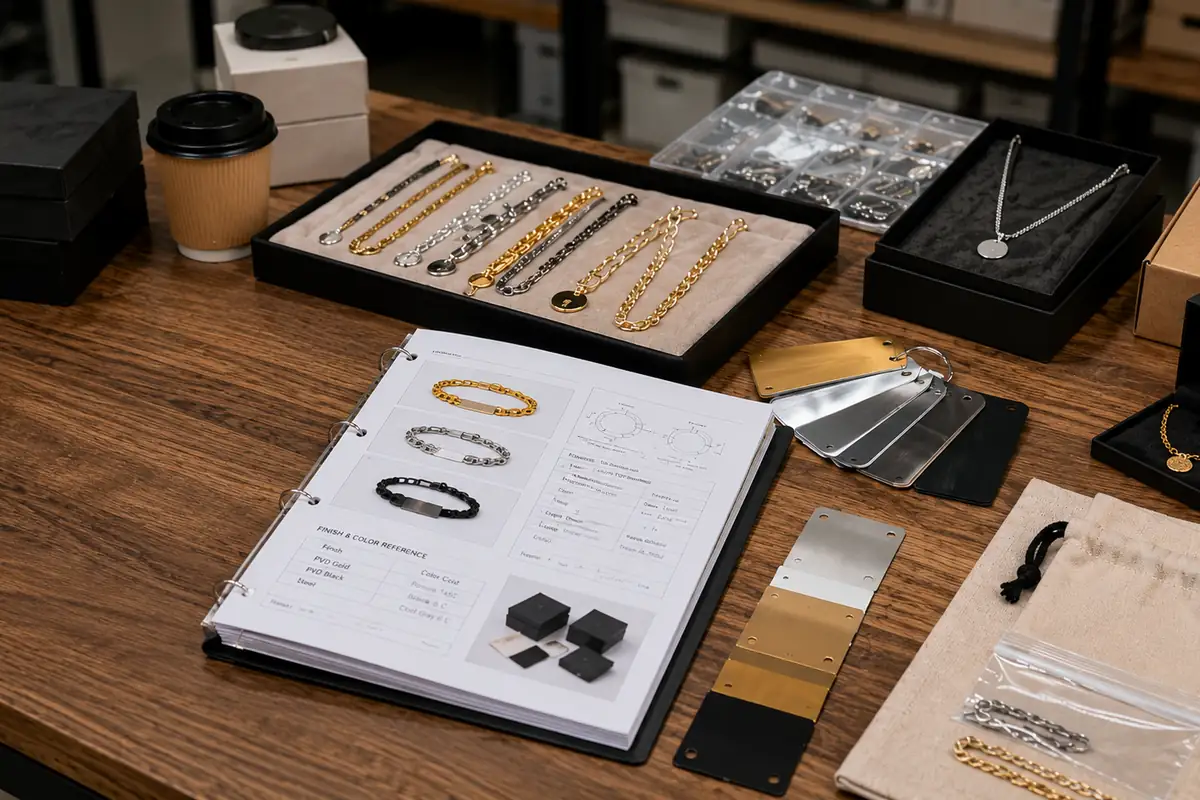
"Gold PVD," "black PVD," polished, brushed, and matte are starting points, not specifications. A usable finish specification should identify the base material, surface preparation, the coating or finishing process, target color and gloss, a physical color or finish master sample, the measurement or comparison method, the inspection lighting or viewing condition where relevant, and the acceptable visual boundaries. Buyers should not assume that one PVD thickness or color tolerance applies across every substrate, coating system, color, and jewelry design; these should be agreed per SKU and written into the specification and PO. Our PVD coating quality checklist covers finish terminology in more depth if you need it before writing your spec.
Treat Performance Tests as Conditional Evidence
Salt spray, abrasion, and adhesion tests each measure a different property, and each requires an agreed test method, sample, duration or load, environment, and acceptance rule before the results can be meaningfully compared. A salt-spray result under ASTM B117-26, for example, describes relative corrosion behavior under the tested conditions — it is not a formula for converting test hours into wearable years. Ask for the method, sample configuration, and duration behind any number a supplier quotes, and confirm it was agreed for your specification rather than a generic in-house benchmark.
4. Approve a Production-Ready Sample and Written Specification
The Sample and Specification Must Work Together
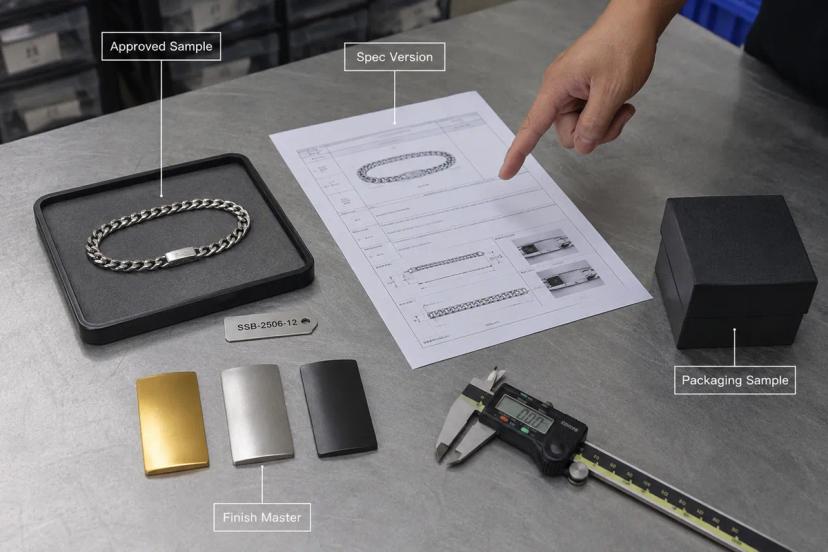
An approval package should include: the sample ID and SKU; the drawing, BOM, component, or reference version; dimensions and weight targets; stone, clasp, welding, logo, engraving, and assembly details; color, gloss, polish, texture, and finish reference; the packaging sample and labeling; any applicable test results; and the buyer's approval, date, and version number. An approved or "golden" sample works alongside the written specification as the production baseline — it is a buyer and contract control practice, not a legal or industry certification, so it only carries weight if both parties treat it as binding and reference it consistently through production.
What Releases Bulk Production
Production should only start once the supplier holds an approved sample ID, the matching specification or BOM version, the approval date and approver, and a written list of any accepted deviations from the original design. When a sample or specification is revised, the earlier version should be formally marked superseded and pulled from the factory floor, so operators are not working from an outdated reference. The specification should also state plainly that the supplier may not substitute materials, processes, components, or packaging without written buyer approval.
Put Change Control in Writing
Require written approval before the supplier changes material source or grade, coating process or subcontractor, a component such as a stone, clasp, or chain, tooling or production method, or packaging structure and printed content. Your specification should define how a change is requested, reviewed, approved, and recorded, so that a mid-run substitution doesn't reach you as a surprise in the finished shipment. This applies to the approved sample and configuration in effect at that time — it does not extend automatically to future SKUs or unrelated product lines.
5. Define Bulk Inspection and Defect Handling Before Production
Define Inspection Stages and the Lot Before Sampling
Agree in advance where inspection happens: incoming material checks where relevant, in-process checkpoints, finished-product inspection, and pre-shipment inspection. Define what counts as a lot or shipment, the sampling method and inspection level, and whether any critical characteristics require 100% screening instead of sampling. ISO 2859-1:2026 offers one recognized attributes-sampling framework for lot-by-lot acceptance, but it does not set a single AQL value for all jewelry orders — the AQL, inspection level, and sampling status should be agreed in the PO based on your product's risk profile.
Define Defects With Product-Specific Examples
Critical, Major, and Minor categories need to be written for your actual product and target market rather than assumed. Useful criteria include regulatory or safety risk, function failure, durability risk, saleability, and appearance outside the approved boundary. There is no single defect list that applies across all jewelry categories, so this should be built into your inspection specification rather than left to the inspector's judgment on the day.
Agree the Nonconformance Workflow
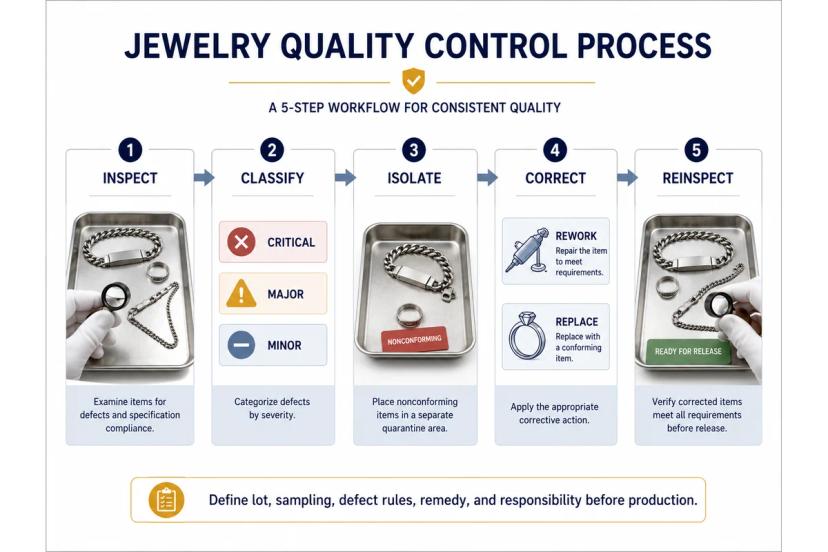
A working nonconformance process typically: isolates the affected goods; records quantities, photos, measurements, and lot information; confirms root cause and scope; agrees on rework, replacement, credit, refund, or another remedy; reinspects the corrected goods; and records completion time and responsibility. State clearly who performs inspection — supplier QC, the buyer's own team, or an independent third-party inspector — and require that the inspection report identify the specific lot or shipment it covers, distinct from any agreed 100% screening of particular critical characteristics. Remedy deadlines and reinspection responsibility should be written into the PO rather than negotiated after a problem surfaces. Writing this into the RFQ or PO helps reduce dispute and repeat-defect risk — it does not guarantee a defect-free order, and sampling acceptance itself is not proof that an entire batch is defect-free.
6. Compare Total Sourcing Cost and Delivery Risk, Not Unit Price Alone
Build a Comparable Cost Basis
Unit price alone hides most of the real cost difference between two quotes from a stainless steel jewelry manufacturer. A fuller comparison should include tooling, mold, CAD, or development cost; sample and revision costs; testing and third-party QC; packaging, inserts, labels, barcodes, and cartons; payment terms and bank costs; freight, insurance, duties, and taxes; expedited production or shipping if needed; rework, replacement, credit, and defect-loss exposure; and reorder MOQ against stockout or delayed-launch risk. A lower unit price with weaker documentation, slower defect resolution, or a higher reorder MOQ can end up more expensive than a supplier with a higher quote and tighter controls. The table below compares these categories side by side without relying on unit price alone.
| Cost Category | What to Compare | Risk if Omitted |
|---|---|---|
| Development and samples | Tooling, CAD, revisions, approval samples | Quote appears cheaper before development costs |
| Testing and QC | Lab tests, inspection, reinspection | Unplanned verification or defect costs |
| Packaging and logistics | Packaging, labels, cartons, freight, duty | Incomplete landed-cost comparison |
| Payment and timing | Terms, bank fees, lead-time trigger, expedite fees | Cash-flow or launch-delay risk |
| Rework and replenishment | Replacement, credit, emergency reorder, stockout | Low unit price becomes higher total cost |
Define When Lead Time Starts
State clearly in the RFQ or PO whether lead time begins after deposit, after final drawing sign-off, after material confirmation, after the approved sample, after packaging confirmation, or after all required buyer files are submitted. Competitor lead-time numbers you've seen quoted elsewhere should not be treated as an industry-standard timeline; confirm the trigger point and build in reasonable buffer for your own project before committing to a launch or reorder date. Custom jewelry packaging options can affect this timeline, so packaging confirmation is worth locking early rather than treating it as a late-stage detail.
7. Confirm Reorder Consistency and Replenishment Capability
Lock the Reorder Baseline
A reorder is only as consistent as the records behind it. Retain or reference the approved specification and its version, the BOM or controlled component list, the approved or working sample, the physical color or finish master, relevant material and test records, packaging artwork and packing specification, the previous lot or shipment record, and any approved deviations and corrective actions from earlier runs. Without these, "same as last time" becomes a guess rather than a controlled repeat.
Require Change Notification
Ask the supplier to notify you before changing material source, process or subcontractor, a component or stone, tooling, the finish route, packaging material or printer, or the production location where relevant. This reduces specification drift between orders — it does not guarantee zero variation, since some tolerance is normal in manufacturing even with strong controls.
Check Replenishment Readiness
Before relying on a supplier for repeat business, confirm the reorder MOQ, the reorder lead-time trigger, their capacity planning, material or component availability, how forecasts should be communicated, whether safety-stock or semi-finished-stock options are commercially available, and what escalation process applies for urgent replenishment. Our repeat-order and supply-chain risk controls article looks at this from a broader supply-chain planning angle.
| Stage | Controlled Record | Buyer Approval / Inspection | Change or Defect Action |
|---|---|---|---|
| RFQ and specification | Written spec, drawing/BOM version | Buyer sign-off on spec | Change requests routed through written approval |
| Approved sample | Sample ID, color/finish master, test results | Buyer approval, date, version | Any deviation triggers re-approval |
| Bulk production | Batch/lot records, in-process checkpoints | Agreed sampling plan and inspection level | Nonconformance isolated and logged |
| Pre-shipment acceptance | Inspection report, defect classification | Accept, reject, rework, or replace decision | Remedy agreed and reinspection scheduled |
| Repeat order | Prior lot record, approved deviations | Comparison against baseline spec/sample | Supplier notifies buyer of any proposed change |
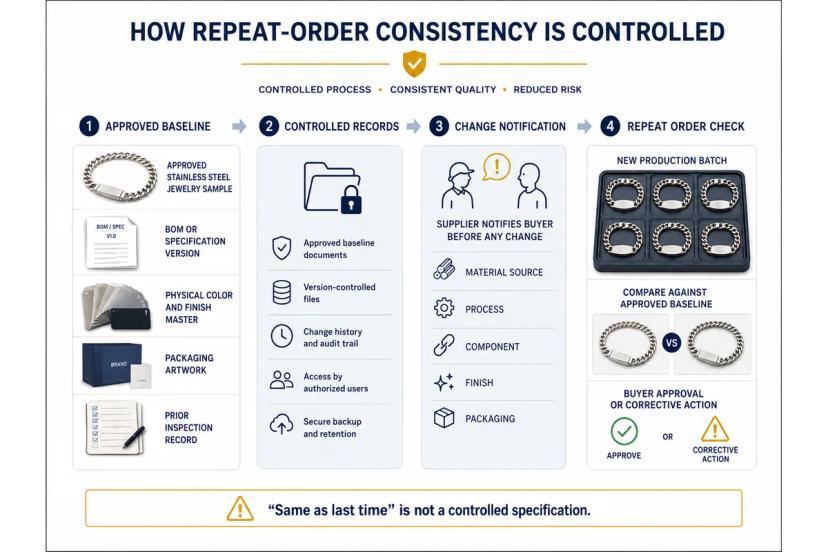
How Jewins Supports a More Controlled Wholesale Sourcing Process
Jewins supports buyers through a structured process rather than a one-size-fits-all promise: requirement review to understand your product, market, and volume; material and finish confirmation against your specification; sample approval before bulk production begins; QC checkpoints through production and pre-shipment; packaging confirmation; and repeat-order specification control for future runs. You can bring a product reference, drawing, or current sample; your target material and finish; your quantity and SKU structure; packaging requirements; any target-market testing or documentation needs; and your first-order and reorder expectations into this process, and Jewins can help organize them into a project-specific sampling and production plan, subject to confirmed specifications. Not every SKU automatically carries every test report, and no process can promise zero defects, zero delays, or perfectly identical repeat orders. What this structure does is help reduce ambiguity between your team and the factory floor, and help you confirm requirements in writing before bulk production commits your budget and production capacity.
Frequently Asked Questions
How do I find reliable wholesale jewelry suppliers?
Most buyers start with recommendations, supplier websites, trade platforms, or directories to build a candidate list. Reliability is then established through verification, not first impressions: confirm business identity, check product fit against your category, request a written quotation, ask for product-specific evidence rather than general claims, review samples, evaluate communication during the RFQ stage, and check how the supplier handles bulk-order controls like inspection and defect resolution before committing to a large order.
Where can I buy wholesale stainless steel jewelry?
Buyers typically source stainless steel jewelry wholesale from ready-made wholesalers, Private Label suppliers, OEM/ODM manufacturers, or factories that specialize in stainless steel and PVD-finished jewelry. Which source fits best depends on how differentiated your product needs to be, your MOQ, how much specification control you require, packaging needs, lead time, and reorder expectations. The seven checks above apply across all of these sourcing routes, though the level of control needed increases as you move from ready-made toward OEM or ODM.
What should I check before ordering jewelry in bulk?
Before placing a bulk order, confirm the sourcing model and responsibility split, verify material and test evidence against your specific SKU or batch, lock a written finish specification, approve a version-controlled sample, and agree bulk inspection, defect handling, total cost, and reorder controls in the RFQ or PO. Skipping any of these tends to surface as a dispute later, once production is already underway.
How should brands check quality before bulk production?
Start by reviewing product-specific evidence rather than general claims, then approve a version-controlled sample together with a written specification that both sides sign off on. Before production, define inspection stages, the sampling method, defect categories, and remedies for nonconformance. Sample approval on its own is not the same as bulk acceptance — the acceptance rule for the full production run needs to be agreed separately and in writing.
Before You Place the Order
A supplier becomes easier to evaluate once claims are converted into documents, approved samples, written specifications, acceptance rules, and reorder records. None of this eliminates sourcing risk entirely — no checklist can promise that. What it does is make responsibilities, evidence, sample approval, and corrective action clear before your budget and the supplier's production capacity are committed to a bulk stainless steel jewelry wholesale order.
Prepare Your Stainless Steel Jewelry Sourcing Requirements
Share your product references or drawings, target material and finish, sample requirements, quantity and SKU structure, packaging needs, testing or target-market requirements, and delivery and reorder expectations.
Discuss Your Sourcing Requirements With Jewins →