
Does Stainless Steel Jewelry Turn Skin Green?
Does stainless steel jewelry turn skin green? Quality stainless steel jewelry is less likely to do so than copper-based or poorly plated alternatives — but whether it does depends on base material grade, alloy composition, finish quality, and how the piece reacts with sweat and skin products. For brands sourcing at wholesale or private label scale, the root cause of green-skin complaints is often linked to material selection, finish quality, or sourcing verification — not an unavoidable property of stainless steel itself.
Does stainless steel jewelry turn skin green? Quality 316L stainless steel jewelry is generally less likely to do so than copper, brass, or poorly plated jewelry. Green marks usually come from copper-containing metals reacting with sweat, moisture, or skin products. For B2B buyers, the more reliable approach is to verify base material grade, finish method, sample performance, and claim language before placing bulk orders — not after complaints arrive.
Quick Summary
- Green skin from jewelry is usually surface discoloration caused by reactive metals — most often copper or brass — reacting with sweat, moisture, or skin products.
- Verified 316L stainless steel jewelry is generally less likely to cause green stains than copper-based or low-quality plated alternatives.
- Even stainless steel can stain skin if the base is not genuine 316L, the plating is thin or worn, or the underlying alloy contains copper-heavy elements.
- Green staining and jewelry allergy are not the same thing — itching, redness, or rash require cautious product language and, where relevant, documentation.
- B2B buyers can reduce green-skin complaints by confirming base grade, finish method, sample performance, and care-card language before bulk orders.
Why Does Jewelry Turn Skin Green?
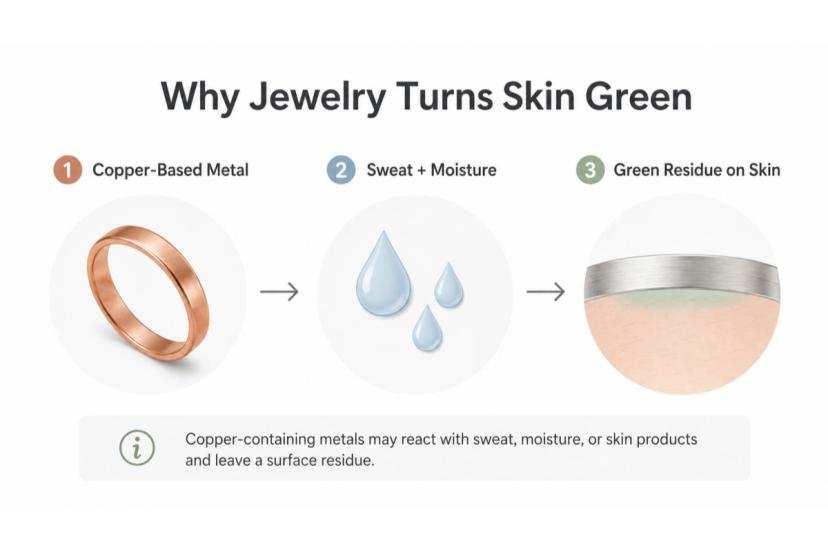
When copper-containing metals — copper, brass, and copper-heavy alloys — contact sweat, moisture, or compounds in lotions and perfumes, they undergo surface oxidation. Copper reacts with organic acids in sweat to form greenish copper salts that transfer to skin as a residue. The marks wash off but return if the same piece is worn under the same conditions. Plated jewelry on a copper or brass base causes the same effect once the coating wears through and the reactive base contacts skin. Low-quality alloy jewelry may also discolor skin depending on composition. Properly specified stainless steel — 316L grade in particular — does not rely on copper as a primary base metal and is generally less prone to this reaction.
Does Stainless Steel Jewelry Turn Skin Green?
Does stainless steel turn skin green? Quality stainless steel jewelry is less likely to than copper or brass — but the answer depends on what “stainless steel” actually means in the supplier’s production process.
What Makes Stainless Steel Different?
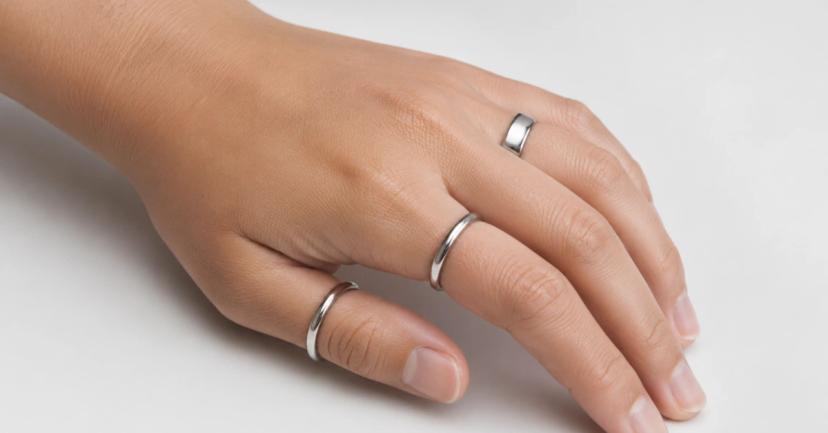
Stainless steel is an iron-based alloy with chromium; it does not use copper as a primary base metal. The chromium content helps form a thin passive surface layer that resists corrosion under normal wear conditions — a property of the alloy structure documented by producers such as Outokumpu. Unlike copper or brass, properly specified stainless steel is less likely to leave green residue under typical skin-contact conditions. Grade, surface treatment, and finish all determine actual performance.
When Can Stainless Steel Jewelry Still Cause Green Marks?
Green marks can still occur when the base is mislabelled or substituted with a copper-containing alloy, when thin or poorly adhered plating wears through on a reactive base, or when exposure to chlorine, cleaning agents, or aggressive skin products degrades the surface faster than normal wear. A “stainless steel” label does not confirm what lies beneath — that requires documentation.
Does 316L Stainless Steel Turn Skin Green?
Why 316L Is Generally a Lower-Risk Choice
316L stainless steel is a corrosion-resistant grade with molybdenum added to improve resistance to surface corrosion. Its composition does not rely on copper as a primary base metal, making it less prone to the oxidation reaction that causes green skin marks under normal wear. For brands sourcing custom stainless steel jewelry, 316L is a widely preferred baseline grade — not because it eliminates all risk, but because it reduces the most common sources of green staining when material and finish are properly specified and verified.
What to Verify Even With 316L
A 316L label is not verification. Suppliers should provide a mill certificate or material documentation confirming the grade, particularly for new supplier relationships or product categories. Batch consistency matters separately: an initial sample may be genuine 316L while production runs use substitute materials if procurement controls are not tight. Buyers targeting markets with nickel-release restrictions — such as the EU under EN 1811/REACH — should also note that 316L contains nickel at controlled levels, and test documentation may be relevant depending on destination market and product type.
Tarnish, Green Skin, and Allergy — What Is the Difference?
What Is Tarnish?
Tarnish is surface discoloration on the jewelry itself — dulling or darkening of the metal — not a residue on the wearer’s skin. Stainless steel generally resists tarnish better than silver or copper-alloy metals, though coating wear can affect surface appearance. For a detailed look, see gold stainless steel tarnish and fading.
What Is Green Skin Discoloration?
Green marks on skin are a residue transferred from a reactive metal when sweat, moisture, or skin products are present. This is cosmetic under normal wear and washes off, but returns if the same conditions repeat.
What Is a Jewelry Allergy?
A jewelry allergy is an immune response, not surface staining. Metal sensitivity — most commonly to nickel — produces redness, itching, swelling, or rash at the skin-contact point. The Mayo Clinic describes nickel allergy symptoms as a separate condition from cosmetic staining; the CDC/NIOSH also identifies nickel skin sensitivity as a distinct concern. Brands should not conflate the two in product copy. For more on sensitive-skin positioning, see hypoallergenic stainless steel jewelry.
| Issue | What It Affects | Typical Cause | What the Buyer or Wearer Notices | How to Address |
|---|---|---|---|---|
| Tarnish | The jewelry surface | Oxidation, finish wear, air exposure, chemicals | Dull, discolored, or darkened metal surface | Choose corrosion-resistant materials; apply a suitable finish; include care guidance |
| Green skin discoloration | The wearer’s skin | Reactive metal (copper, brass) or worn plating transferring residue to skin | Green or dark marks on skin at contact points | Specify 316L; verify base is not copper- or brass-based; control finish quality |
| Jewelry allergy / contact dermatitis | The wearer’s immune response | Metal sensitivity, most commonly to nickel | Redness, itching, swelling, or rash at contact points | Use cautious product language; distinguish from discoloration; request compliance documentation where relevant |
Material Comparison — Green Skin Risk by Jewelry Type
Green skin risk is determined by base metal composition, finish type, finish quality, and wear conditions — not by how a product is labelled.
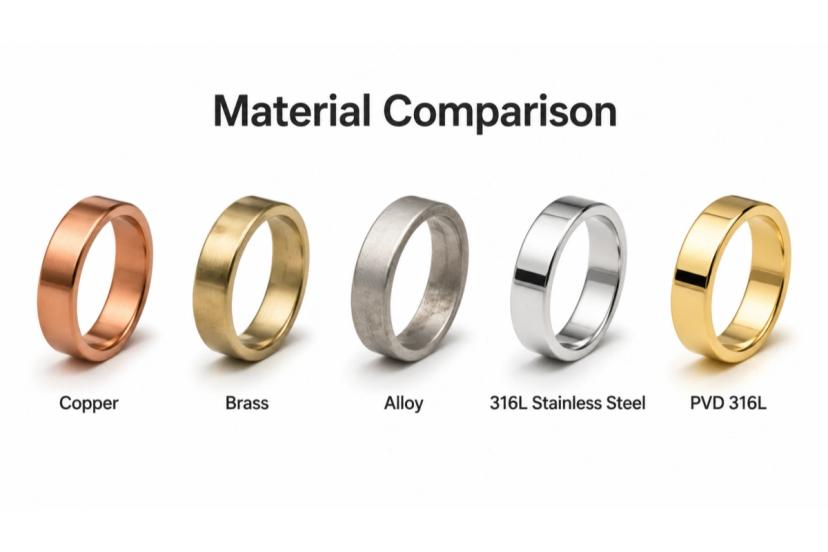
| Material Type | Base Metal | Green Skin Risk | Why | Best For |
|---|---|---|---|---|
| Copper jewelry | Copper | High | Copper oxidizes with sweat and moisture; green residue transfers to skin | Craft or artisan pieces; not suitable for mass-market skin-contact claims |
| Brass jewelry | Copper-zinc alloy | High | Brass contains copper; same oxidation mechanism | Decorative styles where skin staining is an accepted trade-off |
| Costume / alloy jewelry | Mixed (often copper-heavy zinc alloy) | Medium–High | Alloy composition varies; copper content and surface oxidation likely | Short-contact fashion items; not suitable for sensitive-skin claims |
| Gold-plated copper/brass alloy | Copper or brass base with electroplated color layer | Medium–High | Coating wear exposes the reactive copper/brass base | Budget fashion jewelry; not suitable for skin-comfort claims |
| Electroplated 316L stainless steel | 316L base with electroplated color layer | Low–Medium | 316L base is not copper-based; risk depends on plating thickness, adhesion, and wear | Color jewelry where base grade is verified and finish QC is controlled |
| 316L stainless steel (bare or polished) | Iron-chromium-molybdenum; not copper-based | Low | Less reactive under normal skin-contact conditions; corrosion-resistant when grade is verified | Core material for wholesale, private label, and skin-contact jewelry lines |
| PVD-finished 316L stainless steel | 316L base with vacuum-deposited color coating | Low (when properly applied and QC verified) | PVD adds a stable finish layer on a low-reactive base; still requires QC and realistic care guidance | Color SKUs — gold, rose gold, black — where both base grade and finish performance need control |
Risk levels are general guidance, not medical or safety ratings. Actual performance depends on alloy composition, finish quality, production controls, wear conditions, and individual skin sensitivity.
How Plating and PVD Finish Affect Green Skin Risk
Why Plating Quality Matters
Electroplated jewelry relies on a coating to separate the base metal from skin. When that coating wears or was applied too thin, the base contacts skin directly. On a copper or brass base, green staining follows. On a verified 316L base, plating wear is less likely to introduce reactive metal exposure — but coating thickness and adhesion quality still determine how long the barrier holds. Buyers should specify coating thickness in the purchase order.
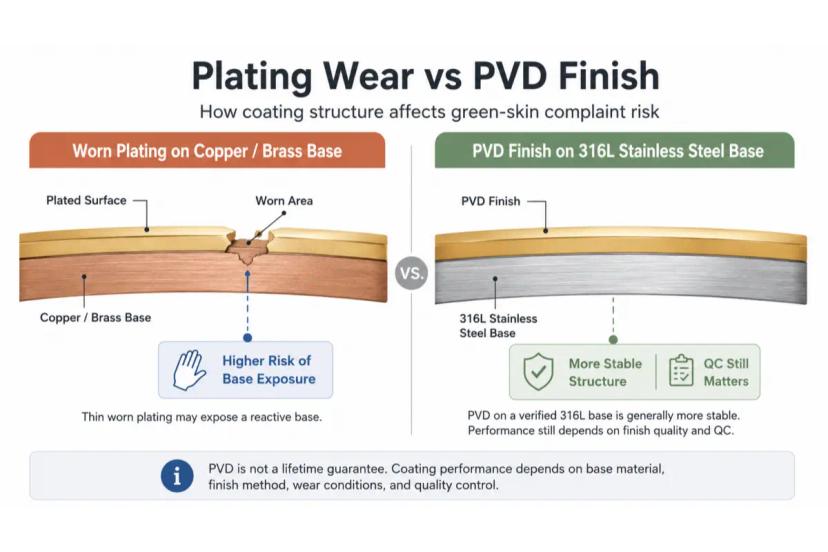
What PVD Finish Can and Cannot Do
PVD (Physical Vapor Deposition) bonds a color coating directly to stainless steel and is commonly used for gold, rose gold, and black finishes on 316L jewelry. A well-applied PVD finish on a verified 316L base may reduce skin contact with reactive base-layer materials under normal wear. Finish performance depends on coating method, wear conditions, and QC — not the process name alone. Brands should not claim PVD finishes are permanent, waterproof, or maintenance-free. For finish specifications, see what PVD jewelry means and stainless steel gold jewelry sourcing.
What Should B2B Buyers Check Before Ordering Stainless Steel Jewelry in Bulk?
1. Confirm the Base Material Grade
Request a mill certificate or material documentation confirming 316L grade before sampling or production. Verbal confirmation and product labelling are not sufficient — confirm that the same grade applies across all categories in the order, not just the initial sample.
2. Confirm the Base Is Not Copper- or Brass-Based
Ask for the alloy composition and verify the base is genuine 316L rather than a copper-heavy or mixed alloy substitute. Some suppliers use lower-grade materials when buyers do not specify. This is especially important for private label brands making any skin-comfort claim.
3. Verify Finish Method, Coating Thickness, and QC
Specify finish type — PVD, electroplating, IP, or bare polish — in the purchase order. Ask for coating thickness range and adhesion testing method. Request finish consistency checks on production batches, not only the pre-production sample.
4. Request Compliance Documentation Where Relevant
In markets with nickel-release restrictions, buyers may need test documentation for skin-contact jewelry. The EU’s EN 1811 standard under REACH is one relevant example — context on nickel-release requirements under REACH is available from SGS. Requirements vary by destination, product type, and compliance process. Do not claim compliance or certification unless documentation has been reviewed.
5. Approve Samples Before Bulk Orders
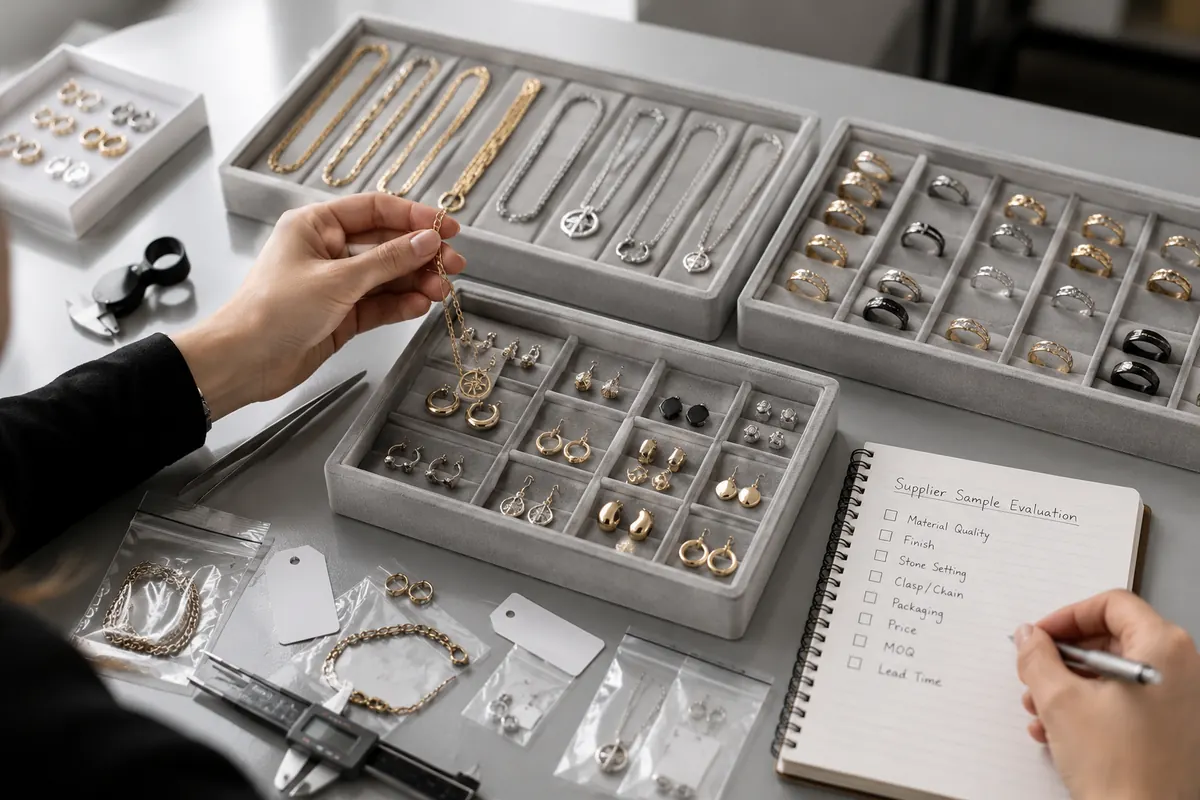
Request production samples — not just prototypes — that reflect the actual base material, finish process, and batch. Use samples to assess finish durability, colorfastness, and skin-contact comfort before committing to bulk quantities. Low-MOQ ordering allows brands to validate performance before scaling.
6. Align Care-Card and Product Claim Language
Review care-card copy and product-page descriptions for language that overclaims. Phrases like “never tarnishes,” “completely safe for sensitive skin,” or “waterproof” are not defensible without test data. Condition-specific, honest guidance reduces post-purchase complaints.
| Check Item | What to Ask | What to Request | Why It Matters |
|---|---|---|---|
| Base material grade | “Is this 316L stainless steel?” | Mill certificate / material documentation | Confirms genuine grade; prevents substitution with a lower-quality alloy |
| Alloy composition | “Is the base genuine 316L rather than a copper-heavy or mixed alloy substitute?” | Alloy composition breakdown | Identifies whether a copper-heavy substitute has been used |
| Finish method | “What coating process is used: PVD, electroplating, IP, or bare polish?” | Finish specification in purchase order | Sets expectations for durability, appearance, and skin-contact barrier |
| Coating thickness and adhesion | “What is the coating thickness range, and how is adhesion tested?” | QC test result or specification sheet | Thin or poorly adhered coatings wear faster and expose base metal earlier |
| Compliance documentation | “Can you provide nickel-release or REACH-related test reports for my target market?” | Relevant test reports where required | Required for some markets (e.g., EU); protects brand from compliance risk |
| Production sample approval | “Can I approve a production sample before bulk?” | Pre-bulk production sample in agreed material and finish | Confirms production-run quality matches approved spec before full commitment |
| Care-card and claim language | “Do you support care-card wording for private label packaging?” | Draft care instructions and claim language guidance | Reduces consumer complaints; prevents overclaiming on product pages |
How Jewins Helps Brands Reduce Green-Skin Complaint Risk
Green-skin complaints are rarely solved by one material label alone. For growing jewelry brands, the practical solution is to control the full sourcing workflow before bulk production: base material, finish method, sample approval, documentation, and customer-facing claim language. Jewins helps brands build that process so material or finish risks are addressed before products reach customers.
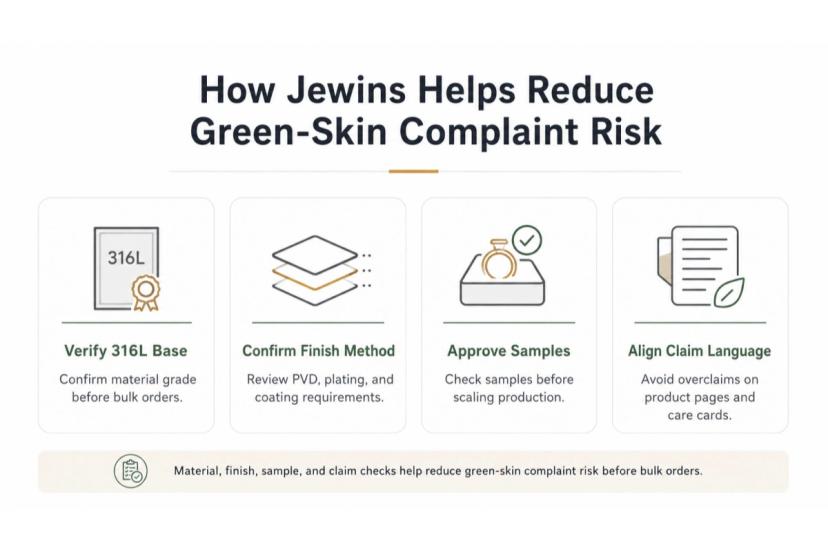
1. Start With Verified 316L Material Options
316L stainless steel is a stronger sourcing baseline for skin-contact jewelry than copper, brass, or unknown mixed-alloy bases. Jewins supports OEM, ODM, wholesale, and private label projects with 316L stainless steel options for rings, earrings, chains, bracelets, and pendants. Instead of treating “stainless steel” as a vague product label, Jewins helps buyers define the material grade clearly before sampling and bulk production.
2. Avoid Copper or Brass Substitution
One of the fastest ways to create green-skin complaints is to approve a sample that looks good but scale production with a cheaper copper-heavy or brass-based substitute. Jewins helps align the agreed base material with the product specification, sample approval, and bulk-order requirement. This reduces the risk that a low-cost substitute enters production after the buyer has already confirmed the design.
3. Match the Finish Method to the SKU
Gold, rose gold, black, and polished silver finishes should not be chosen by color alone. The finish method affects wear resistance, skin-contact comfort, and customer expectations. Jewins helps brands review whether a style is better suited for bare polished stainless steel, electroplating, or PVD finish based on product category, target price, expected wear conditions, and brand positioning. For color SKUs, finish planning is especially important because poor coating adhesion or thin plating can expose the base layer faster.
4. Approve Samples Before Scaling Orders
Pre-bulk sample approval gives brands a practical checkpoint before inventory risk grows. Jewins supports sample development and low-MOQ testing so buyers can review material feel, finish color, coating consistency, polishing quality, and wear expectations before committing to larger quantities. This is especially useful for new collections, new color finishes, or styles intended for daily skin contact.
5. Prepare Documentation for Target Markets
For brands selling into markets with stricter skin-contact requirements, documentation matters. Depending on the destination market and product type, buyers may need material documentation, nickel-release test reports, or REACH-related support. Jewins helps buyers organize the documentation conversation early, instead of waiting until marketplace review, customs questions, or customer complaints create pressure.
6. Align Product Page and Care-Card Language
Strong product copy should sell the advantage of stainless steel without making claims that create avoidable refund risk. Jewins helps private label buyers align product descriptions, care-card wording, and customer service language around realistic benefits: 316L material options, corrosion-resistant stainless steel, PVD finish choices, and care guidance for sweat, water, perfume, and chemicals. This helps brands communicate value clearly while avoiding overclaims such as “never tarnishes,” “100% waterproof,” or “zero allergy risk.”
7. Keep Repeat Orders Consistent
For growing brands, the first order is only the beginning. Green-skin complaint risk can increase when repeat orders change base material, finish method, coating thickness, or polishing standard without the buyer noticing. Jewins helps keep repeat production aligned with the approved material and finish requirements so brands can scale SKUs with more consistent customer experience.
| Green-Skin Risk Point | What Can Go Wrong | How Jewins Helps |
|---|---|---|
| Unclear base material | The product is sold as stainless steel, but the actual base may be mixed alloy, copper-heavy alloy, or brass. | Helps buyers specify 316L stainless steel options and align material requirements before sampling. |
| Material substitution after sampling | The approved sample performs well, but bulk production uses a cheaper base material. | Connects sample approval with bulk-order specification so the approved material is not treated as optional. |
| Weak plating or coating control | Thin or poorly adhered finish wears quickly and exposes a reactive base layer. | Reviews finish method, coating expectations, and production consistency for color SKUs such as gold, rose gold, and black. |
| No pre-bulk validation | Brands discover finish or skin-contact issues only after inventory reaches customers. | Supports sample development and low-MOQ testing before larger production runs. |
| Missing market documentation | Brands cannot answer marketplace, retailer, or customer questions about material and skin-contact requirements. | Supports the documentation conversation for material grade and relevant market testing requirements where needed. |
| Overclaimed product copy | Product pages or care cards promise more than the material and finish can defensibly support. | Helps align care-card and claim language with realistic product performance to reduce avoidable complaints. |
| Repeat-order inconsistency | Later batches look similar but use different material or finish controls. | Helps brands keep repeat production aligned with approved specifications for more consistent SKU performance. |
What Should Brands Tell Customers About Green Skin?
Customer education also reduces complaint risk. For private label brands, Jewins can support care-card and product-page wording that helps customers understand how to wear and maintain stainless steel jewelry without turning the message into a legal disclaimer. Useful guidance may include:
- Dry jewelry after heavy sweat, water exposure, or humid wear conditions.
- Apply perfume, lotion, sunscreen, or hair products before wearing jewelry, and let the skin dry first.
- Wipe jewelry with a soft cloth after use, especially for plated or PVD color finishes.
- Avoid chlorine, harsh cleaning chemicals, and long chemical exposure for color-coated pieces.
- Contact the brand if repeated discoloration appears, especially on a new product or batch.
This is where a manufacturing partner matters. Jewins does not just supply finished jewelry; it helps brands connect material selection, finish planning, sample approval, documentation, and customer-facing guidance into one sourcing workflow. For a full overview of production support, see OEM/ODM stainless steel jewelry support, or contact Jewins to discuss material, finish, and sample options for your target market.
Frequently Asked Questions
These FAQs answer common sourcing questions about stainless steel jewelry, 316L material, green-skin discoloration, PVD finish, and bulk-order verification.
Does stainless steel jewelry turn skin green?
Whether stainless steel jewelry turns your skin green depends more on base material grade and finish quality than on the metal category. Quality 316L stainless steel is generally less likely to cause green marks, but mislabelled material, worn plating, and harsh conditions all affect the outcome. Verifying both base grade and finish before ordering reduces this risk.
Does 316L stainless steel turn skin green?
316L stainless steel is generally a lower-risk sourcing choice because it does not use copper as a primary base metal and resists surface corrosion under normal wear. Labelling alone is not verification — buyers should request mill certificates and confirm batch consistency across production runs.
Why does some jewelry turn skin green?
Green skin marks are typically caused by reactive metals — especially copper or brass — reacting with sweat, moisture, or skin products. Plated jewelry on a copper or brass base causes the same effect if the coating wears through and the base contacts skin. Base metal type and finish quality are the two main variables.
Is green skin a sign of allergy?
Not necessarily. Green staining is usually surface discoloration — a cosmetic residue that washes off. Redness, itching, swelling, or rash may indicate nickel sensitivity or contact dermatitis, which is a separate concern. If a customer reports irritation symptoms rather than a green mark, treat it as a possible sensitivity issue and review product claim language accordingly.
Is PVD stainless steel better for skin discoloration risk?
A well-applied PVD finish on a verified 316L base may reduce skin contact with reactive base-layer materials under normal wear. It is not a guarantee — coating thickness, abrasion, chemical exposure, and QC all affect performance. Brands should not claim PVD finishes are permanent, waterproof, or maintenance-free.
What should B2B buyers check before ordering stainless steel jewelry in bulk?
Confirm the base is genuine 316L rather than a copper-heavy substitute; specify finish method and coating thickness; request compliance documentation for your target market where relevant; approve production samples before bulk sign-off; and review care-card and product claim language for overclaiming. These steps address the most common root causes of green-skin complaints before the product reaches the customer.
Reduce Green-Skin Complaint Risk Before Bulk Orders
Brands sourcing stainless steel jewelry for private label, wholesale, or OEM production can request samples to evaluate material and finish performance before committing to bulk quantities, or contact Jewins to discuss grade specifications, finish options, and documentation support for their target market.