
Sustained gold price increases are compressing margins across the jewelry industry, and more brands are responding by shifting parts of their collections to PVD-coated stainless steel rather than absorbing the cost or thinning out their gold pieces.
The shift can protect margins, but only if the material switch is treated as a sourcing decision — with a defined quality standard, traceable QC checkpoints, and a replenishment plan — rather than a one-time supplier swap.
The practical takeaway: define your material and coating standard in writing, test on a smaller SKU first, and confirm a supplier's QC checkpoints before committing bulk volume to a gold-look transition.

If you've already read our overview of what PVD jewelry is and how it compares to gold plating and gold filled finishes, this guide looks at a different angle of the same material: what to do about it when gold prices themselves become the problem.
This guide treats gold price pressure as a sourcing and margin-control problem: which SKUs should stay in gold, which can move to PVD-coated stainless steel, and what brands should verify before changing materials at scale.
Why Gold Price Pressure Is Becoming a Margin Problem, Not Just a Headline
Gold prices have moved sharply over the past year, with the LBMA gold price reaching a historical high above US$5,400/oz in January 2026 before settling into an elevated range well above prior-year levels. According to the World Gold Council's Q1 2026 Gold Demand Trends report, global jewellery demand volumes fell sharply year-on-year while overall jewellery spending increased, signaling that buyers are paying more for less rather than disappearing from the category.
For jewelry brands, this isn't a story about gold being “expensive right now.” It's a structural cost question: if gold input costs stay elevated, every SKU built primarily on gold or heavy gold plating carries a cost base that's harder to control, harder to forecast, and harder to scale profitably.
This is where the conversation shifts from “interesting market news” to a sourcing and margin decision — which materials in your line can absorb gold-tier pricing, and which ones need a different cost foundation.
What Gold Price Increases Actually Break in Your Cost Structure
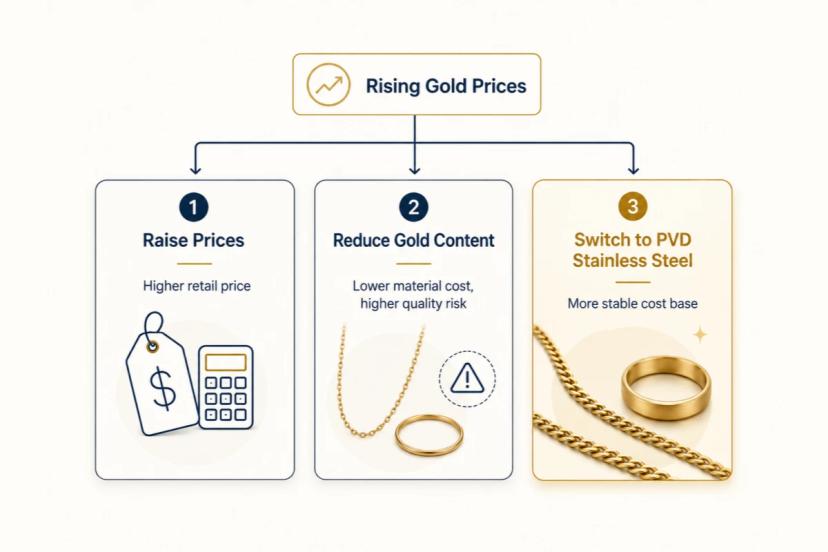
When gold costs rise, brands typically respond in one of three ways. For SKUs that do not need to be positioned as fine jewelry, the third option is often the most structural response.
- Pass the cost to the customer. This works for committed buyers but risks losing price-sensitive customers at exactly the SKUs — everyday chains, stacking pieces, entry price points — that usually drive repeat purchase volume.
- Reduce gold content per piece. Thinner plating, lighter base metal, smaller stone settings. This often shows up later as faster fading, weaker durability, and a rise in quality complaints — which adds cost back in through returns and damaged repeat-purchase trust.
- Shift the affected SKUs to a different material foundation. This is where PVD-coated stainless steel comes in — not as a replacement for fine jewelry, but as a cost-stable alternative for the gold-look pieces that don't need to be solid gold to do their job in your collection.
The detail that matters most for a buyer: the third option is the one that actually changes your cost structure rather than just deferring the problem. But it only works if the material switch is executed carefully — which is where most of the real risk in this conversation actually sits.
PVD Coating Jewelry vs. Traditional Gold Plating: Why the Difference Matters for Margins
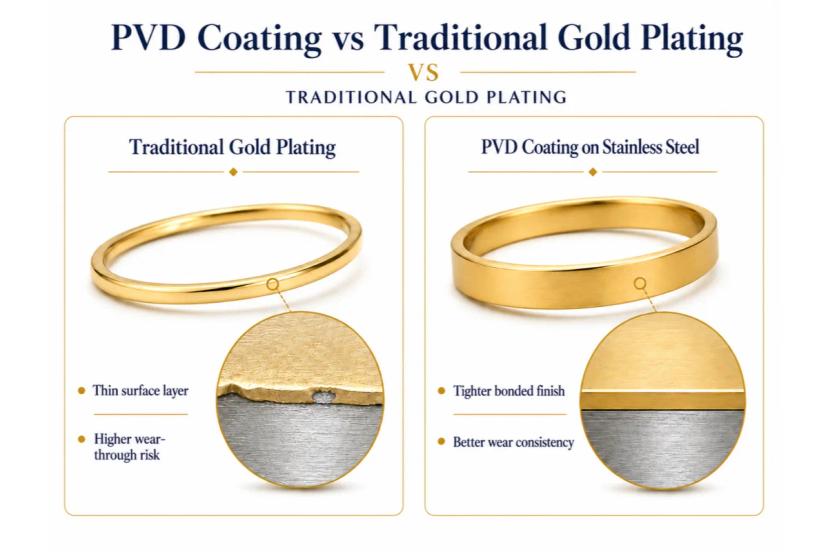
Not all “gold-look” stainless steel is the same, and the difference has a direct effect on long-term margin — not just on the unit cost of the first order.
| Finish | Process | Margin Implication |
|---|---|---|
| Traditional electroplating | Electrochemical deposition of a thin metal layer | Cheapest upfront, but wears through faster under friction — rings, clasps, chain links — raising return and complaint costs later |
| PVD (Physical Vapor Deposition) | Metal bonded to the base material inside a vacuum chamber | Denser, more tightly adhered finish; longer wear life before fading becomes visible, fewer downstream rework costs |
The margin protection argument for PVD coating jewelry isn't just “it's cheaper than gold” — it's that, done correctly, it's a more cost-predictable finish than either solid gold or low-grade plating, with fewer downstream costs from rework and complaints. For brands weighing PVD against other gold-tone finishes, gold filled and gold plated options sit on a different part of the same cost-vs-durability spectrum.
Why 316L Stainless Steel Supports Long-Term Margin Stability
The coating is only half of the cost-stability equation — the base metal underneath it matters just as much for repeat-order consistency.
316L stainless steel is widely used as a base for PVD coating because its corrosion resistance and surface stability give the coating a more reliable foundation to bond to, batch after batch. This matters for margin protection in a way that's easy to miss: a base metal that behaves consistently from batch to batch means fewer color-mismatch rejections, fewer adhesion failures, and a more predictable cost per repeat order — which is exactly what a margin-focused material switch is supposed to deliver.
A note on precision: 316L is not nickel-free, and it isn't immune to all wear conditions. The honest version of this argument is that 316L plus a properly applied PVD finish gives brands a more cost-stable, more durable foundation than lower-grade base metals or thin electroplating — not a permanent, maintenance-free material.
Common Mistakes Brands Make When Switching Materials Under Cost Pressure
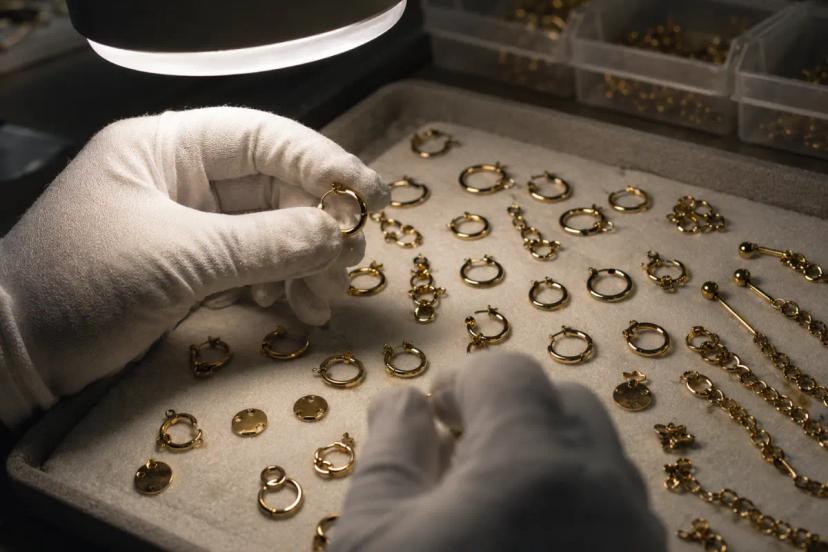
Cost pressure tends to push brands to move faster than their supplier verification process can keep up with. The most common mistakes show up after the first bulk order, not during sampling.
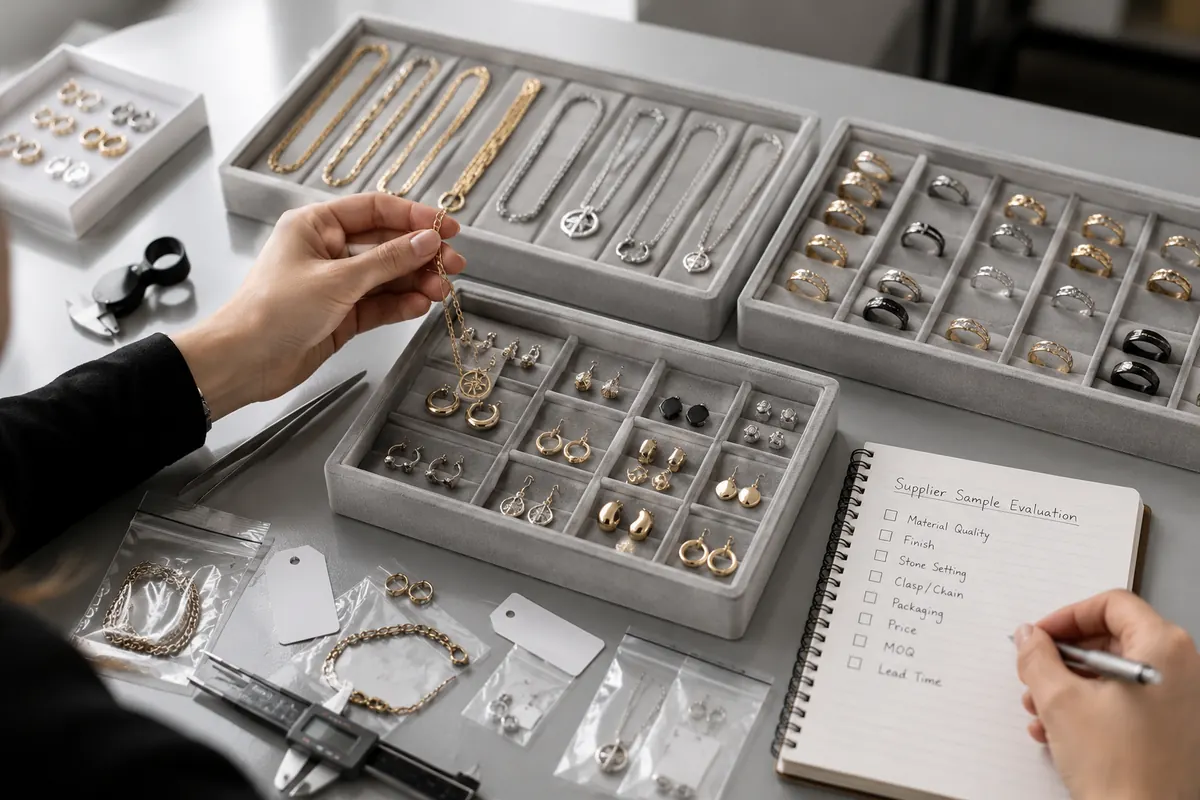
- Approving a sample without a written quality standard behind it. A sample can look great and still not represent what a factory can repeat at scale unless the color, coating thickness, and finish are written down as a standard — not just visually approved.
- Treating “PVD” as a single, uniform finish. Coating thickness, adhesion quality, and the deposition process itself vary significantly between suppliers, even when the marketing material says the same word.
- Optimizing for the lowest per-unit price without accounting for return and complaint costs. A material switch that lowers unit cost but raises the return rate isn't actually protecting margin — it's relocating the cost to a line item that's harder to see.
- Skipping documentation that target markets will eventually ask for. Nickel release testing, material declarations, and compliance documentation are easier to gather before bulk production than after a customer or retailer requests them.
None of these mistakes are reasons to avoid the material switch. They're reasons to treat it as a sourcing process with checkpoints, rather than a single supplier decision made under time pressure.
Turning a Material Switch Into a Controlled Process
The brands that successfully protect margin through a material transition tend to follow a similar pattern, regardless of how they describe it internally.
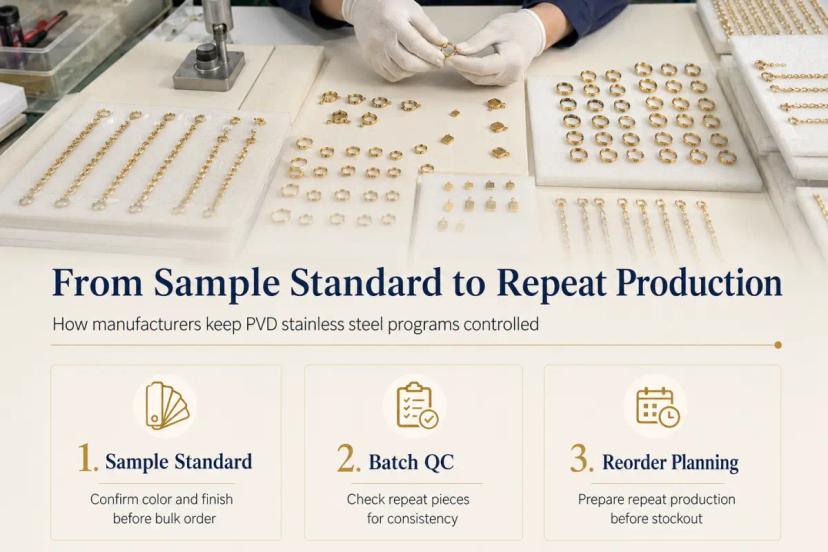
They lock the sample into a written standard before scaling. Color tolerance, coating thickness range, and finish quality get documented — not just approved by eye — so that order three looks like order one.
They build in checkpoints, not just a final inspection. Catching a coating or color issue at the raw-material or pre-plating stage costs far less than discovering it after a full batch is finished and packed.
They plan replenishment before the first SKU sells out. A margin-protecting material switch only pays off if the brand can actually keep the resulting SKU in stock — which means thinking about reorder lead time and safety stock on key components before a style takes off, not after.
This is less about any single supplier capability and more about treating the material switch as an ongoing system rather than a one-time decision. Brands that skip this step often find that the first batch looks exactly like the sample — and the third batch doesn't.
What a Material Switch Actually Looks Like in Practice
Consider a typical growing DTC brand scenario: a gold vermeil chain has become one of the brand's top three sellers. As gold costs rise, the landed cost on that chain climbs enough to either push the retail price past what the brand's customer base has shown willingness to pay, or eat directly into the margin the brand needs to fund ad spend and inventory for the next season.
The brand's response wasn't to swap suppliers and ship the same design in a cheaper material. It was a three-step transition:
- Define the standard before sampling. The brand specified a 316L base, a minimum PVD coating thickness, and an approved gold-tone reference sample — in writing — before requesting bulk pricing from any supplier.
- Test on a smaller SKU first. Rather than converting the bestseller immediately, the brand ran the new material on a lower-volume companion piece (a matching bracelet) for one production cycle, using it to validate color consistency and wear performance across a full batch.
- Convert the bestseller only after the test batch held up. Once the companion piece came back consistent — same tone, same coating performance, no rejected units — the brand moved the original chain to the same material standard, with a reorder plan already in place for the components most likely to need fast replenishment.
The result wasn't a perfect 1:1 cost replacement for solid gold — PVD stainless steel and gold vermeil aren't priced or positioned identically. What it did was give the brand a SKU that could absorb continued gold-price pressure without the brand needing to either raise prices on its best-selling item or quietly thin out the materials customers were already buying it for.
This is the practical version of “protecting margin”: not a single supplier swap, but a tested, documented transition that a brand can repeat the next time a material or cost shock hits a different part of the line.
Choosing a Stainless Steel Jewelry Manufacturer for a Margin-Focused Transition
If margin protection is the goal, the supplier conversation should go further than price per unit. A few practical questions are worth asking any stainless steel jewelry manufacturer before committing volume to a gold-look transition:
- Can they confirm base metal grade and coating method in writing, not just describe it verbally?
- Do they have documented QC checkpoints between raw material and finished product, or only a final inspection?
- Can they show batch-to-batch color and finish consistency on a prior order, not just a single sample?
- Do they support the order volumes you actually need — small enough to test a SKU, but with a clear path to repeat production once it sells?
| What Brands Run Into | How It Shows Up | How Jewins Addresses It |
|---|---|---|
| Sample-to-bulk mismatch | The approved gold-tone sample looks right, but batch two drifts in color or coating thickness because nothing was written down | Jewins' Brand Quality Standard Program turns the approved sample into a written standard before bulk production starts |
| Unverifiable quality claims | A supplier says the finish is “durable” with no test method, checkpoint, or documentation behind it | Jewins' Traceable Quality Control System runs checkpoints from raw material through pre-shipment inspection |
| Best-seller stockout | A gold-look PVD piece takes off, but replenishment is slow because no one planned for it | Jewins' Inventory Protection Program supports raw material prep and faster reorder turnaround |
Jewins works with growing jewelry brands on exactly this kind of transition — building PVD-coated 316L stainless steel lines on a documented quality standard, with traceable QC checkpoints from raw material through pre-shipment inspection, and replenishment planning so a gold-look bestseller doesn't stall out the moment it starts selling. The goal isn't just producing a cheaper alternative to gold — it's making the alternative reliable enough that it actually protects the margin it was supposed to protect.
Need Help Building a Margin-Stable PVD Stainless Steel Line?
Jewins supports growing jewelry brands with 316L stainless steel sourcing, PVD finish development, documented QC checkpoints, and replenishment planning — from sample approval through repeat production. Contact Jewins to discuss samples, quality standards, and production timelines for your collection.
Contact Us →FAQ
How is PVD gold different from other gold finishes?
PVD (Physical Vapor Deposition) bonds metal to the base piece inside a vacuum chamber, producing a denser, more tightly adhered layer than electroplating or other surface finishes — which is why it generally holds up longer under everyday wear.
Is PVD gold fake or real gold?
Not always. Gold-color PVD describes the coating process and appearance, not automatically solid gold or thick gold content. Depending on the supplier, the finish may use gold-containing material or other gold-tone coating compounds. Brands should confirm the coating composition, base metal, and claim wording before marketing it as “gold.”
Does PVD coating wear off or fade like regular gold plating?
A properly applied PVD coating on a 316L base is more wear-resistant than typical electroplating, but no plated or coated finish should be marketed as permanent or maintenance-free — it will eventually show wear under heavy friction or harsh chemical exposure.
Is PVD-coated stainless steel actually cheaper than gold jewelry to produce?
Generally yes, on a per-unit material cost basis, though the real margin benefit depends on coating quality and return rates — not unit price alone.
What should I consider when choosing a custom jewelry manufacturer for a margin-focused transition?
At minimum: written material and coating specifications, sample approval against that standard, a documented QC process from raw material through pre-shipment, and a realistic reorder lead time for the volumes the brand expects to need.
How long does it take to test a PVD stainless steel SKU before committing to bulk production?
This varies by supplier, but sample development and approval should happen before any bulk-order commitment, with a written standard locked in at sample sign-off.
Can a brand mix solid gold and PVD stainless steel in the same collection?
Yes — many growing brands position gold-look PVD pieces as everyday/entry items alongside solid gold pieces reserved for higher price points, rather than replacing gold across the whole line.
About Jewins
Jewins supports growing jewelry brands through a structured Growing Brand Success Program. Instead of only completing one production order, Jewins helps brands define quality standards, control key production checkpoints, prepare for repeat orders, develop new products, and review supply chain performance over time. For stainless steel and moissanite jewelry brands, this creates a more stable foundation for scaling collections, reducing sourcing risk, and building stronger customer trust.
Data reference in this guide: World Gold Council, Q1 2026 Gold Demand Trends. Jewins-specific program names (Brand Quality Standard Program, Traceable Quality Control System, Inventory Protection Program) reflect Jewins' internal sourcing support structure and are noted as such throughout. This article is general sourcing guidance, not financial or investment advice. Last reviewed: June 2026.
Related reading: What Is PVD Jewelry?, 316L Stainless Steel Jewelry Guide, Gold Filled vs Gold Plated, Custom Jewelry Manufacturing Guide. For sourcing, samples, or wholesale questions, contact Jewins.